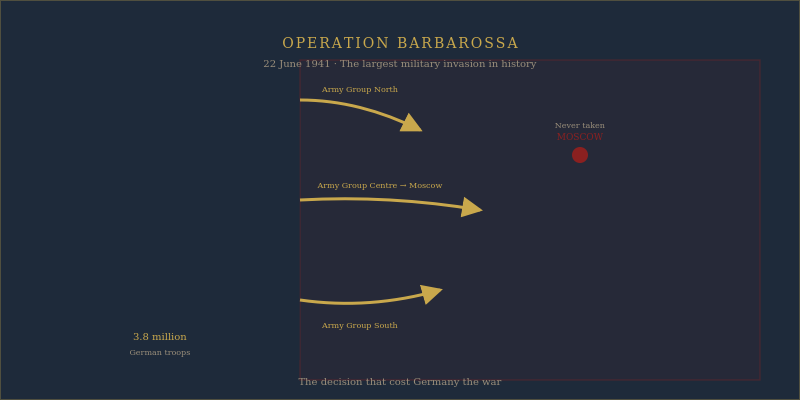
The Decision
Hitler had outlined his intention to expand eastward into Soviet territory in Mein Kampf, published in 1925. The ideological reasoning was explicit: the acquisition of Lebensraum — living space — for the German people, and the destruction of what Nazi ideology characterised as Jewish Bolshevism.
The military reasoning appeared, to its architects, equally compelling. Germany was at war with Britain and could not achieve a decisive victory there. The Soviet Union, after the purges of its officer corps in the late 1930s, was believed to be militarily weak. A rapid victory in the east would remove the threat of a two-front war and secure the agricultural and industrial resources Germany needed for a prolonged conflict.
The plan assumed the Soviet state would collapse quickly — within weeks or months — under the pressure of the initial assault. That assumption proved catastrophically wrong.
The Scale of Barbarossa
Operation Barbarossa involved approximately three million German and Axis troops, 3,600 tanks, 2,700 aircraft and 7,000 artillery pieces along a front stretching nearly 3,000 kilometres. It remains the largest military operation in history by number of forces involved.
The Opening Weeks
For the first weeks and months of the campaign, the German calculation appeared entirely correct. The Wehrmacht advanced hundreds of kilometres, encircling and destroying entire Soviet armies in enormous battles of annihilation — including over 600,000 Soviet troops captured at Kiev alone, the largest single encirclement in military history. By the end of 1941, Germany had killed or captured approximately 4.5 million Soviet soldiers and occupied territory containing more than 40% of the Soviet population.
The scale of the Soviet collapse reflected genuine structural weaknesses. The Red Army had been devastated by Stalin's purges of its own officer corps in 1937-38. Soviet doctrine wasn't well suited to the fast-moving warfare the Germans practised. And Stalin, having dismissed repeated intelligence warnings before the invasion, appears to have suffered a period of genuine paralysis at the very top of Soviet command during the war's opening days.
By every conventional measure available at the time, this looked like a war already won. It wasn't.
Where the Plan Broke Down
The German operational plan had been built entirely around the assumption of rapid, decisive victory. When that victory failed to materialise on schedule, the campaign ran into problems its planners had never designed a solution for.
Some of these problems were beyond German control: the sheer scale of Soviet territory, poor road quality, and a climate that German logistics planning had significantly underestimated. But some were self-inflicted. The Balkan campaign in spring 1941 — a detour to secure Germany's southern flank — cost perhaps six weeks of the campaigning season, weeks that may have been decisive in front of Moscow. Then, in August 1941, Hitler redirected forces away from the direct Moscow axis toward Ukraine, producing a spectacular encirclement victory at Kiev but delaying the final push on Moscow until autumn, just as mud and then snow began to paralyse German operations.
The German Army reached the outskirts of Moscow in December 1941 — and stopped there. Fresh Siberian divisions, freed for deployment once Soviet intelligence confirmed Japan would not attack from the east, joined a counteroffensive that pushed German forces back from the capital. Leningrad was besieged but never taken. The war Hitler's planners had expected to conclude before winter would instead run for nearly four more years, ending in the ruins of Berlin.
Invasion begins
Three million Axis troops cross into Soviet territory along a 3,000km front. Initial advances are rapid and devastating.
Kiev encirclement
Germany encircles and captures over 600,000 Soviet troops at Kiev — the largest encirclement in military history.
Operation Typhoon
Germany launches its drive on Moscow. Initial advances are rapid but supply lines are stretched to breaking point.
German advance halted
German forces reach the outskirts of Moscow but cannot take the city. Soviet counteroffensive begins. The plan has failed.
The Decision Chain
Barbarossa is a case study in the logic of escalating commitment. Each step in Germany's strategic situation seemed to point toward the next. War with Britain could not be ended on terms Germany found acceptable. The Soviet Union represented both a potential threat and an apparent opportunity. The window for action seemed limited.
Each of these assessments contained elements of truth. What they collectively produced was a decision that extended Germany's commitments beyond what its resources could sustain — and against an adversary whose capacity to absorb punishment and regenerate military power proved far greater than German planning had assumed.
The war in the east continued for nearly four more years, killing tens of millions of people. The Eastern Front was, by most measures, the central theatre of the Second World War. Germany's defeat there determined the outcome of the conflict.
Frequently Asked Questions
Why did Hitler invade the Soviet Union?
Hitler's decision was driven by a combination of ideological and strategic factors. Ideologically, he sought Lebensraum — living space — for Germany in the east, and aimed to destroy Soviet communism. Strategically, German planners believed the Soviet Union was militarily weak following the purges of its officer corps, and that a rapid victory would secure resources and remove the threat of a two-front war.
Why did Operation Barbarossa fail?
Barbarossa failed primarily because its central assumption — that the Soviet state would collapse rapidly under military pressure — proved wrong. Soviet resistance, though initially chaotic, proved far more sustained than anticipated. German supply lines also stretched to breaking point as forces advanced deeper into Soviet territory, and the onset of winter found German forces unprepared for the conditions.
How many people died in Operation Barbarossa?
Precise figures are debated by historians. Soviet military casualties in 1941 alone numbered in the millions. German and Axis casualties were also severe. The broader war on the Eastern Front, which Barbarossa initiated, killed an estimated 25 to 30 million Soviet citizens — soldiers and civilians — by the time it ended in 1945.
Did Stalin know about Barbarossa in advance?
Stalin received multiple warnings from Soviet intelligence, British intelligence and other sources prior to the invasion. He largely dismissed or suppressed them, apparently believing they were attempts to draw the Soviet Union into conflict prematurely. The reasons for his response remain debated by historians.
A Note From The Editor
What strikes me about Barbarossa is how rational each individual decision appeared to its makers at the time. The assumption of Soviet weakness wasn't unreasonable given what had been observed in the Winter War with Finland. The belief that rapid victory was achievable wasn't absurd given what had happened in France. It was the combination of those assumptions, applied to a country of continental scale with reserves of manpower and determination that German planning had never seriously modelled, that produced catastrophe. The system rewarded the wrong decisions — until it didn't.
Key Facts
- Start date
- 22 June 1941
- German forces
- ~3.8 million — largest invasion force in history
- Initial German advance
- Over 1,000 km in six months
- Soviet military losses 1941
- Approximately 4.5 million killed, wounded or captured
- Outcome
- Germany failed to defeat Soviet Union; beginning of Germany's eventual defeat
Historians still disagree on the underlying causes — which is part of what makes this story worth pursuing further.
Was Operation Barbarossa's failure inevitable given Soviet resilience — or did specific German operational decisions make defeat more likely than it needed to be?