The Halt Order
On 24 May 1940, Hitler issued what became known as the Halt Order, stopping German armoured forces from advancing on Dunkirk for approximately two days. The reasons for this decision remain debated among historians. Suggested factors include the need to rest and refit armoured units after rapid advances, Luftwaffe commander Hermann Göring's claim that air power alone could destroy the trapped forces, and concerns about terrain unsuitable for tanks near the coast.
Whatever the precise reasoning, the pause gave Allied forces time to strengthen the defensive perimeter around Dunkirk and begin organising an evacuation.
Operation Dynamo — The Numbers
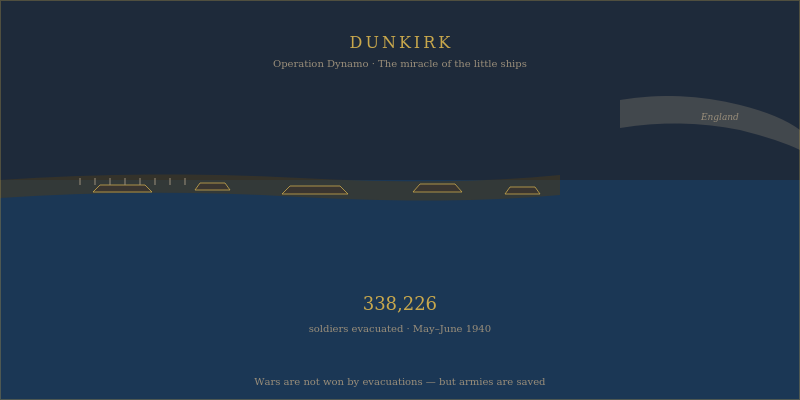
Between 26 May and 4 June 1940, approximately 338,000 Allied troops were evacuated from Dunkirk — around 198,000 British and 140,000 French and Belgian soldiers. British planners had initially hoped to rescue perhaps 45,000 men. The operation exceeded expectations by a significant margin.
Operation Dynamo
The evacuation, codenamed Operation Dynamo, began on 26 May 1940. Over nine days, Allied troops were evacuated across the Channel under sustained air and artillery attack. Casualties were significant. Virtually all heavy equipment — vehicles, artillery, supplies — was left behind.
The operation involved the Royal Navy, merchant vessels, and a large number of smaller civilian craft requisitioned for the purpose. The image of the little ships — private boats crossing the Channel to rescue soldiers — became one of the enduring images of the war. The majority of troops were actually evacuated on larger naval and merchant vessels, but the civilian craft played a genuine and important role.
Halt Order issued
Hitler orders German armoured forces to stop advancing on Dunkirk. Allied forces begin organising a defensive perimeter.
Dynamo begins
Operation Dynamo — the evacuation — officially begins. Initial estimates suggest 45,000 men might be saved.
Evacuation ends
The last ships leave Dunkirk. Approximately 338,000 Allied troops have been rescued. Churchill addresses Parliament.
What Was Saved and What Was Lost
The men evacuated from Dunkirk formed the core of the British Army that would continue fighting. Had they been captured or destroyed, Britain's ability to continue the war would have been severely compromised.
At the same time, Dunkirk was unambiguously a military defeat. Britain had been driven off the continent. France fell weeks later. Virtually all heavy equipment — vehicles, artillery, supplies — was abandoned on the beaches. Churchill's address to the House of Commons on 4 June 1940 performed a remarkable piece of rhetorical work: he openly acknowledged that "wars are not won by evacuations," refusing to let the rescue be mistaken for a victory, and then pivoted the same speech into one of the most famous declarations of intent in British political history — "we shall fight on the beaches... we shall never surrender."
That speech is also where the popular "Britain stood alone" narrative largely took root, and it's worth being precise about what that narrative simplifies. France was still fighting when Churchill spoke. The Empire remained a vast material and manpower resource. The United States, though not yet formally at war, was already providing significant material support. "Standing alone" was a powerful rallying image rather than a precise account of Britain's actual strategic position — which doesn't make it dishonest so much as necessarily selective, the way most unifying national stories are.
The wider narrative that developed around Dunkirk — the spirit of the evacuation, the civilian boats, the orderly rescue — served real and important purposes for British morale at a moment of acute danger. It was also, in important respects, a story imposed retrospectively on events that were, at the time, chaotic, costly, and militarily catastrophic in their immediate context.
The RAF's Invisible Battle
None of the evacuation was possible without air cover, and that cover came at real cost: RAF Fighter Command lost 106 aircraft during the operation, flying continuous sorties to keep the Luftwaffe from destroying the evacuation fleet outright. Hermann Göring had assured Hitler that his air force alone could annihilate the trapped Allied forces — one of the contributing arguments behind the Halt Order in the first place — and the RAF's success in denying him that outcome was, in its own way, as consequential as anything happening on the beaches.
Yet the soldiers waiting on the sand rarely saw it. Much of the RAF's fighting took place further inland or out over the Channel, beyond view from the beaches themselves, while German bombing runs that did reach the shore were highly visible and deeply demoralising. "Where is the RAF?" became a bitter, recurring question among the stranded troops — a question that reflected what they could actually see, not what was actually happening in the skies above and around them.
Frequently Asked Questions
Why did Germany stop at Dunkirk?
The precise reasons for the Halt Order of 24 May 1940 remain debated. Possible factors include the need to rest and refit German armoured units after rapid advances, Hermann Göring's argument that the Luftwaffe could destroy the trapped forces without army involvement, and concerns about the terrain near the coast being unsuitable for tanks. Whatever the reason, the pause allowed Allied forces to organise their evacuation.
How many soldiers were rescued at Dunkirk?
Approximately 338,000 Allied troops were evacuated during Operation Dynamo between 26 May and 4 June 1940 — around 198,000 British and 140,000 French and Belgian soldiers. This far exceeded initial expectations of perhaps 45,000.
Was Dunkirk a victory or a defeat?
Dunkirk was a military defeat that was transformed into a moral and strategic survival. Britain was driven off the continent, France fell weeks later, and enormous quantities of equipment were lost. But the evacuation preserved the trained core of the British Army and allowed Britain to continue fighting. Churchill was explicit that wars are not won by evacuations — but this particular evacuation kept Britain in the war.
A Note From The Editor
What interests me most about Dunkirk is the question of the Halt Order. A decision made by Hitler — for reasons that historians still debate — may have saved over 300,000 Allied soldiers and kept Britain in the war. History sometimes turns on decisions whose full consequences their authors cannot see. The men on the beaches at Dunkirk couldn't know that the decision to stop the tanks had been made. They just knew the tanks had stopped.
This is one of those topics where the more you read, the more complicated it gets.
If the Halt Order had not been issued, could Germany have captured the BEF — and would that have ended British participation in the war?