The Maginot Line and the Assumption of Static War
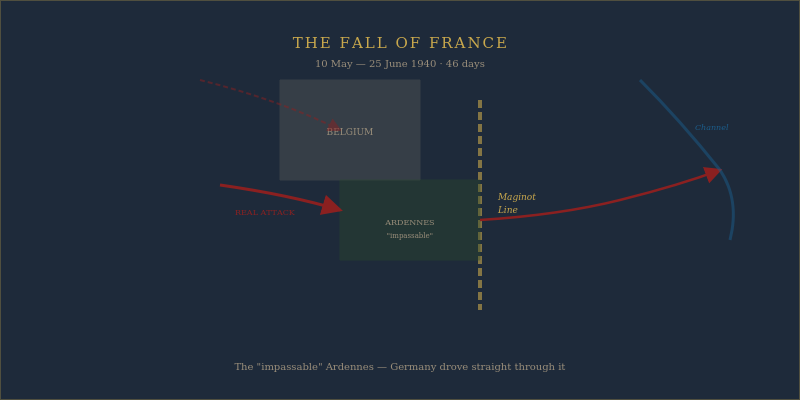
France had spent heavily in the 1930s constructing the Maginot Line — an extensive system of fortifications along its border with Germany. The Line was a formidable defensive structure, and it worked as designed. German forces did not break through it.
The problem was that German forces didn't try to.
French strategic planning had been built around the assumption that any German invasion would follow a broadly similar path to 1914 — through Belgium, across relatively open terrain, in a manner that French and British forces could meet and contain. Allied forces were accordingly positioned to respond to exactly that attack.
The Numbers Didn't Tell the Story
In May 1940, France and Britain together had approximately 3,384 tanks compared to Germany's 2,445. French tanks were in many respects technically superior. The Allied defeat was not a consequence of material inferiority — it was a consequence of how those materials were used and commanded.
The Ardennes Breakthrough
The German plan, shaped significantly by General Erich von Manstein, sent the main armoured thrust through the Ardennes forest — terrain that French planners had assessed as unsuitable for a major armoured advance. That assessment was wrong.
German armoured forces crossed the Ardennes and reached the Meuse river at Sedan in mid-May 1940. French reserves in that sector were inadequate, and the speed of the German advance outpaced the ability of French command structures to respond.
The critical feature of the German operational approach was decision-making speed. German commanders at the operational level were given significant latitude to exploit opportunities without waiting for approval from higher command. French command structures were more centralised and slower to respond to rapidly changing situations.
Invasion begins
Germany invades France, Belgium, Luxembourg and the Netherlands simultaneously. Allied forces advance into Belgium as anticipated.
Meuse crossing
German armoured forces cross the Meuse at Sedan. French reserves in the sector are overwhelmed. The line has broken.
Channel reached
German forces reach the English Channel, cutting off Allied forces in Belgium from those in southern France.
Dunkirk evacuation begins
Operation Dynamo begins the evacuation of Allied forces from Dunkirk. Over 330,000 troops are rescued.
Armistice signed
France signs an armistice with Germany. The campaign that began on 10 May is over in six weeks.
Why the Collapse Was So Complete
The speed of French collapse after the initial breakthrough reflected several compounding factors. Command structures disrupted by the breakthrough struggled to reconstitute coherent defensive lines. Civilian populations moving away from the fighting blocked military movements. Political leadership was divided on whether to continue fighting or seek terms.
There were French units that fought effectively throughout the campaign. The collapse was not uniform. But the overall institutional response to a situation that had moved faster than planning had anticipated was inadequate.
The Pattern
The Fall of France illustrates a recurring pattern: systems built to perform well against known threats can be acutely vulnerable to threats that operate differently from assumptions. The Maginot Line was not a mistake in isolation. It was part of a broader strategic framework built on assumptions about how the next war would be fought. When those assumptions proved wrong in a critical sector, the framework that depended on them failed rapidly.
The collapse didn't start on the battlefield. It started in the planning rooms, years earlier, when certain possibilities were assessed as unlikely.
What followed the military collapse was itself a consequential choice, not an inevitability. France could have continued fighting from North Africa and the wider French Empire, as Charles de Gaulle and others urged — France's fleet, colonial territories, and much of its army remained intact even after the mainland defeat. Instead, French leadership sought an armistice, signed on 22 June 1940, reflecting both the defeatism that had spread through the political and military establishment and a fateful miscalculation: many French leaders assumed Britain would fall to Germany within weeks too, making any continued resistance from North Africa a pointless delay of the inevitable. Britain did not fall. The decision to stop fighting when continuing was still genuinely possible remains one of the most consequential judgement calls of the entire war.
Frequently Asked Questions
Why did France fall so quickly in 1940?
The rapid collapse of France resulted from a combination of factors: German forces attacked through the Ardennes in a direction French planners had considered impassable for armour, outflanking the Maginot Line. French command structures were slower and more centralised than German ones, making response to the fast-moving situation difficult. Once the German breakthrough at Sedan succeeded, the strategic position of Allied forces became extremely difficult very rapidly.
Did France have enough soldiers to stop Germany?
France and Britain together had forces comparable to Germany in size and in some respects superior in equipment, including tanks. The defeat was not primarily a consequence of numerical inferiority but of how forces were deployed and commanded, and of the German decision to attack at an unexpected point with concentrated armoured forces.
What was the Maginot Line and did it fail?
The Maginot Line was a system of fortifications built along France's border with Germany in the 1930s. It did not fail in the sense of being breached — German forces did not attack it directly. It failed strategically because French planning had assumed any invasion would come in a direction the Line covered, and Germany attacked through Belgium and the Ardennes instead.
A Note From The Editor
The Fall of France is one of history's most instructive strategic failures precisely because it wasn't a failure of courage or resources. France had the tanks. France had the soldiers. What France had built was a military and strategic system optimised for the last war — one that worked perfectly against an enemy that obligingly attacked where expected. Germany didn't. The lesson isn't that France was weak. It's that systems optimised for known threats become brittle when the threat changes.
Key Facts
- Campaign duration
- 10 May – 25 June 1940 (46 days)
- French and Allied forces
- ~3 million soldiers
- German forces
- ~3 million soldiers
- French casualties
- ~360,000 killed and wounded; ~1.8 million captured
- Outcome
- France divided into occupied north and Vichy south; armistice 22 June 1940
This is one of those topics where the more you read, the more complicated it gets.
Could France have avoided defeat in 1940 with different command decisions — or had the structural assumptions built into French strategy made collapse likely regardless?