The Decision to Begin
In August 1939, physicist Leo Szilard drafted a letter warning President Franklin Roosevelt that Germany might be developing atomic weapons. The letter was signed by Albert Einstein, whose name carried sufficient weight to ensure it was read seriously.
Roosevelt established an advisory committee. Progress was initially slow. The full commitment of American resources came after Pearl Harbor in December 1941 brought the United States into the war. In 1942, the Manhattan Project was formally established under US Army control with J. Robert Oppenheimer as scientific director and General Leslie Groves as military commander.
The decision was made under conditions of genuine uncertainty. Germany's nuclear programme was believed to be advanced. It turned out not to be — but the decision-makers of 1942 could not know that.
The Scale of the Project
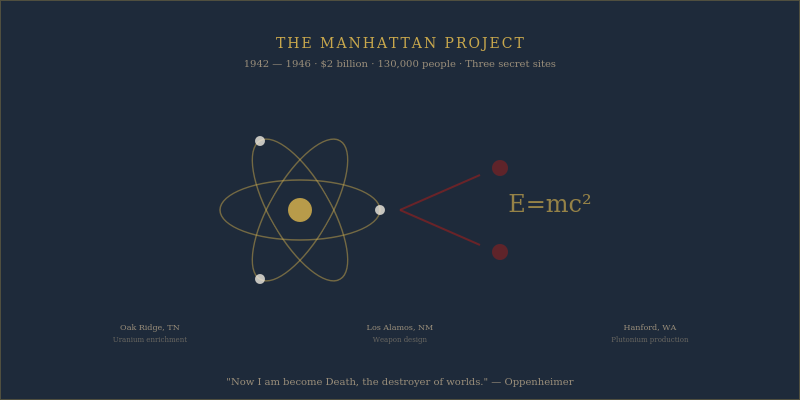
The Manhattan Project eventually employed over 130,000 people across multiple sites including Los Alamos in New Mexico, Oak Ridge in Tennessee and Hanford in Washington state. Its total cost in wartime dollars was approximately two billion dollars. Most participants did not know what they were building.
What the Project Required
Building an atomic bomb required solving problems that had never been solved before, using materials that barely existed in usable quantities, on a timeline set by the pace of a global war. Two separate approaches to producing fissile material were pursued simultaneously — enriched uranium and plutonium — because neither had been proven to work at scale.
The industrial infrastructure was extraordinary. Oak Ridge processed uranium on an industrial scale. Hanford produced plutonium. Los Alamos designed the weapons. The secrecy required meant that most workers understood only their specific task and nothing more.
Oppenheimer's challenge at Los Alamos was to assemble the world's leading physicists — many of them refugees from Nazi Europe — and direct them toward a single practical goal under wartime conditions. By most accounts, he did this remarkably effectively.
The Trinity Test
The first nuclear device was tested at Trinity, New Mexico, on 16 July 1945. The yield was approximately 21 kilotons of TNT — larger than many physicists had predicted. Oppenheimer later recalled that the test brought to mind a line from the Bhagavad Gita: "Now I am become Death, the destroyer of worlds." Germany had surrendered two months earlier. The war in Europe was over.
Einstein letter to Roosevelt
Szilard and Einstein warn Roosevelt of German nuclear weapons potential. Advisory committee established.
Pearl Harbor accelerates commitment
US enters the war. Full commitment to atomic weapons programme follows.
Manhattan Project formally established
Oppenheimer appointed scientific director. Groves appointed military commander. 130,000 eventually employed.
Trinity test
First nuclear device successfully detonated at Trinity, New Mexico. Germany has already surrendered.
Hiroshima and Nagasaki
Atomic bombs dropped on Japan. Japan surrenders. The Second World War ends.
The Decision to Use
With Germany defeated, the question became whether and how to use the weapons against Japan. The stated justification was that the bombs would end the war without the casualties projected for an invasion of the Japanese home islands — estimates ranged from hundreds of thousands to over a million.
Critics have argued that Japan was already close to surrender and that the bombings were unnecessary, or that they were partly motivated by a desire to end the war before Soviet involvement in the Pacific deepened. The historical debate is genuine and unresolved. Scholars including Tsuyoshi Hasegawa have argued that the Soviet declaration of war against Japan on 8 August — between the two bombings — may have been more decisive in Japan's surrender calculation than the bombs themselves.
An estimated 70,000 to 80,000 people died immediately at Hiroshima, with similar numbers at Nagasaki. Many more died from injuries and radiation in the following months and years.
The World the Project Created
Japan surrendered on 15 August 1945. The Second World War was over. The Manhattan Project had achieved its immediate objective.
It had also created something that could not be uncreated. The Soviet Union tested its first atomic bomb in 1949. The nuclear arms race that followed shaped international relations for the remainder of the twentieth century. The project that began as a response to a feared German weapon produced a permanent transformation in the nature of military power and international relations.
The scientists and decision-makers of 1942 were responding to a real threat as best they understood it. The world they created was one none of them had fully anticipated.
Key Facts
- Period
- 1942–1946
- Cost
- ~$2 billion (1945 dollars; ~$28 billion today)
- Peak workforce
- ~130,000 people
- Sites
- Oak Ridge (Tennessee), Hanford (Washington), Los Alamos (New Mexico)
- First test
- Trinity, 16 July 1945, New Mexico
The Scientific Background
The Manhattan Project emerged from a chain of scientific discoveries made in the 1930s. In 1938, German physicists Otto Hahn and Fritz Strassmann demonstrated nuclear fission — the splitting of uranium atoms — producing energy and the possibility, in principle, of a chain reaction. Lise Meitner and her nephew Otto Frisch provided the theoretical explanation for what Hahn and Strassmann had observed.
The scientific community grasped immediately that fission could in principle be weaponised. A chain reaction that released the energy of nuclear fission in an uncontrolled fashion could produce an explosion of unprecedented destructive power. And the most urgent concern was that Nazi Germany — which had the scientific talent, including many of the physicists who had made the key discoveries — was working toward exactly this goal.
Albert Einstein and Leo Szilard drafted the Einstein-Szilard letter, sent to President Roosevelt in October 1939, warning of the possibility that Germany might develop an atomic bomb and urging American research into the same technology. This letter initiated the chain of events that led to the Manhattan Project.
The Decision to Use the Bomb
The decision to use atomic weapons against Japan — Hiroshima on 6 August 1945, Nagasaki on 9 August 1945 — remains one of the most contested decisions in modern history. The justifications offered at the time and subsequently have included: that the bombs saved lives by making an invasion of Japan unnecessary; that Japan would not surrender without the shock of an unprecedented attack; that using the bombs was no worse morally than the firebombing of Tokyo that had already killed more people than either atomic bomb.
Critics have argued: that Japan was already close to surrender and the bombs were not necessary; that the primary motivation was to end the war before Soviet entry into the Pacific could give the USSR a claim to postwar influence in Japan; that the use of weapons designed to kill civilians indiscriminately was morally indefensible regardless of the military circumstances.
The debate cannot be definitively resolved because the counterfactuals — what would have happened if the bombs had not been used — are inherently unknowable. What is clear is that the decision was made under conditions of uncertainty, time pressure, and political considerations that went beyond pure military calculation.
The Scientists' Moral Reckoning
Many of the scientists who built the bomb subsequently grappled with the moral implications of what they had created. Robert Oppenheimer, the scientific director of the project, famously quoted the Bhagavad Gita after the Trinity test: "Now I am become Death, the destroyer of worlds." He later opposed the development of the hydrogen bomb and was eventually stripped of his security clearance in the McCarthy era.
The Manhattan Project raised fundamental questions about the relationship between science and responsibility that remain unresolved. Scientists had created a technology of unprecedented destructive potential; they had done so in service of a war against genuine evil; and the technology they created had been used in ways that killed hundreds of thousands of civilians. The moral architecture for thinking about this — for deciding what responsibilities scientists bear for the uses of their discoveries — was and remains inadequate to the scale of the challenge.
The Nuclear Age
The Manhattan Project did not merely produce two bombs. It initiated the nuclear age — the period in which human beings possessed the technical capability to destroy civilisation. The Cold War arms race between the United States and Soviet Union produced arsenals of tens of thousands of nuclear weapons. The development of thermonuclear weapons — hydrogen bombs — made the Hiroshima and Nagasaki weapons look small by comparison.
The management of nuclear weapons — preventing their proliferation, reducing the risk of accidental use, maintaining deterrence while avoiding actual conflict — has been one of the central challenges of international relations since 1945. The near-misses of the Cold War — the Cuban Missile Crisis being the most famous — demonstrated how fragile that management could be.
Frequently Asked Questions
What was the Manhattan Project?
The Manhattan Project was the Allied scientific and military programme that developed the first nuclear weapons during World War Two. Running from 1942 to 1945, it employed over 130,000 people across multiple sites and produced the bombs dropped on Hiroshima and Nagasaki in August 1945.
Why did the United States develop the atomic bomb?
The primary stated motivation was fear that Nazi Germany was developing nuclear weapons first. Scientists including Leo Szilard and Albert Einstein warned Roosevelt of this possibility in 1939. Germany surrendered before the bombs were ready, raising questions about whether the original rationale still applied to their use against Japan.
Was the decision to use the atomic bomb on Japan justified?
This remains one of the most debated questions in modern history. Proponents argue the bombs ended the war without an invasion that would have caused greater casualties on all sides. Critics argue Japan was close to surrender and the bombings were unnecessary, or were partly motivated by Cold War strategic considerations. Historians continue to disagree, and the question has no settled answer.
How many people died at Hiroshima and Nagasaki?
Estimates vary and remain debated. An estimated 70,000 to 80,000 people died immediately at Hiroshima, with similar numbers at Nagasaki. Total deaths including those from radiation and injuries in subsequent months are estimated at 130,000 to 226,000 across both cities, though precise figures are difficult to establish.
Kai Bird and Martin Sherwin's biography of Oppenheimer argues that the decision to use the bombs was less inevitable than the postwar narrative suggests — and that the political and military pressures shaping the decision were more complex than a simple calculation of lives saved. This is one of those topics where the more you read, the more complicated it gets.
A Note From The Editor
What strikes me about the Manhattan Project is not the physics or even the destruction. It is the gap between what the decision-makers intended and what they created. The project began as a defensive response to a threat that turned out not to exist at the level feared. It ended by permanently altering the logic of international conflict. The scientists who built the bomb understood the physics. Nobody fully understood what the world would look like afterward — including them.