The Boy Who Should Have Died
In 1162, on the vast empty steppe of what is now Mongolia, a child was born clutching a blood clot in his fist. His father Yesugei, a minor tribal chieftain, named him Temujin. When Temujin was nine, his father was poisoned by rival Tatars. His clan abandoned the family entirely — a deliberate death sentence in the harsh steppe environment. They survived by eating berries, roots and small animals. Temujin never forgot the abandonment, and never forgot the lesson: loyalty was the only currency that mattered, and it had to be earned.
Through his teenage years and twenties, Temujin built alliances through a revolutionary approach to power. Rather than organising his growing army by tribal lineage — the traditional approach — he based everything on personal loyalty and merit. Officers were promoted on ability, not birth. Looting was forbidden during battle; all spoils were distributed equally after victory. He absorbed captured enemies who showed capability rather than enslaving them. He created an army of unprecedented cohesion.
The Great Assembly of 1206
In 1206, at a great assembly called a Kurultai at the headwaters of the Onon River, Temujin was proclaimed Genghis Khan — Universal Ruler — by the united tribes of the Mongolian steppe. He was approximately 44 years old. Within the next two decades his forces would conquer territory stretching from the Pacific Ocean to Eastern Europe.
The Campaigns of Conquest
Genghis Khan's military strategy was as much psychological as military. Cities that submitted were spared and absorbed. Cities that resisted — or killed Mongol ambassadors — were annihilated completely. Every man, woman and child killed. The city erased from existence. This was calculated terror: word of what happened to resistant cities spread ahead of the Mongol armies, causing populations to surrender without a fight. It was a force multiplier that allowed a relatively small army to control an enormous territory.
His army was organised in decimal units — squads of ten, companies of one hundred, battalions of one thousand, divisions of ten thousand (tumens). Communication across the battlefield used a system of flags, torches and drums that allowed coordinated manoeuvres at distances impossible for European armies of the period. The Mongol cavalry's speed and range — soldiers could cover 60 to 100 miles per day — allowed them to appear where they were least expected.
The Death Toll and the Legacy
Estimates of the death toll from the Mongol conquests range from 40 to 60 million people — perhaps 10 percent of the global population at the time. Some regions, particularly in Central Asia, Persia and northern China, suffered population declines of 50 to 75 percent. Cities that had been among the largest in the world were reduced to rubble.
And yet the Mongol Empire's legacy is profoundly contradictory. Under the Pax Mongolica that followed the initial conquests, the empire created the first true international trade network. The Silk Road — discussed in our article on how trade built the modern world — functioned more safely and efficiently under Mongol protection than at any previous point in history. Merchants could travel from China to Europe under Mongol safe-conduct. Religious freedom was formally guaranteed. The postal relay system established across the empire was the most sophisticated in the ancient world. That same connectivity carried a darker cargo too: historians widely believe the same reopened Silk Road routes later carried the bubonic plague westward, contributing to the Black Death that devastated Europe in the following century.
Genghis Khan died in 1227, during a campaign against the Tangut kingdom of Xi Xia. The cause of his death is disputed — falls from a horse, illness and assassination have all been suggested. His burial site was kept secret; soldiers who escorted his body were reportedly killed to preserve the secret. The location has never been found.
His legacy is one of the most contested in world history. In many of the regions he conquered — China, Iran, Russia, the wider Islamic world — he is remembered primarily as a destroyer. In Mongolia, he remains the founding national hero. And his biological legacy is almost unimaginable in scale: genetic research suggests roughly 16 million men alive today — approximately 0.5% of the entire global male population — are likely descended from him through the male line, a consequence of both the sheer number of children he fathered and the subsequent spread of his male-line descendants across the empire's vast territory over subsequent centuries.
"I am the punishment of God. If you had not committed great sins, God would not have sent a punishment like me upon you." — Genghis Khan to the people of Bukhara, 1220 (per Juvayni)
Frequently Asked Questions
How did Genghis Khan rise to power?
Genghis Khan — born Temujin around 1162 — rose to power through a combination of military genius, political alliances and ruthless elimination of rivals. After a childhood marked by poverty and captivity following his father's murder, he systematically united the warring Mongol tribes and was proclaimed Great Khan in 1206.
How large was Genghis Khan's empire?
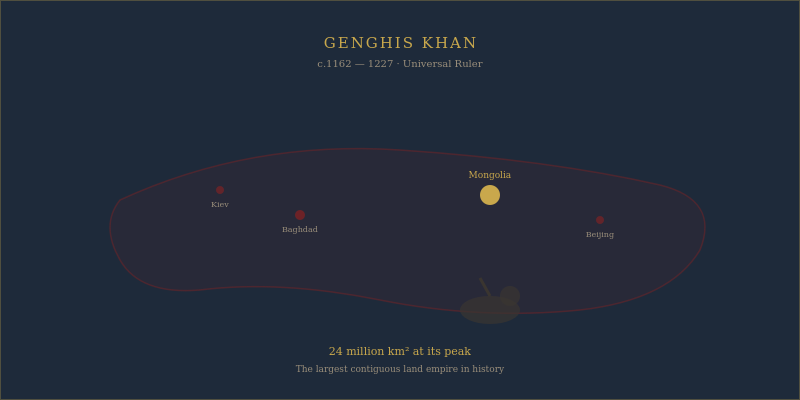
At its greatest extent the Mongol Empire covered approximately 24 million square kilometres — roughly the size of Africa. It stretched from the Pacific Ocean in the east to Eastern Europe in the west, making it the largest contiguous land empire in human history.
How many people did Genghis Khan kill?
Estimates of the death toll from Mongol conquests range from 40 to 70 million people — roughly 10 percent of the world's population at the time. Some regions, particularly in Central Asia and China, lost more than half their population. The destruction was so complete that some areas took centuries to recover.
How did Genghis Khan die?
The exact cause of Genghis Khan's death in 1227 remains disputed. The most widely accepted accounts suggest he died from injuries sustained after falling from a horse, though other theories include illness, typhoid fever or wounds from battle. He was approximately 65 years old.
Where is Genghis Khan buried?
The location of Genghis Khan's tomb remains one of history's greatest mysteries. According to tradition, he requested a secret burial and the soldiers who carried his body killed anyone they encountered on the journey. The tomb has never been found despite numerous archaeological searches.
A Note From The Editor
Genghis Khan is genuinely difficult to evaluate. The destruction was real and staggering — cities erased, populations massacred, entire civilisations set back centuries. But so was the Pax Mongolica that followed — the longest period of connected trade the ancient world had ever seen. He was simultaneously history's greatest destroyer and one of its great connectors. I'm not sure we're meant to resolve that contradiction. Some historical figures resist simple moral judgement — and perhaps that's the most honest thing we can say about them.
Key Facts
- Born
- c. 1162, Khentii Mountains, Mongolia
- Died
- 1227, age approximately 65
- Empire at peak
- ~24 million square kilometres — largest contiguous land empire in history
- Population under control
- Approximately 100 million people
Historians still disagree on the underlying causes — which is part of what makes this story worth pursuing further.
Was the Mongol Empire's rapid collapse after Genghis Khan inevitable, or could different succession choices have produced a different outcome?