Rome at Its Peak
The Roman Empire at its height under Trajan (98-117AD) controlled territory from Scotland to Mesopotamia. Roughly 70 million people lived under Roman rule. Roman infrastructure — roads, aqueducts, legal codes, a professional army, a currency used across the known world — was without parallel. The Pax Romana provided nearly two centuries of relative stability. It would be 1,500 years before anything comparable emerged in Europe.
The Financial Collapse
The seeds of Rome's destruction were financial. To fund military campaigns and an expanding bureaucracy, emperors debased the currency — reducing the silver content of coins while maintaining face value. The denarius, nearly pure silver in the early empire, contained just 2-5 percent silver by the 270s AD. Inflation exploded. Trade became difficult. Tax revenues, collected in debased currency, bought less and less.
The Crisis of the Third Century
Between 235 and 284AD, Rome had at least 26 emperors — most of whom died violently. The army had become the kingmaker. This 50-year political crisis made coherent long-term governance impossible. Infrastructure deteriorated. Trade networks broke down. Disease spread unchecked. In some regions, entire villages were abandoned.
The Barbarians Were a Symptom
The traditional narrative emphasises barbarian invasion, and Rome did face increasing border pressure from Germanic tribes and the Huns. But a strong, well-funded empire could have managed these pressures — as Rome had done for centuries. What Rome could no longer do, by the late 4th century, was field an effective army. Soldiers went unpaid. Recruitment declined. Rome relied increasingly on barbarian mercenaries with divided loyalties.
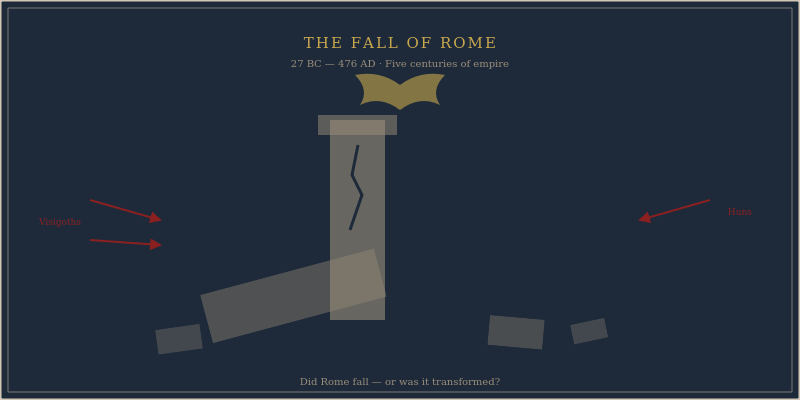
The Battle of Adrianople in 378 CE was the moment the danger became undeniable: the Visigoths defeated and killed the Emperor Valens himself, demonstrating that Roman military dominance could no longer be assumed. In 395 CE, the empire was formally split into western and eastern halves — a division that revealed just how differently the two regions could withstand the same pressures. The east, wealthier and more defensible, endured for another thousand years. The west, larger but poorer, struggled from that point onward.
When the Visigoths sacked Rome in 410AD — the first time the city had been breached in 800 years — much of the empire had already effectively collapsed. The final moment in 476AD, when the last western emperor was deposed, was the conclusion of a long decline rather than a sudden disaster. The parallels with modern institutional decline — currency debasement producing inflation, political instability preventing long-term planning, military overextension consuming resources — are studied by historians, economists and political scientists to this day. For more on empire collapse see our article on Napoleon's Russian campaign.
What Historians Still Debate
Edward Gibbon's monumental eighteenth-century account, still influential today, treated Rome's fall largely as a story of moral and institutional decay from within. Modern historians have split into genuinely opposing camps on how to read the same evidence. Peter Heather's The Fall of the Roman Empire (2006) argues for a relatively traditional reading: external military pressure, ultimately, is what Rome could no longer withstand. Bryan Ward-Perkins, in The Fall of Rome and the End of Civilization (2005), points to hard archaeological evidence of genuine material decline — cruder pottery, smaller buildings, falling literacy, collapsed long-distance trade — arguing this was a real catastrophe, not merely a political rebranding.
Set against both is the "transformation" school, associated with historians like Walter Goffart and Peter Brown, which argues the whole framing of collapse is misleading. On this view, the Germanic kingdoms that replaced Roman rule in the west largely adopted Roman administrative structures, kept Roman law, and presented themselves as legitimate successors rather than conquerors — meaning what happened wasn't really a fall at all, but a transformation of Rome into something new. The honest answer is that both camps are pointing at something real: the material culture of fifth-century Western Europe genuinely was less sophisticated than the second century's, and Roman forms and institutions genuinely did persist, transformed, in what came after.
Frequently Asked Questions
Why did the Roman Empire fall?
The Roman Empire fell due to a combination of internal and external pressures over several centuries. Internal factors included political instability, economic decline, military overstretch and the gradual erosion of civic institutions. External pressures from migrating Germanic peoples and the Hunnic invasions accelerated the collapse. No single cause explains the fall — it was the cumulative effect of interconnected failures.
When did the Roman Empire fall?
The traditional date for the fall of the Western Roman Empire is 476 AD, when the Germanic chieftain Odoacer deposed the last Western emperor Romulus Augustulus. However this date is somewhat arbitrary — the empire had been fragmenting for decades before and Roman institutions continued in various forms long after. The Eastern Roman Empire, centred in Constantinople, continued until 1453 AD.
Did Rome really fall or just transform?
Many historians argue Rome did not fall so much as transform. Roman institutions, law, language and culture were absorbed and adapted by the Germanic kingdoms that replaced the empire. The Catholic Church preserved much of Roman learning and administration. In this view the Middle Ages were not a break from Rome but a continuation of it in different form.
How long did the Roman Empire last?
The Roman Empire, dating from the traditional founding of the Republic in 509 BC to the fall of Constantinople in 1453 AD, lasted in various forms for nearly two thousand years. The Western Empire specifically, from Augustus in 27 BC to 476 AD, lasted approximately 500 years — making it one of the most durable political entities in human history.
Could the Roman Empire have survived?
Historians debate whether Roman decline was inevitable or whether different decisions could have prolonged the empire. Some argue the fundamental economic and military problems were insurmountable. Others point to the Eastern Empire's survival for another thousand years as evidence that better governance could have preserved the West. The question remains genuinely open.
A Note From The Editor
Rome didn't fall in a day — or a decade, or even a century. That's what makes it such a compelling study. The decline was so gradual that many Romans living through it didn't recognise it as decline at all. They adapted, rationalised, continued. There's something uncomfortable about that when you consider our own moment — the way complex systems can deteriorate slowly, visibly, and yet somehow remain invisible to the people inside them until it's too late to change course.
The interpretation remains debated, and the further you read, the more layers emerge.
Was the fall of Rome a catastrophic collapse or a gradual transformation — and does the answer change depending on whose experience we prioritise?