The Roaring Twenties
Through the 1920s, the United States experienced extraordinary economic expansion. New technologies — automobiles, radio, cinema — transformed everyday life. The stock market rose steadily, then spectacularly. Ordinary people borrowed money to buy stocks on margin — putting down as little as 10 percent and borrowing the rest. This leverage amplified gains on the way up. It would amplify losses catastrophically on the way down. By September 1929, stock prices had risen far beyond any connection to corporate earnings.
Black Thursday
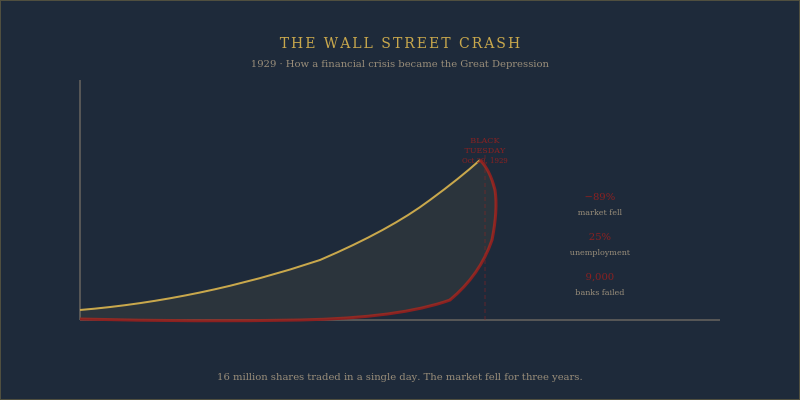
On October 24th 1929, panic hit. Selling orders flooded the market. In four days the market lost 25 percent of its value. The crash was catastrophic — but it was potentially survivable. Previous market crashes had lasted months before recovery. What turned the 1929 crash into a decade-long catastrophe was a series of catastrophically bad government decisions that followed.
The Government Made It Worse
The Federal Reserve raised interest rates after the crash to protect the gold standard — exactly the wrong response. Congress passed the Smoot-Hawley Tariff in 1930, raising import taxes to protect American jobs. Other countries retaliated immediately. Global trade collapsed by 66 percent in two years. The US government allowed over 9,000 banks to fail without intervention, wiping out millions of Americans' savings. A serious recession became the Great Depression.
The Parallels to Today
Unemployment hit 25 percent. Families lost homes and savings. The crisis was not confined to America either — the United States was the world's largest creditor nation, and as American banks recalled loans extended to Germany and elsewhere in Europe, the shock spread internationally, deepened further by the collapse in global trade that Smoot-Hawley triggered. In Germany specifically, the resulting mass unemployment fed directly into the political conditions that brought Hitler to power in 1933 — a reminder that the consequences of a financial collapse rarely stay contained within the country where it began.
It took World War Two — and the largest government spending programme in history — to finally end the Depression in America. Every financial crisis since has been managed differently because of this lesson: central banks cut rates rather than raising them, governments increase spending rather than cutting it, banks are supported rather than allowed to fail. These interventions are imperfect and controversial, but they have prevented any post-1929 recession from becoming a full depression. The warning signs that preceded 1929 — excessive debt, disconnected asset prices, widespread speculation by those who do not understand what they are buying — reappear regularly. The question is never whether another crash will happen. It is whether we will make the same mistakes in response. For related financial history see Tulip Mania.
Frequently Asked Questions
What caused the 1929 stock market crash?
The 1929 crash was caused by a combination of factors — rampant speculation on margin, overvalued stocks, weak banking regulation, agricultural depression and the Federal Reserve's tight monetary policy. The crash itself began on Black Thursday, 24 October 1929, when panic selling wiped out billions in value within hours.
How long did the Great Depression last?
The Great Depression lasted approximately a decade, from 1929 to around 1939. Recovery was slow and uneven — the US economy did not fully recover until World War Two military spending created sufficient demand. Some countries recovered earlier through government intervention while others, particularly the United States, remained depressed throughout the 1930s.
How did the 1929 crash cause the Great Depression?
The crash itself did not directly cause the Depression — it was government responses that turned a severe recession into a decade-long catastrophe. The Smoot-Hawley Tariff Act of 1930 triggered a global trade war. Bank failures destroyed savings. The Federal Reserve raised interest rates. Each decision compounded the damage of the previous one.
How many people lost their jobs in the Great Depression?
At its peak in 1933 unemployment in the United States reached approximately 25 percent — one in four workers. In some industrial cities unemployment exceeded 50 percent. Globally the Depression threw an estimated 30 million people out of work. Many who kept jobs saw wages cut by 40 to 60 percent.
What ended the Great Depression?
The Great Depression effectively ended with World War Two. Massive government military spending created full employment almost overnight. In the United States unemployment fell from 17 percent in 1939 to under 2 percent by 1943. The war demonstrated that government spending could stimulate economies in ways that voluntary market recovery could not.
A Note From The Editor
The 1929 crash is usually presented as an economic story. I think it's really a story about decisions — and about how the wrong decisions made at the wrong moment can turn a bad situation into a catastrophe. The crash itself lasted days. The Depression lasted a decade. That gap between the two is entirely the story of human choices, political failures and ideological stubbornness. The market didn't create the Great Depression. People did. That's both more frightening and more hopeful — because people can also choose differently.
Historians still disagree on the underlying causes — which is part of what makes this story worth pursuing further.
Would the Great Depression have remained a severe recession without the policy failures that followed — or was prolonged collapse inevitable once the crash occurred?