Why Napoleon Invaded Russia
The invasion of Russia in 1812 was not an act of territorial aggression in the traditional sense. Napoleon's primary motivation was economic and strategic: Russia had withdrawn from the Continental System, the French-imposed trade blockade designed to strangle Britain economically. By trading with Britain, Russia was undermining the central pillar of Napoleon's anti-British strategy.
The Continental System was itself a recognition of Napoleon's fundamental problem: he could not defeat Britain militarily. His navy had been destroyed at Trafalgar in 1805. Britain controlled the seas. The only weapon available to Napoleon was economic warfare, and that weapon required the participation of all European states. Russia's defection from the system was therefore not merely a diplomatic affront but a strategic crisis.
There were also personal and political factors. Napoleon had married the Austrian princess Marie-Louise in 1810, effectively aligning France with Austria and marginalising Russia. Tsar Alexander I felt humiliated by the Tilsit arrangements of 1807, which had placed France and Russia as nominal equals but had in practice extended French power across Europe. The relationship between the two emperors had deteriorated steadily since their apparent friendship at Tilsit.
The Grande Armée
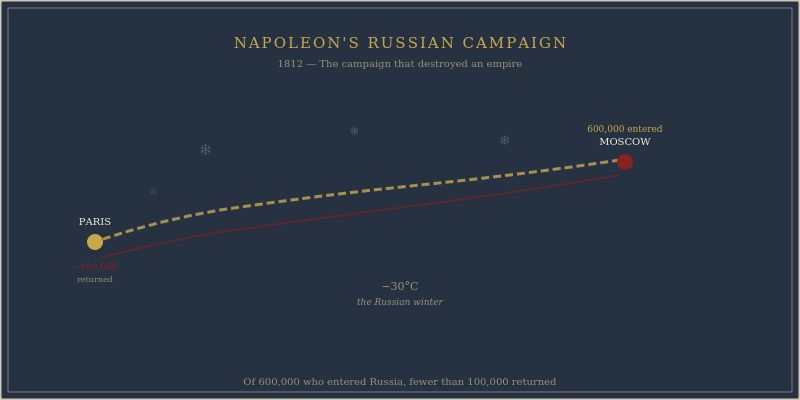
The army Napoleon assembled for the Russian campaign was the largest military force Europe had ever seen: approximately 600,000 men, drawn from across the French Empire and its satellite states. Only about a third were French; the remainder included Poles, Germans, Italians, Spaniards, Austrians, Prussians, and soldiers from many other nations. This multinational composition, which reflected the breadth of French power, also created coordination problems and differing levels of commitment.
The army crossed the Niemen River into Russia on 24 June 1812. Napoleon expected the campaign to be concluded within weeks — he would force a decisive battle, defeat the Russian army, and compel Alexander to negotiate. He had no plan for an extended campaign deep into Russian territory.
The Russian Strategy
The Russians, under generals Barclay de Tolly and later Kutuzov, declined to give Napoleon the decisive battle he sought. They retreated steadily, drawing the French deeper into Russia while avoiding encirclement. The scorched earth policy — destroying supplies, crops, and infrastructure as they retreated — denied Napoleon's army the resources it needed.
The strategy was controversial within Russia. Abandoning Russian territory to the enemy without fighting seemed to many Russian officers and aristocrats like cowardice or treachery. Barclay de Tolly was replaced by the more aggressive Kutuzov, who finally gave battle at Borodino on 7 September 1812, seventy miles west of Moscow. Borodino was the largest and bloodiest battle of the Napoleonic Wars: approximately 70,000 casualties in a single day. Neither side achieved a decisive victory. The Russians retreated in good order; Napoleon occupied Moscow.
The Burning of Moscow
Napoleon entered Moscow on 14 September 1812. He expected Alexander to negotiate peace. Instead, Russian authorities ordered the city burned rather than allow it to serve as winter quarters for the French army. The fire destroyed approximately three-quarters of the city. Napoleon waited in the ruins for five weeks, hoping for a Russian response that never came.
By mid-October, with no peace offer forthcoming and winter approaching, Napoleon ordered the retreat. The Grande Armée left Moscow on 19 October 1812. What followed was one of the most catastrophic military withdrawals in history.
The Retreat
The retreat from Moscow was a disaster of unprecedented scale. The Russian winter — earlier and more severe than usual in 1812, with temperatures reaching as low as minus 37 degrees Celsius — killed thousands of soldiers who had marched into Russia in summer uniforms and had nothing adequate against the cold. The scorched earth policy meant there was little left to forage; starving soldiers ate their own collapsed horses. Cossack cavalry harassed the retreating columns continuously, while regular Russian forces under Kutuzov shadowed the army and periodically cut off retreating units.
Of the approximately 600,000 men who had entered Russia, fewer than 100,000 crossed back out in any fighting condition — some estimates place the final effective force at under 20,000 by the time the remnants reached safety. The rest had died of cold, disease, starvation, or combat, or had been captured. The losses included not only French soldiers but the Poles, Germans, Italians, and others who had joined the campaign. The catastrophe reverberated across every nation that had contributed troops.
The Russian campaign did not immediately end Napoleon's rule — he returned to France, raised another army, and continued fighting until 1814. But it fundamentally changed the strategic situation. The myth of French invincibility had been shattered. Prussia, Austria, and other powers that had accommodated French dominance now saw an opportunity to overthrow it. Napoleon was defeated and exiled to Elba by 1814; he returned briefly in 1815, was defeated at Waterloo, and died in exile in 1821. The greatest military mind of his age was ultimately beaten not by a rival general but by his own hubris and the physical limits of strategic overreach. The parallel with Alexander the Great's army refusing to advance further at the Indus, and with the overextension that helped unravel Rome, is a direct one — see our articles on Alexander the Great and the Fall of Rome.
Frequently Asked Questions
Why did Napoleon invade Russia in 1812?
Napoleon invaded Russia primarily because Tsar Alexander I had withdrawn Russia from the Continental System — Napoleon's trade blockade designed to strangle Britain economically. Napoleon also sought to enforce French dominance over Europe and eliminate Russia as a potential threat to his empire. He expected a swift decisive victory, not the catastrophic campaign that followed.
How many soldiers did Napoleon take to Russia?
Napoleon's Grande Armée that crossed into Russia in June 1812 numbered approximately 600,000 men — the largest army ever assembled in European history to that point. It included soldiers from across Napoleon's empire — French, Polish, Italian, German, Spanish and many others. Fewer than 100,000 returned in any fighting condition.
What was the scorched earth policy in Russia?
As Napoleon's army advanced the Russians deliberately destroyed everything in their path — burning crops, villages and supplies — to deny the French army food and shelter. This strategy, combined with Russia's vast distances and the approaching winter, turned Napoleon's numerical advantage into a liability. The French army marched hundreds of miles finding nothing to eat or burn for warmth.
Why did Napoleon fail in Russia?
Napoleon failed in Russia for several interconnected reasons — the Russians refused a decisive battle and retreated, the scorched earth policy denied him supplies, the vast distances exhausted his supply lines, the Russian winter arrived earlier and more severely than expected, and guerrilla warfare harassed his forces continuously. He captured Moscow but found it abandoned and burning.
How did the Russian campaign affect Napoleon?
The Russian campaign effectively ended Napoleon's dominance of Europe. The destruction of his Grande Armée emboldened his enemies — Prussia, Austria and others — to join forces against him. Within two years he had been defeated, abdicated and exiled to Elba. Though he returned briefly in 1815, the Russian campaign marked the beginning of his final decline.
A Note From The Editor
Napoleon's Russian campaign is studied in military academies precisely because it represents such a complete failure of strategic thinking by someone who was, by any measure, a strategic genius. That paradox is instructive. The same qualities that made Napoleon extraordinary — absolute confidence, contempt for conventional limits, belief in his own exceptionalism — became catastrophic liabilities the moment circumstances changed. Genius and hubris are often the same thing, separated only by outcomes.
The full picture is more complex than any short article can cover.
Could Napoleon have won in Russia with different timing — or was the campaign structurally impossible from the start?