Why It Was Called the Spanish Flu
Despite its name, the 1918 influenza pandemic almost certainly did not originate in Spain. Spain was one of the few European nations not involved in World War One and therefore had a free press — its newspapers could report freely on the epidemic when other countries' wartime censorship suppressed coverage. Because Spanish newspapers were full of reports about the devastating illness (including reports that King Alfonso XIII had contracted it), the disease became associated with Spain in international coverage. The countries actually responsible for the pandemic's spread could not report on it without undermining wartime morale.
The actual origin of the 1918 pandemic remains debated. Leading hypotheses include the United States (possibly Kansas, where an early outbreak was documented in March 1918), China and northern France. What is clear is that it spread globally with unprecedented speed, carried by the massive movement of troops and civilians during the final year of World War One.
Scale of the 1918 Pandemic
According to the CDC and peer-reviewed research published in the journal Emerging Infectious Diseases, the 1918 influenza pandemic infected approximately 500 million people — one-third of the global population — and killed an estimated 50 to 100 million. The death toll exceeded that of the First World War (approximately 17 million) and possibly the Second World War (approximately 70-85 million, depending on methodology).
Why This Flu Was Different
Influenza typically kills the very young and the very old — those with the weakest immune systems. The 1918 pandemic was uniquely lethal partly because it disproportionately killed healthy young adults aged 20 to 40. This unusual pattern has been explained through several hypotheses, including the possibility that people over 40 had partial immunity from exposure to an earlier influenza strain, and that the strong immune response (cytokine storm) of healthy young adults actually contributed to their deaths by causing overwhelming inflammation in the lungs.
Many victims died not from the influenza itself but from secondary bacterial pneumonia — a complication that in the pre-antibiotic era was almost impossible to treat. Death could come with shocking speed: people reported feeling well in the morning and being dead by nightfall. The symptoms included severe respiratory distress, and in some cases the characteristic blue discolouration of the skin (cyanosis) from oxygen deprivation.
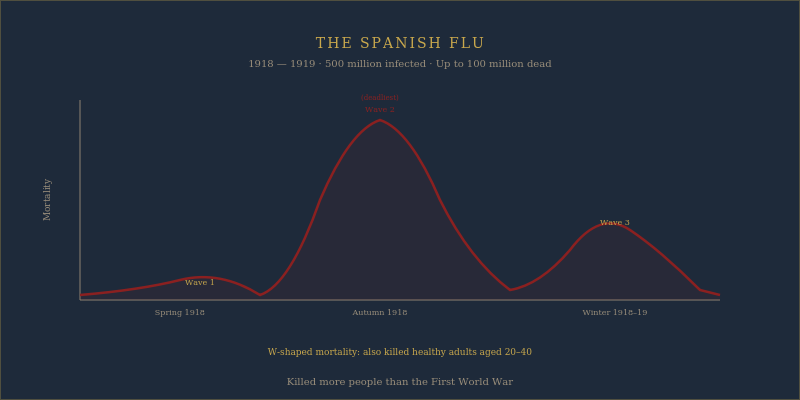
The disease struck in three waves. The first wave in spring 1918 was relatively mild. The second wave in autumn 1918 was catastrophic — this is when the great majority of deaths occurred. A third wave in winter 1918-1919 was less severe but still deadly. The second wave's unusual lethality may have resulted from the virus mutating to a more virulent form during the summer of 1918.
The Censorship Problem
The wartime information environment made the 1918 pandemic significantly worse than it needed to be. In Britain, France, Germany and the United States, governments suppressed or minimised reporting on the epidemic to avoid damaging morale and potentially aiding the enemy. Newspapers published stories downplaying the severity. Officials reassured publics that the illness was no worse than ordinary flu.
This censorship had direct consequences. People who might have isolated themselves did not, because they were not told the truth about the risk. Public gatherings — parades, political meetings, church services — continued in cities where the pandemic was actively spreading. The Second Liberty Loan parade in Philadelphia in September 1918, attended by 200,000 people, is frequently cited as a super-spreader event that contributed to Philadelphia's exceptionally high death toll.
The Legacy and Lessons
The 1918 pandemic disappeared as quickly and mysteriously as it had appeared. By 1920 it was over, leaving behind a world that was strangely reluctant to discuss what had happened. Unlike World War One — which produced enormous literature, memorial culture and political analysis — the 1918 pandemic was largely forgotten. Historians have speculated that the scale of the tragedy was simply too large to process, or that societies wanted to move on from years of death and disruption.
The pandemic's reach extended even into the peace that ended the war that had helped spread it. President Woodrow Wilson is believed to have contracted influenza at the Paris Peace Conference in April 1919, in the midst of negotiating the treaty terms with Britain and France. Some historians argue his illness weakened his resolve at a critical moment, contributing to his acceptance of harsher terms against Germany than he had originally intended — terms that would later be cited as a contributing factor in the conditions that produced the Second World War. If that connection holds, a virus that began as a public health catastrophe may have reached, however indirectly, into the shape of the peace that followed it.
The lessons of 1918 were directly applied in the COVID-19 pandemic response of 2020-2022. Epidemiologists studied the differential mortality between cities that implemented early social distancing measures (like San Francisco) versus those that held public gatherings (like Philadelphia) and found that early intervention significantly reduced both peak mortality and total death tolls. The 1918 pandemic also drove the development of modern influenza surveillance systems and the annual flu vaccine programme.
The 1918 virus itself was reconstructed in 2005 by researchers using fragments recovered from preserved tissue samples, including from the body of a victim buried in the Alaskan permafrost. Analysis confirmed it was a novel H1N1 influenza A virus that the human immune system had never previously encountered — exactly the conditions that made it so lethal. The research is published in the journal Science and remains a landmark in pandemic preparedness research.
Frequently Asked Questions
Why was it called the Spanish Flu if it didn't start in Spain?
The 1918 pandemic became known as the Spanish Flu because Spain, being neutral in World War One, did not censor its press. Spanish newspapers reported freely on the outbreak while other nations suppressed news to maintain wartime morale. The disease likely originated in the United States, France or China — historians still debate this.
How many people did the Spanish Flu kill?
The Spanish Flu killed an estimated 50 to 100 million people worldwide between 1918 and 1920 — more than World War One itself, which killed approximately 17 million. It infected roughly 500 million people, about a third of the world's population at the time.
Why did the Spanish Flu kill young healthy adults?
Unusually, the Spanish Flu was most deadly to young healthy adults aged 20 to 40. This is thought to be because the virus triggered a cytokine storm — an overreaction of the immune system. Stronger immune systems produced more violent reactions, making healthy adults more vulnerable rather than less.
Why did governments hide the Spanish Flu?
Governments involved in World War One suppressed news of the pandemic to maintain public morale and military recruitment. Reporting on widespread illness was seen as damaging to the war effort. This censorship prevented effective public health responses and likely allowed the disease to spread further than it otherwise would have.
How did the Spanish Flu end?
The Spanish Flu ended through a combination of factors — those who were infected either died or developed immunity, reducing the pool of susceptible hosts. The virus also mutated into less deadly forms over time. By 1920 the pandemic had largely subsided, though seasonal flu descended from the 1918 strain still circulates today.
A Note From The Editor
The thing that haunts me about the Spanish Flu isn't the death toll — it's the silence. Governments suppressing news. Newspapers printing nothing. Families not understanding why healthy young people were dying within hours of showing symptoms. We look back at 1918 and judge the censorship harshly. But I find myself wondering — how different is the instinct to suppress uncomfortable truths, really, from what we see today? The names change. The mechanisms change. The instinct remains.
Key Facts
- Period
- 1918–1919 (four waves)
- Pathogen
- H1N1 influenza A virus
- Estimated deaths
- 50–100 million globally (revised estimates: possibly higher)
- Infections
- Approximately 500 million — one third of the world's population
- Unusual feature
- Disproportionate mortality among healthy young adults (20–40 years old)
Historians still disagree on the underlying causes — which is part of what makes this story worth pursuing further.
Why did the 1918 pandemic receive so little historical attention for so long, and what does that absence tell us about how societies process collective trauma?