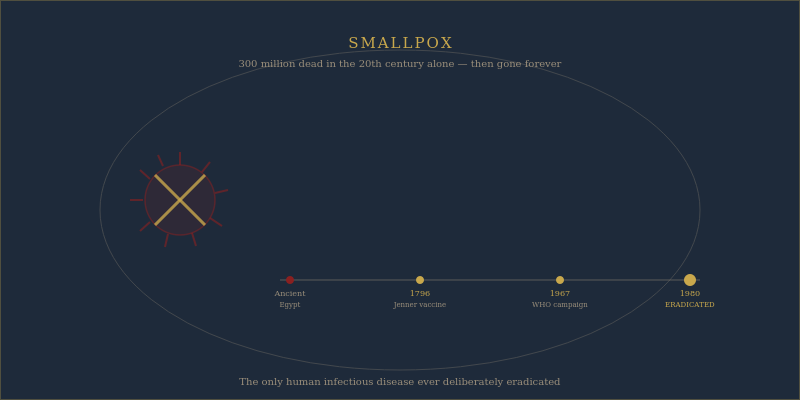
The Most Lethal Disease in Human History
Smallpox was caused by the Variola virus, which had no animal reservoir — it infected only humans. The disease had a case fatality rate of approximately 30 percent in unvaccinated populations, though some variants were significantly more lethal. Those who survived were left with distinctive pitted scars across the face and body, and many were permanently blinded.
The origins of smallpox are not precisely known, but genetic evidence suggests the virus emerged sometime between 3,000 and 4,000 years ago. Mummified remains from ancient Egypt show characteristic pockmarks consistent with smallpox, and ancient texts from India and China describe a disease matching smallpox's symptoms. According to the World Health Organization, smallpox killed an estimated 300 to 500 million people in the 20th century alone — more than all the wars of that century combined.
Death Toll in Perspective
According to the WHO and CDC, smallpox killed approximately 300-500 million people in the 20th century alone. In the 18th century, it killed an estimated 400,000 Europeans annually. It was responsible for one-third of all cases of blindness in Europe. In the Americas after European contact, it killed between 50 and 90 percent of some indigenous populations.
Smallpox and the Conquest of the Americas
The most catastrophic episode in smallpox history occurred after European contact with the Americas in 1492. Indigenous American populations had no prior exposure to smallpox and therefore no immunity. The results were devastating beyond any parallel in human history.
When Hernán Cortés and his force of fewer than 600 Spanish soldiers landed in Mexico in 1519, the Aztec Empire contained approximately 25 million people. Within a century the indigenous population of Mexico had fallen to approximately 1 million — a reduction of around 96 percent. Smallpox was not the only cause, but it was by far the most significant. Historians estimate that smallpox and other European diseases killed between 50 and 90 percent of the pre-Columbian population of the Americas — a demographic collapse without parallel in recorded history.
The psychological impact was enormous. Communities watched as people died at rates that seemed impossible without supernatural explanation. Traditional healing practices were powerless. The social structures that held communities together collapsed under the weight of mass death. European conquerors and their diseases together dismantled civilisations that had taken thousands of years to build.
Variolation: The First Vaccine
Resistance to smallpox developed in parallel with the disease. In China and the Ottoman Empire, a process called variolation — deliberately infecting patients with material from a mild smallpox case to produce immunity — was practised from at least the 10th century. The practice was introduced to Western Europe in 1721 by Lady Mary Wortley Montagu, the wife of the British ambassador to the Ottoman Empire, who had witnessed it in Istanbul and had her own children variolated.
Variolation was effective but dangerous — it produced immunity in most cases but killed approximately 1 to 2 percent of those treated. The breakthrough came in 1796 when Edward Jenner, an English physician, observed that milkmaids who contracted cowpox — a much milder disease — seemed to be immune to smallpox. He tested his theory by inoculating an eight-year-old boy named James Phipps with cowpox material, then exposing him to smallpox. The boy did not develop the disease. Jenner called his new procedure vaccination, from the Latin vacca meaning cow. The new method spread quickly precisely because it carried none of variolation's fatal risk; Napoleon, recognising its military value, ordered all French soldiers vaccinated — one of the earliest large-scale state-mandated public health interventions in history.
The Global Eradication Campaign
Vaccination gradually reduced smallpox's toll throughout the 19th and early 20th centuries in countries where it was systematically applied. But the disease persisted in developing countries where vaccination coverage was incomplete. In 1967, the World Health Organization launched an intensified global eradication campaign — one of the most ambitious public health operations in history.
The strategy combined mass vaccination with intensive surveillance and targeted response. When a case was identified, health workers would vaccinate every person who had contact with that individual — a technique called ring vaccination — to prevent further spread. The campaign required enormous logistical effort and political commitment across more than 30 countries.
The last naturally occurring case of smallpox was diagnosed in Somalia on October 26th, 1977. After two years of continued surveillance to ensure no cases had been missed, the WHO declared smallpox eradicated on May 8th, 1980. It remains the only human disease to have been completely eradicated through deliberate human effort.
The eradication of smallpox is widely considered the greatest achievement in the history of public health. It demonstrated that coordinated global action could eliminate an ancient human affliction — remarkably, the campaign relied on sustained cooperation between the United States and Soviet Union throughout some of the tensest years of the Cold War, proving that even bitter geopolitical rivals could unite around a genuinely shared enemy. It also established the template for subsequent disease eradication efforts — including the near-eradication of polio, which as of 2026 persists in only two countries.
For more on historical pandemic response see our article on The Black Death and The Spanish Flu of 1918.
Frequently Asked Questions
How did smallpox spread from person to person?
Smallpox spread primarily through direct contact with infected individuals, particularly through respiratory droplets from coughing or sneezing. It could also spread through contact with contaminated clothing or bedding. The virus was highly contagious — a single infected person could infect many others before symptoms even appeared.
How many people did smallpox kill throughout history?
Smallpox is estimated to have killed over 300 million people in the 20th century alone. Throughout recorded history it may have killed more humans than any other infectious disease, including the Black Death. In the 18th century it killed approximately 400,000 Europeans annually.
When was smallpox eradicated?
Smallpox was officially declared eradicated by the World Health Organisation on 8 May 1980, following a global vaccination campaign that began in 1967. The last naturally occurring case was recorded in Somalia in 1977. It remains the only human disease to have been completely eradicated.
What was the smallpox vaccine made from?
The original smallpox vaccine, developed by Edward Jenner in 1796, used cowpox virus — a related but much milder disease. Jenner observed that milkmaids who contracted cowpox appeared immune to smallpox. This discovery led to the first vaccine in medical history and eventually to the eradication of smallpox.
Does smallpox still exist anywhere?
Officially, smallpox virus now exists only in two secure laboratory facilities — one at the Centers for Disease Control in Atlanta, USA, and one at the VECTOR Institute in Novosibirsk, Russia. These samples are maintained for research purposes under strict international oversight.
A Note From The Editor
Smallpox is the only human disease we have ever completely eradicated. Not controlled. Not managed. Eliminated from existence. Think about what that means — a disease that killed more humans than any war, any famine, any other pathogen in recorded history, simply no longer exists. We did that. Collectively, imperfectly, bureaucratically — but we did it. In an age of endless pessimism about humanity's capacity to solve problems, smallpox is the most underrated proof that we can.
Key Facts
- Pathogen
- Variola virus (major and minor strains)
- Case fatality rate
- Variola major: 20–30% in unvaccinated populations
- Last natural case
- Ali Maow Maalin, Somalia, 26 October 1977
- Eradication declared
- 8 May 1980 by the World Health Assembly
- Historical deaths
- Estimated 300 million in the 20th century alone
The interpretation remains debated, and the further you read, the more layers emerge.
How differently might world history have unfolded if Indigenous populations had possessed immunity to European diseases?