John Law's Theory
John Law killed a man in a duel in Edinburgh in 1694. He was convicted of murder and sentenced to death. He escaped from prison — the details are unclear — and spent the next two decades moving around Europe, gambling, thinking, and developing a theory about money that would eventually be put into practice on the grandest possible scale.
The theory was this: gold and silver are not inherently valuable. They function as money because people treat them as money. This means, in principle, that any object can function as money as long as enough people are willing to accept it as such. The implication Law drew was that a government could issue paper money backed not by gold but by productive assets — land, trade revenues, expected future wealth — and this money would work as long as people believed in it.
This insight was not entirely wrong. Modern monetary systems work exactly this way. What Law failed to anticipate was the speed at which collective belief can dissolve, and what happens to a monetary system when it does.
A Bankrupt Kingdom
France in 1715 was effectively bankrupt. The wars of Louis XIV had consumed the treasury. The new regent, Philippe d'Orléans, was managing a national debt that consumed most of state revenues and left little for anything else. Law arrived in Paris with his theory and his proposal: let him implement it, and France's financial problems would be solved.
The regent, with few alternatives, agreed. In 1716, Law established the Banque Générale, initially a private bank with the right to issue notes that could be used to pay taxes. This was a genuine innovation — making the notes tax-acceptable gave them a guaranteed use and therefore a guaranteed demand. The bank succeeded. In 1718, it was converted to the Banque Royale, a state institution, and its notes became legal tender.
Simultaneously, Law established the Compagnie d'Occident — the Mississippi Company — to develop French territories in Louisiana. Louisiana was, in 1717, a vast and largely unknown territory. French settlers had established a few precarious trading posts. The land itself was real. The wealth that Law promised from it was not.
The Mississippi Company
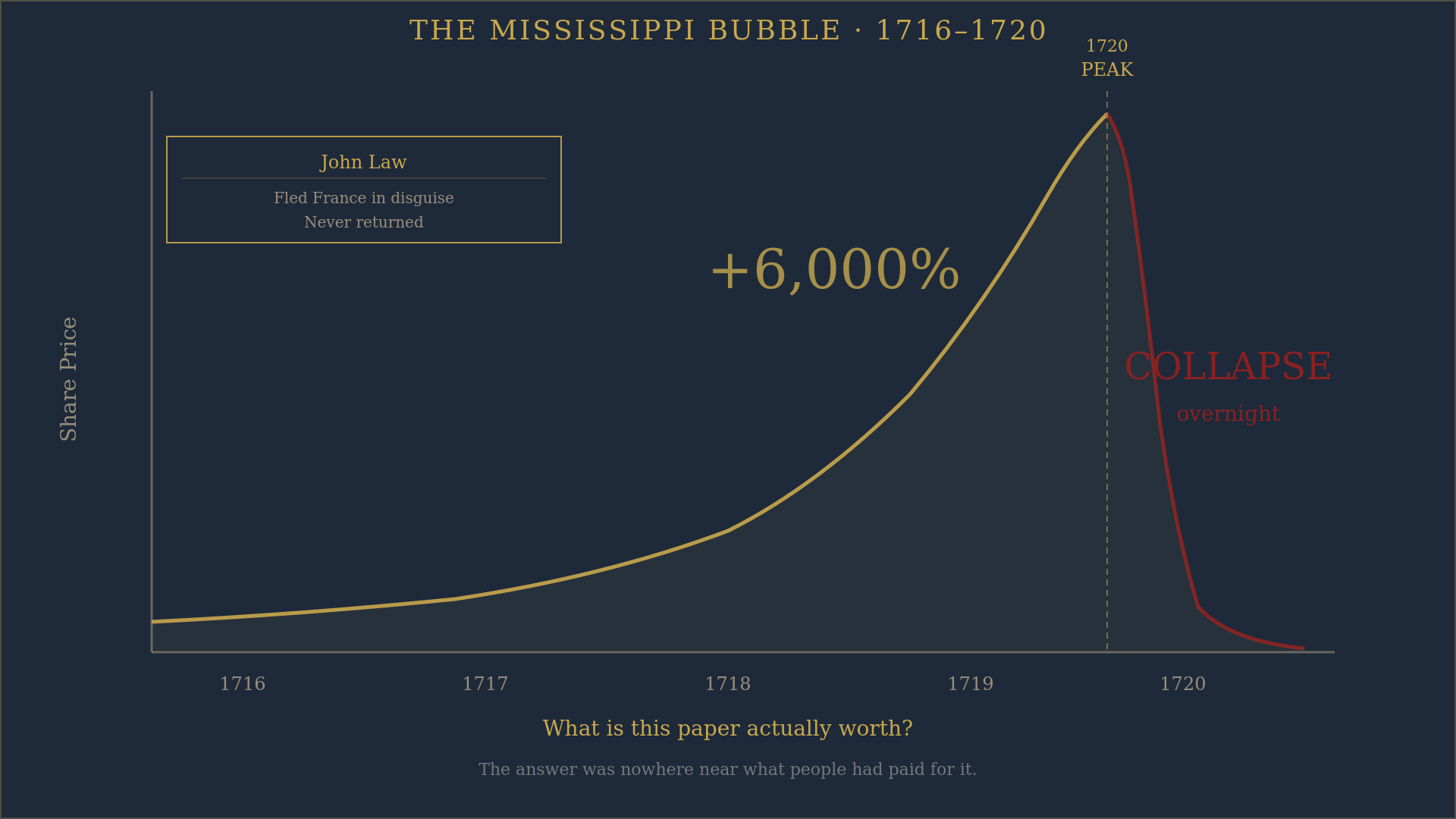
At its peak in January 1720, Mississippi Company shares traded at approximately 10,000 livres — twenty times their initial offering price. The word 'millionaire' entered the French language during this period, coined to describe those who had made their fortunes in the boom.
The Mania
What followed was the first modern stock market mania. Law used the Banque Royale to issue paper money, which investors used to buy Mississippi Company shares. Rising share prices attracted more investors. More investors required more paper money. The cycle fed itself. The rue Quincampoix in Paris — where share trading took place — became the scene of extraordinary scenes. People who arrived as modest merchants left as wealthy men. A man reportedly rented out his hunchback as a writing desk for traders who needed a surface for their contracts.
Law was, by 1719 and 1720, the most powerful man in France. He was simultaneously controller-general of finances, director of the Banque Royale, and head of the Mississippi Company. He had, in effect, merged the monetary system of France with a single speculative vehicle, and the vehicle was rising.
The Question That Destroyed the System
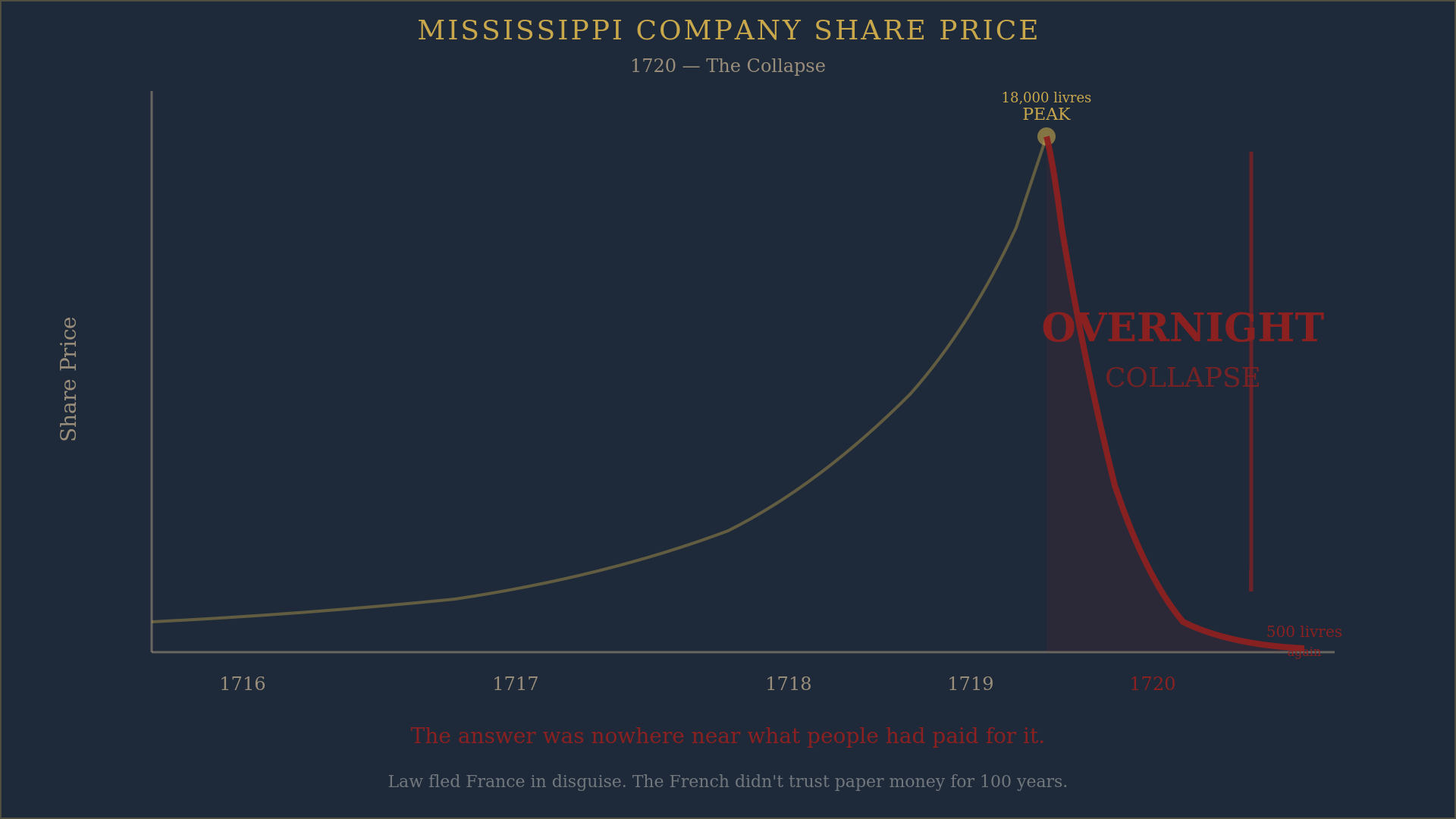
In early 1720, a senior French prince — the Prince de Conti — attempted to convert a large holding of Mississippi Company paper notes into gold coin. The Banque Royale could not meet his request in full. The news spread. Other large holders began attempting the same conversion. The bank could not honour all the requests.
Law, in a desperate attempt to maintain confidence, took a step that confirmed every fear it was meant to allay: he issued a decree making gold and silver coins no longer legal tender. Paper was henceforth the only valid currency. The message this sent was unambiguous: the paper system was in trouble, and the authorities were trying to make it impossible to escape. Confidence evaporated. Share prices, which had risen from 500 livres to 10,000 in three years, fell back to 500 in a matter of months.
Law was forced to flee France in disguise in December 1720. He died in Venice in 1729, having spent his final years gambling away what little remained of his once-enormous fortune.
Key Facts
- Period
- 1716–1720
- Peak share price
- ~10,000 livres (from initial 500)
- Peak-to-trough decline
- ~95%
- John Law's fate
- Fled France in disguise, December 1720. Died in Venice, 1729.
- Long-term consequence
- France did not adopt a central bank until 1800. Distrust of paper money persisted for nearly a century.
The Long Shadow
The Mississippi Bubble's most significant consequence was not the immediate economic damage — that was real but not catastrophic at the national level — but what it did to French financial culture for the next century. The French did not establish a permanent central bank until 1800. When paper currency was reintroduced during the French Revolution as the assignat, its rapid inflation was partly the consequence of a population that had learned, forty years earlier, that paper money could be worthless. The Banque de France, when it was finally established, faced considerable popular scepticism that traced directly to Law's system.
Meanwhile in Britain, the South Sea Bubble — which occurred in the same year and involved similar dynamics — had a shorter-term effect on British financial culture. Britain established the Bank of England earlier, had a more developed financial system, and absorbed the bubble's consequences more quickly. The divergence in financial development between Britain and France over the eighteenth century has a partial explanation in the different experiences of 1720.
What Historians Still Debate
The standard account treats Law's theory itself as fundamentally sound, undone by his own greed and overreach in execution. Some economic historians push back on this, arguing the theory contained a deeper flaw from the start: Law never adequately separated the state's need to finance its debts from the question of what the currency itself should actually be backed by. Under this reading, the system wasn't a good idea corrupted by ambition — it was structurally unstable from its first year, and collapse was less a matter of "if" than "when" and "how badly."
There's also genuine disagreement about how much personal blame Law deserves versus how much responsibility sits with the French court that empowered him. The regent Philippe d'Orléans handed Law extraordinary, unchecked authority — merging central banking, colonial development, and state finance under one man with no meaningful oversight — largely because France's alternatives looked even worse. Some historians treat Law as a reckless architect of his own downfall; others see him as a genuinely talented monetary theorist placed in an impossible position by a desperate state that needed a miracle and was willing to gamble everything on one man to get it.
Frequently Asked Questions
What was the Mississippi Bubble?
The Mississippi Bubble was a financial crisis in France between 1716 and 1720, triggered by John Law's monetary system. Law created a central bank and a trading company backed by French territories in Louisiana, used paper money to drive share prices to unsustainable levels, and triggered a collapse when the paper could not be converted to gold.
Who was John Law?
John Law was a Scottish economist who killed a man in a duel in 1694, escaped imprisonment, and spent two decades developing a theory about paper money before persuading the French regent to let him implement it. He briefly became the most powerful man in France before his system collapsed.
Was the Mississippi Company land real?
Louisiana was a real territory, but the wealth Law promised from it was imaginary. The colony had very few French settlers and almost no developed economic activity. The company's share price reflected expectations, not assets.
How does the Mississippi Bubble relate to later financial crises?
The basic structure of the Mississippi Bubble — a novel asset class, rapidly rising prices driven by expectations rather than fundamentals, paper money and credit expansion feeding the bubble, then sudden collapse when confidence fails — reappears in every subsequent financial bubble. The mechanism has not changed in three hundred years.
Enjoyed this?
New stories, hidden mechanisms and forgotten history, straight to your inbox every week.
A Note From The Editor
What I find interesting about John Law is that he was not a fraud in the conventional sense. He genuinely believed his theory about money. The theory was not wrong — it described, fairly accurately, how modern monetary systems work. What he missed was the fragility of collective belief: that a monetary system backed by expectations rather than gold can function as long as those expectations hold, and catastrophically fail the moment they don't. He built a system that was correct in theory and disastrous in practice.