The Planning Problem
Start with the question the Allies actually had to answer: how do you land a large enough force on a heavily defended coastline, keep it supplied, reinforce it fast enough to survive a counterattack, and then break out into occupied France — against an enemy that knows an invasion is coming and has had years to prepare defences for exactly that? Nobody had ever attempted anything at this scale before. There was no proven playbook to follow.
The lessons came the hard way, through earlier and much smaller amphibious operations in North Africa, Sicily, and Italy — each one exposing a different failure point. By 1944, those failure points had been studied and, mostly, solved. But one decision still had no established precedent: where, exactly, to land.
Here's the part that rarely gets enough attention. The shortest, most obvious crossing point was Pas-de-Calais — which is exactly why German defences there were the strongest in occupied France. Normandy was a longer, riskier crossing, but less heavily defended. Choosing it meant accepting a harder journey in exchange for a softer landing. That trade-off only worked if the Germans could be convinced the real invasion was still coming at Calais — which is where the story's first genuinely audacious gamble begins.
The Scale of Operation Overlord
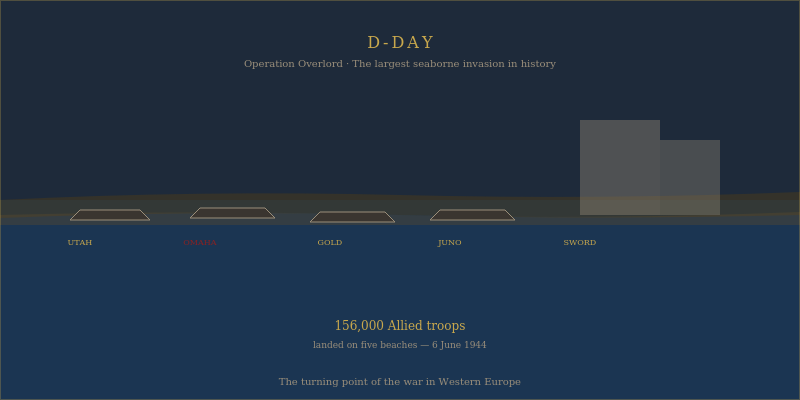
D-Day involved approximately 156,000 Allied troops, 5,000 ships and 11,000 aircraft. It remains the largest amphibious military operation in history. The operation was supported by years of planning, an extensive deception campaign, and air supremacy achieved through costly bombing campaigns in the preceding months.
The Weather Decision
Here's the moment the whole operation actually hinged on, and it isn't a battle. By early June 1944, roughly 150,000 men were loaded onto ships, keyed up and ready, when the weather turned. Supreme Allied Commander Dwight Eisenhower now faced a genuinely brutal choice with no good options: launch into poor conditions and risk a catastrophe at sea, or postpone — knowing that a delay of even a few days could unravel the secrecy the entire plan depended on, and that the next viable window of matching tides and moonlight was nearly two weeks away.
His meteorologists spotted something: a narrow, uncertain break in the weather on 6 June. Not a guarantee. A window. Eisenhower gave the order based on that window holding — a decision made with real uncertainty about whether it actually would.
This is the detail worth sitting with: Eisenhower didn't have better information than anyone else in that room. He had the same forecast, the same risk, the same fog of uncertainty. What made the decision "correct" wasn't superior insight — it was that he was the one person willing to commit to a call everyone else could only advise on. Historian Max Hastings has argued that this willingness to decide under genuine uncertainty, not any single tactical advantage, was as important to Overlord's success as anything that happened on the beaches themselves.
Planning begins in earnest
COSSAC plan developed. Normandy selected over Pas-de-Calais. Deception planning begins.
Eisenhower appointed
Eisenhower takes command of SHAEF. Montgomery commands ground forces. Planning intensifies.
D-Day postponed
Eisenhower postpones one day due to weather. Meteorologists identify brief improvement window for 6 June.
Operation Overlord begins
156,000 Allied troops land on five Normandy beaches. Airborne landings precede seaborne assault.
Paris liberated
Allied forces enter Paris. The breakout from Normandy has succeeded. France is being liberated.
The Five Beaches
Same day, same plan, same enemy — and five completely different outcomes. That's worth noticing before anything else. At Utah, American forces landed with surprisingly light resistance. At the British and Canadian beaches — Gold, Juno and Sword — the fighting was contested but the objectives, mostly, held. And then there was Omaha, where the entire operation nearly unravelled in a single morning.
Why did one beach out of five come this close to failing when the others didn't? Stack the factors together and the answer becomes clear: stronger-than-expected German defences, amphibious tanks that sank before reaching shore instead of providing cover, and a German division Allied intelligence hadn't even detected. Omaha wasn't secured because the plan worked there — it was held because small groups of soldiers, cut off from command and improvising under fire, refused to accept the ground was lost. That distinction matters, because it's the clearest evidence in the entire operation that success wasn't guaranteed by the plan alone.
What Made It Work
So if Omaha shows how close things came to failure, what actually kept the other four beaches — and eventually Omaha too — from unravelling completely? Not courage alone, though there was plenty of it. Two structural advantages did most of the real work, and neither of them happened on the beaches themselves.
The first was air supremacy, built over years of costly bombing campaigns, which crippled German supply lines just when Germany needed them most. The second was Operation Fortitude — the deception that convinced German commanders, including Hitler, that Normandy was a diversion. For weeks after the landings, Germany held back the armoured reserves that could have driven the beachheads back into the sea, still waiting for the "real" invasion at Calais that was never coming.
Put those two factors together and a pattern emerges: the actual outcome of D-Day was decided less by what happened on 6 June, and more by decisions and deceptions set in motion months earlier. The invasion succeeded because its hardest problems had already been solved before the first landing craft touched sand.
Key Facts
- Date
- 6 June 1944
- Beaches
- Utah, Omaha, Gold, Juno, Sword
- Allied forces landed
- ~156,000 on D-Day; 875,000 within first month
- Allied casualties D-Day
- Estimated 10,000–12,000 killed, wounded, missing
- Significance
- Largest seaborne invasion in history; decisive turning point in Western Europe
Why the Invasion Was Necessary
Step back from the beaches for a moment, because none of this happened in a vacuum. By the summer of 1944, one question had been hanging over the Allied relationship for three years: why hadn't Britain and America opened a real second front yet? Stalin had been asking, with growing impatience, since 1941. The Soviet Union was absorbing the overwhelming weight of the war against Germany — millions of lives lost on the Eastern Front — while the Western Allies waited.
That wait wasn't indecision. An amphibious invasion of heavily fortified coastline was one of the hardest operations in warfare to get right, and a failed attempt could have been catastrophic on every level — militarily, politically, for the alliance itself. Campaigns in North Africa and Italy bought valuable experience, but they also bought time, and time was exactly what Stalin was running out of patience over.
By 1944, the pieces the Allies had been missing were finally in place: air superiority achieved, an enormous force assembled in Britain, and Operation Fortitude ready to misdirect German attention. The invasion wasn't launched the moment it became possible — it was launched the moment every precondition for success had actually been met.
Omaha Beach: What Nearly Went Wrong
Come back to Omaha now, because this is where the whole operation's real vulnerability shows itself most clearly. Everything that could compound against a single beach, did. German defences here were stronger than intelligence had predicted. Most of the amphibious tanks meant to support the infantry sank in rough seas before ever reaching shore. Strong currents pushed landing craft away from their intended positions. And a full German division — one Allied intelligence hadn't detected at all — was waiting on the bluffs above.
The result was brutal: roughly 2,000 American casualties within the first hours alone. What actually turned the tide wasn't a plan reasserting itself — it was small groups of soldiers, cut off from their officers and improvising under fire, finding gaps in the German lines and pushing through anyway. The beach held by the end of the day. But it held on individual initiative, not on the strength of the plan that had been drawn up months before — which is exactly why Omaha remains the clearest evidence of how close the entire invasion came to a very different outcome.
D-Day Timeline
Frequently Asked Questions
Why did the Allies choose Normandy for the D-Day landings?
Normandy was chosen over the Pas-de-Calais because it was less heavily defended and offered better terrain for breakout into France. The deception operation Fortitude convinced German commanders that the main invasion would come at Pas-de-Calais, causing them to hold armoured reserves back even after the Normandy landings had begun.
How many soldiers landed on D-Day?
Approximately 156,000 Allied troops landed in Normandy on 6 June 1944, supported by 5,000 ships and 11,000 aircraft. Around 4,000 Allied soldiers died on D-Day itself, though estimates vary. Forces came from the United States, United Kingdom, Canada and other Allied nations.
Why did Omaha Beach have such high casualties?
Omaha faced stronger German defences than the other beaches, including more experienced troops. Rough seas disrupted the assault plan, many amphibious tanks sank before reaching shore, and the terrain gave German defenders a significant advantage. American forces came close to being driven back before establishing a foothold.
Max Hastings argues in Overlord that the campaign succeeded not despite its difficulties but because of decisions made under genuine uncertainty at every level — from Eisenhower's weather call to the initiative of junior officers on the beaches themselves. The full picture is more complex than any single account can cover.
What Historians Still Debate
The standard narrative treats Eisenhower's weather decision as a single, decisive moment — but historians disagree about how much genuine choice he actually had by 4 June. Some argue the political and logistical pressure to launch had become so overwhelming by that point that postponement beyond a few days was never realistically available, regardless of what the forecast said. Under this reading, the "decision" was less a live 50/50 gamble than a formal ratification of a course that circumstances had already largely fixed. Others maintain the opposite: that a genuinely available alternative — delaying until the next viable tidal window nearly two weeks later — carried its own catastrophic risk of discovery, meaning Eisenhower's choice was every bit as consequential as the traditional account suggests.
There is a similar disagreement over Omaha Beach. The traditional account emphasises German defensive strength and Allied bad luck — the sunken tanks, the misidentified division. A revisionist strand of scholarship argues that planning failures on the Allied side were at least as significant: pre-invasion bombing had largely missed the beach defences, and the decision to launch amphibious tanks in rough seas several miles offshore reflected an avoidable misjudgement rather than pure misfortune. Neither position fully displaces the other; most serious historians now treat Omaha's near-failure as the product of several compounding factors rather than any single decisive cause.
A Note From The Editor
What I find most instructive about D-Day is not the scale — though the scale is extraordinary — but the decision chain underneath it. The deception that held German reserves back. The weather call made with incomplete information. The near-disaster at Omaha that didn't become a disaster. Every consequential decision in the operation was made under conditions of genuine uncertainty by people who could not know the outcome. That is true of most important decisions in history — and it is worth remembering when we judge them in hindsight.