What the Plan Required
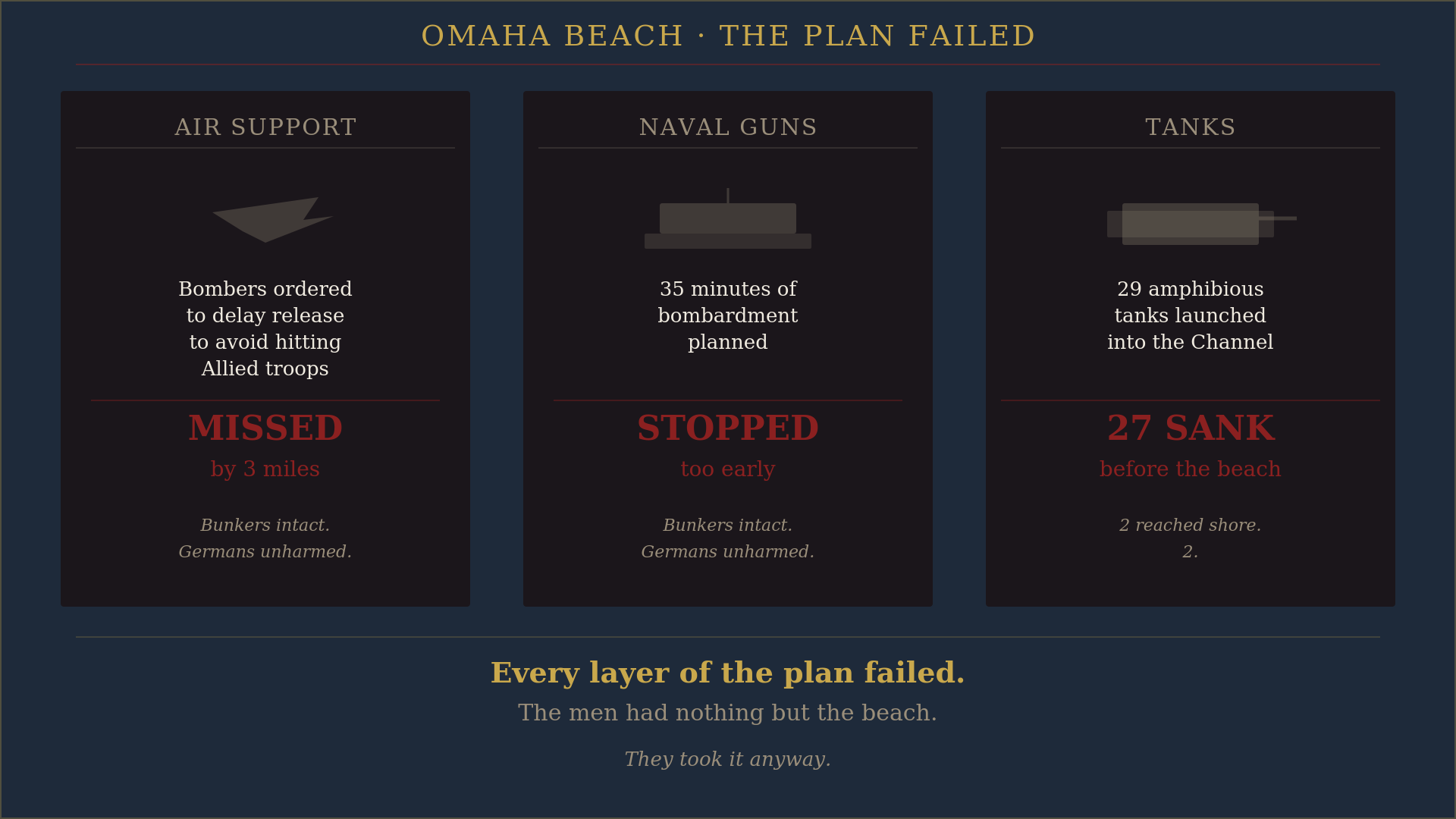
The Allied plan for Omaha Beach was, on paper, thorough. Heavy bombers would arrive before dawn and saturate the beach defences. Naval guns would maintain a continuous bombardment until moments before the landing craft arrived. Amphibious tanks — DD Shermans equipped with flotation screens — would accompany the first infantry waves, providing armoured fire support from the moment the ramps went down. Engineers would clear beach obstacles before the main body landed.
Almost none of it worked.
The bombers, flying blind through cloud, delayed their releases to avoid hitting the landing craft below. The bombs fell two to three miles inland. The beach defences were untouched. The naval bombardment, though intense, stopped more than thirty minutes before the first landing craft arrived — time enough for the German defenders to emerge from their shelters and man their weapons. Twenty-seven of the twenty-nine amphibious tanks launched into four-foot Channel swells sank within minutes of leaving their landing craft. The flotation screens that were supposed to hold them up were not designed for those conditions. Two tanks reached the shore.
The men who landed at Omaha had nothing that was supposed to be there. They had a beach, and German machine guns with a clear field of fire across every inch of it.
The Scale of Failure
Of 29 DD tanks launched at Omaha, 27 sank before reaching shore. The bombers missed the beach defences by 2-3 miles. The naval bombardment stopped 35 minutes before H-Hour. By mid-morning, senior commanders were considering abandoning the beach entirely.
The First Waves
The landing craft carrying the first assault waves had been circling in heavy seas for hours before H-Hour. Many men were seasick. The LCVPs — the flat-bottomed Higgins boats — were taking water. The beach was obscured by smoke and haze from the bombardment. Currents pushed craft eastward from their designated landing zones.
The ramps went down. The men who survived described what happened next in similar terms: a wall of fire. German machine gun positions, particularly the strongpoints at the mouths of the draws — the gullies leading off the beach through the bluffs — could sweep the beach laterally. Men were hit in the water before they reached the shore. Men were hit stepping off the ramps before they entered the water. Of Company A, 116th Infantry Regiment, which landed almost directly in front of a strongpoint at Dog Green sector, the company had lost most of its officers and a third of its men within minutes. Within twenty minutes, it had effectively ceased to exist as a fighting unit.
The survivors reached the shore and found whatever cover was available: beach obstacles, the bodies of the dead, a narrow seawall at the back of the beach. From the seawall, the bluffs above were a hundred and fifty to a hundred and seventy feet high, topped by German positions. Moving forward meant crossing open ground under fire. Staying meant waiting to be killed.
What Changed the Situation
The breakthrough at Omaha came from below, not above. There was no single command decision that turned the battle. Senior commanders were offshore, unable to see clearly what was happening, with communications unreliable and the situation chaotic. What changed the situation was a series of independent decisions by small groups of men — junior officers, sergeants, and in some cases ordinary soldiers acting without any officer — who identified routes up the bluffs and started climbing.
The German positions had been designed to repel a frontal assault. They were not well positioned to deal with attackers who had climbed around and above them. As small groups cleared German positions from the rear, the fire on the beach diminished. More men moved. More positions fell. By mid-afternoon, the situation had changed from potential catastrophe to contested victory.
Brigadier General Norman Cota, assistant division commander of the 29th Infantry Division, landed in the second wave and moved along the beach under fire, personally pushing men forward. His reported words — "Two kinds of people are staying on this beach, the dead and those who are going to die. Now let's get the hell out of here" — may be as accurately quoted as anything spoken that day.
Key Facts
- Date
- 6 June 1944
- Formation
- US 1st Infantry Division and 29th Infantry Division
- Beach length
- Approximately 5 miles
- US casualties on D-Day
- Approximately 2,000 killed, wounded, or missing
- DD tanks reaching shore
- 2 of 29 launched
- German division
- 352nd Infantry Division — not previously identified by Allied intelligence
Why Omaha Was Different
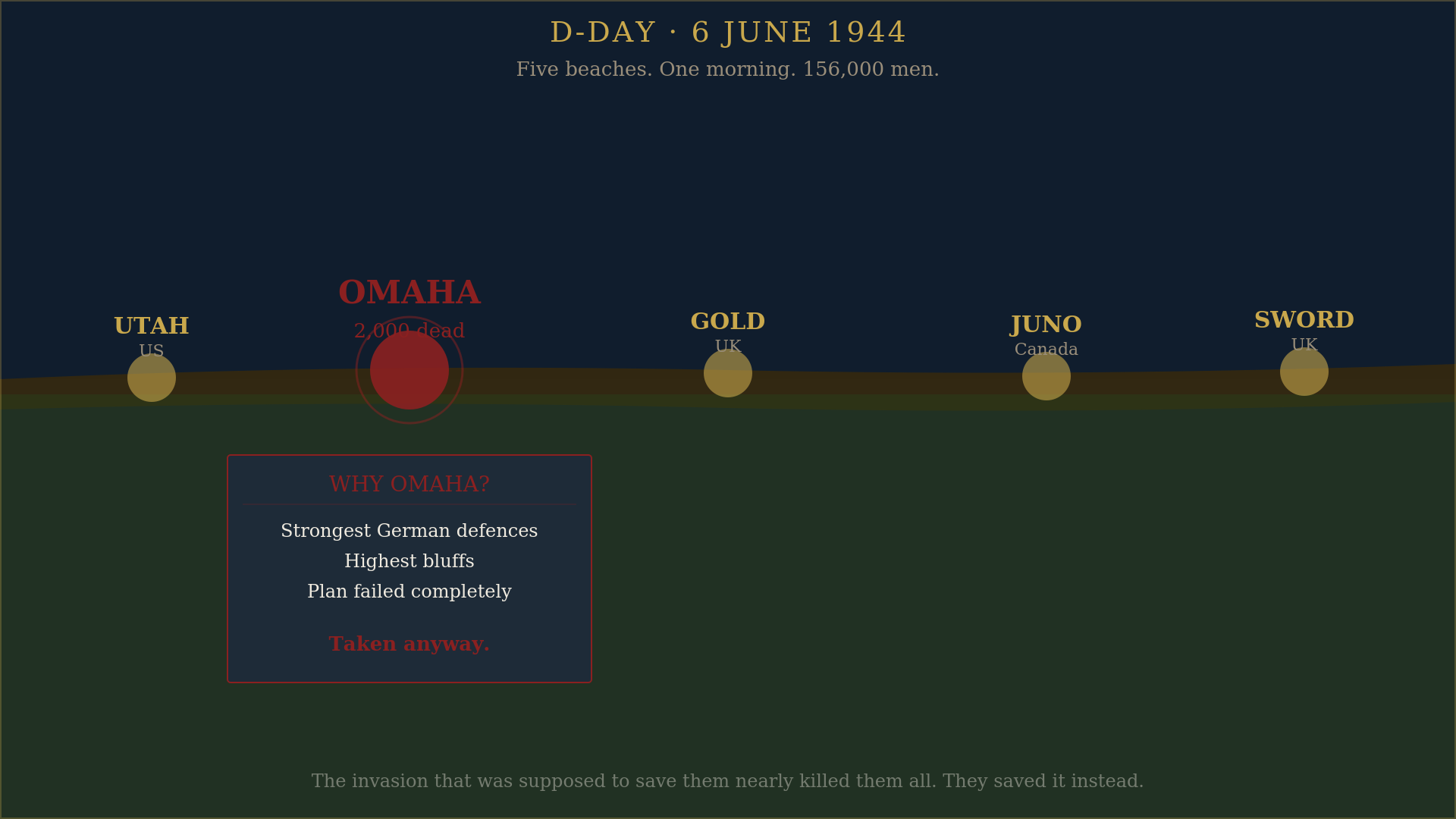
The other four D-Day beaches — Utah, Gold, Juno, Sword — also saw casualties and confusion, but none came as close to outright failure as Omaha. Several factors combined to make Omaha uniquely dangerous. The beach was overlooked by bluffs that gave defenders a commanding view and field of fire. The German 352nd Infantry Division, a more experienced formation than the coastal defence units the Allies had expected, had moved to the area in the weeks before D-Day and had not been identified by Allied intelligence. The terrain — the beach, the obstacles, the bluffs — gave the defenders enormous advantages that the failure of the supporting plan left fully intact.
Had the bombers hit the defences, or the tanks arrived, the story might have been different. Counterfactuals in military history are always uncertain. What is not uncertain is that the men who took Omaha did so with almost none of the support that had been planned for them.
What Historians Still Debate
The standard account treats the missed bombing and the sunken tanks as bad luck compounding bad luck — a chain of misfortune nobody could have reasonably foreseen. A more critical strand of scholarship pushes back on that framing. The decision to launch the DD tanks several miles offshore in four-foot swells wasn't an unpredictable accident; naval officers on the scene had genuine reservations about conditions before launch, and the choice to proceed anyway reflected a judgement call under pressure, not simple misfortune. Under this reading, at least part of Omaha's near-catastrophe was a planning failure the Allies made themselves, not one imposed on them by weather or chance.
There's also genuine disagreement over how much credit the "bottom-up" breakthrough deserves versus how much Omaha would have stabilised regardless, once German ammunition and manpower began to run down over the course of the day. Some historians argue the small-group breakthroughs were the decisive factor; others suggest they mattered less than the sheer weight of numbers the Allies kept feeding onto the beach, which German defenders — however well positioned — could never have held back indefinitely. Both explanations can be partly true at once, which is precisely why the debate hasn't settled.
Frequently Asked Questions
Why was Omaha the bloodiest D-Day beach?
Omaha combined the strongest German defences, a defender-favourable terrain, the failure of nearly every element of the supporting plan, and the unexpected presence of an experienced German division. American forces landed with almost no armoured support and faced intact bunkers and machine gun positions with clear lines of fire across the beach.
How many soldiers died at Omaha?
Approximately 2,000 American soldiers were killed, wounded, or missing at Omaha Beach on 6 June 1944 — more than at all the other beaches combined.
Why did the DD tanks sink?
The DD Shermans were equipped with flotation screens designed for calmer water than the four-foot swells present on 6 June. Of 29 launched, 27 sank. The two that made it were launched from closer to shore than the others.
What turned the battle at Omaha?
Small groups of men — acting independently, without orders from above — began finding routes up the bluffs and flanking German positions. There was no single turning point from command level. The beach was taken by accumulated individual initiative.
Enjoyed this?
New stories, hidden mechanisms and forgotten history, straight to your inbox every week.
A Note From The Editor
The detail about Company A of the 116th Infantry — nearly destroyed in the first twenty minutes — is not often foregrounded in the broader D-Day narrative, which tends to focus on the eventual success. But it represents what actually happened to many men that morning: they landed, they were immediately under fire, and within minutes their unit had ceased to function. That the beach was taken despite this is not a vindication of the plan. It is a tribute to what people do when the plan runs out.