The Panzer Debate
The disposition of German armoured forces in France before D-Day was the subject of a fundamental disagreement between two of Germany's most capable commanders. Erwin Rommel, commanding Army Group B, believed the decisive moment would come on the beaches. Allied air superiority was so overwhelming, he argued, that armoured formations attempting to move to the front in daylight would be destroyed from the air before they arrived. The Panzers had to be positioned forward, close to the likely landing beaches, and committed within hours of the first landings.
Gerd von Rundstedt, Commander-in-Chief West, disagreed. He believed in the classic military doctrine of mobile reserve: hold the Panzers back, wait to see where the main Allied effort fell, then commit them in overwhelming force to the decisive point. Committing too early — to what might be a feint — would waste irreplaceable armoured strength.
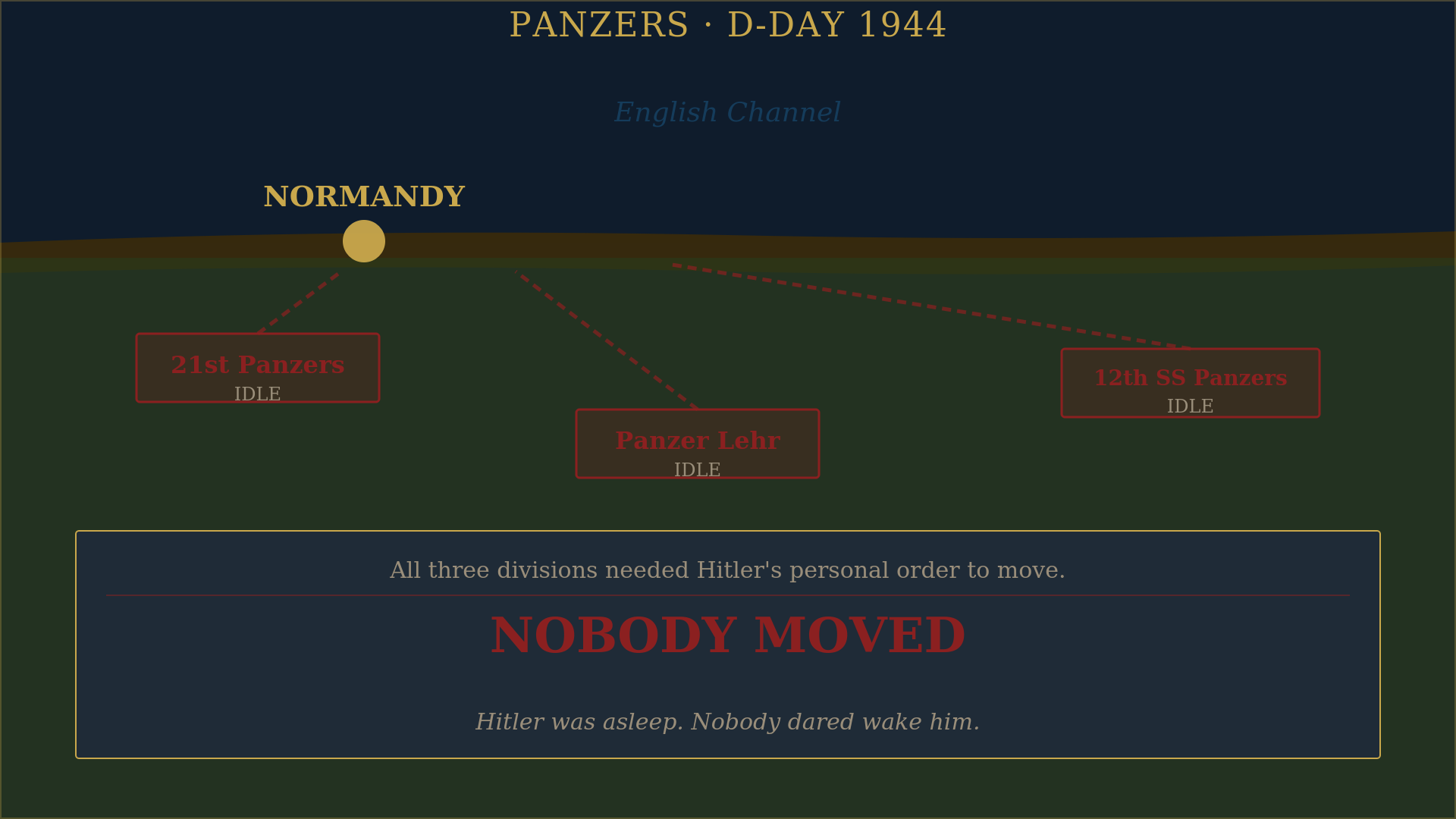
Hitler, characteristically, sided with neither position entirely. He agreed to hold several Panzer divisions as OKW reserve — meaning they could not be committed without his personal authorisation. On the night of 5 to 6 June 1944, three of the most powerful armoured formations in France were under this restriction: the Panzer Lehr Division, the 12th SS Panzer Division, and elements of the 1st SS Panzer Corps.
The Night of 5 June
Hitler had taken sedatives on the evening of 5 June and retired to Berchtesgaden. The Allied paratroopers began dropping on Normandy shortly after midnight. Reports began reaching German headquarters: paratroopers here, paratroopers there, landings at multiple points, confused and contradictory intelligence. The pattern was partly the result of the scattered American drops — many paratroopers had landed miles from their intended zones — and partly the result of Operation Fortitude, which had conditioned German intelligence to expect complexity and ambiguity in any initial Allied action.
As the scale of the beach landings became apparent in the early morning, Rommel's headquarters began requesting release of the OKW Panzer reserves. The request went up the chain. It reached Hitler's headquarters. His aides were aware of his sedative use and his volcanic temper when woken. They declined to disturb him.
The Critical Window
Military analysts generally agree that the first 12-24 hours after the Normandy landings represented the period in which a determined armoured counterattack had the best chance of pushing the Allies back. It was during precisely this window that the OKW Panzer reserves sat immobile, awaiting a telephone call that didn't come.
Hitler Wakes
Hitler was briefed on the landings around mid-morning. His initial reaction was scepticism: this, he believed, was the diversion the Allies had been preparing. Operation Fortitude had done its work well. German intelligence — fed a continuous diet of false information by double agents including GARBO — had been predicting a main effort at Pas-de-Calais. A landing at Normandy fitted perfectly into the deception narrative: draw the reserves to Normandy, then strike at Calais.
The Panzer Lehr and 12th SS were finally released in mid-afternoon. By then, Allied air power was operating freely over Normandy. The Panzer Lehr Division, which had to move by day, was attacked repeatedly from the air on its approach march and arrived in the combat zone having already lost significant vehicles and materiel. By the time German armour arrived in strength, the Allied beachhead was consolidating. The window that Rommel had been most afraid of — the hours when an immediate armoured response might have been decisive — had closed.
The System Problem
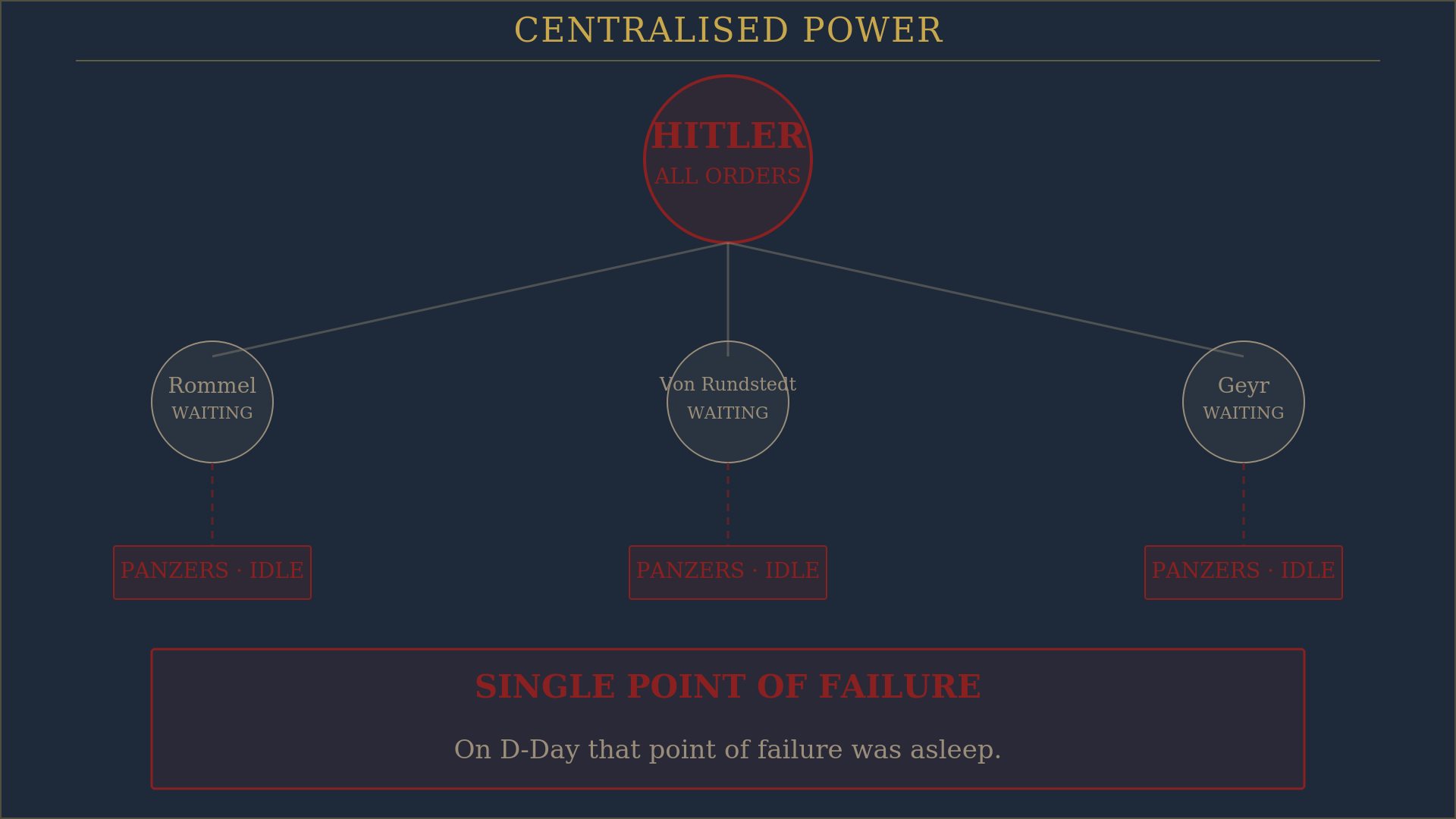
The events of 6 June 1944 illustrate what happens when decision-making authority is concentrated in a single individual without adequate provision for that individual's incapacity. The German command system in France had a fundamental structural flaw: the most powerful offensive formations in the theatre could not be committed without Hitler's personal authorisation, and Hitler was in some respects the least reliable node in the system. His strategic judgment was deteriorating. He was subject to medical interventions that affected his mental state. He was geographically remote from the front. And his subordinates were, by 1944, too afraid of his temper to challenge his decisions effectively.
Von Rundstedt, on being told on the evening of D-Day that his request to commit the Panzers had been denied by OKW, reportedly responded: "What does it matter? You might as well give them a role of toilet paper. They have no real authority."
A system designed for a supremely capable decision-maker becomes catastrophically fragile when the decision-maker is absent, incapacitated, or wrong. The Wehrmacht in 1944 was discovering this at the worst possible moment.
Key Facts
- OKW Panzer divisions, 6 June
- Panzer Lehr, 12th SS Panzer, 1st SS Panzer Corps elements
- Time of release authorisation
- Approximately 1600 hours — 10 hours after beach landings began
- Hitler's location on D-Day morning
- Berchtesgaden, Bavaria
- Reason Panzers not released earlier
- Hitler asleep; aides declined to wake him; then Hitler believed Normandy was a feint
- Effect of delay
- Allied beachhead secured before armoured counterattack could be mounted
What Rommel Said
Rommel was in Germany on 6 June, visiting his wife for her birthday. He had believed an invasion was unlikely that day due to the weather conditions, and had judged it safe to leave his post. When he was reached by telephone and told the invasion had begun, he reportedly said simply: "How stupid of me."
The absent Rommel, the sleeping Hitler, the refused telephone calls, the held Panzers — all of them flowing from the same structural feature of German command in 1944: every important decision required one man, and that man was not available. D-Day succeeded, in part, because the German system had a single point of failure — and on 6 June, that point failed.
Frequently Asked Questions
Why didn't Germany use its Panzer divisions on D-Day?
The most powerful Panzer divisions in France were held as OKW reserve, requiring Hitler's personal authorisation to move. When the landings began, Hitler was asleep and his aides declined to wake him. When he was finally briefed, he initially believed Normandy was a diversion and held the reserves back.
Where was Rommel on D-Day?
Rommel was in Germany visiting his wife for her birthday. He believed an invasion was unlikely that day due to weather conditions and judged it safe to be away. He returned to France on the morning of 6 June.
Could Germany have defeated D-Day?
Most historians believe a rapid commitment of the Panzer reserves in the first hours offered Germany its best chance of pushing the Allies back. Whether it would have been decisive is debated — Allied air superiority would have made daytime movement costly regardless.
What was the Rommel vs Von Rundstedt disagreement?
Rommel wanted Panzers positioned close to the beaches and committed immediately upon any landing, arguing air superiority made later movement impossible. Von Rundstedt wanted a mobile reserve committed only once the main Allied effort was clear. Hitler's compromise — holding reserves under OKW control — satisfied neither view.
Enjoyed this?
New stories, hidden mechanisms and forgotten history, straight to your inbox every week.
A Note From The Editor
The Von Rundstedt quote — 'You might as well give them a roll of toilet paper' — captures something important about the state of German command by mid-1944. The officers who had built the Wehrmacht into the most effective fighting force in Europe had, by this point, largely stopped believing that their decisions mattered. The structure that Hitler had created — centralised, personal, subject to his whims — had made genuine military planning difficult. D-Day exposed how fragile that structure had become.