
The Cold War Context
The MKUltra programme was born from a specific fear: that the Soviet Union had developed techniques for controlling human behaviour that the United States had not. American prisoners of war returning from Korea in the early 1950s had made public confessions of crimes they had not committed. Some appeared to have been genuinely persuaded. Others seemed to have had their personalities fundamentally altered. The question for American intelligence was not whether "brainwashing" worked — the evidence suggested it might — but whether it could be countered, and whether the United States could develop its own version.
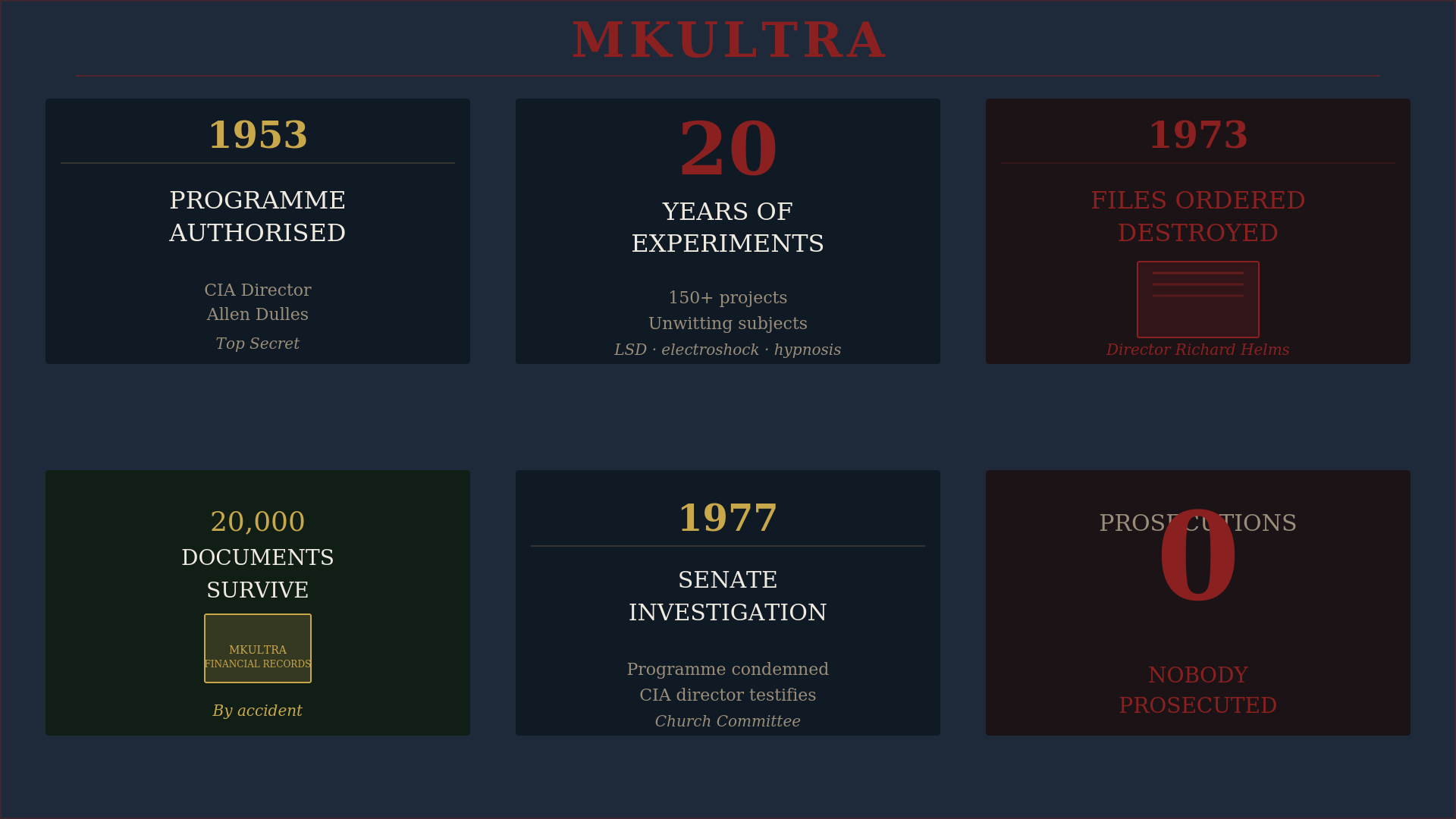
CIA Director Allen Dulles authorised MKUltra in April 1953. The programme was placed under the direction of Sidney Gottlieb, a chemist in the Technical Services Division. Its mandate was broad: to investigate the use of chemical, biological, and radiological materials in modifying human behaviour, extracting confessions, and enhancing interrogation. Its methods were constrained by nothing beyond what Gottlieb and his colleagues thought the ends required.
What Actually Happened
MKUltra encompassed approximately 150 separate research projects conducted at 80 institutions including universities, hospitals, prisons, and CIA safe houses. The subjects included prisoners who were told they were participating in cancer research, mental patients who were not told they were participating in anything, soldiers who were ordered to take part, and ordinary members of the public who had no idea what was happening to them.
The central substance was LSD, which Gottlieb and others believed might be useful for inducing states of confusion, compliance, or revelation. It was administered in doses far above what any legitimate researcher would have considered ethical — sometimes without the subject's knowledge, sometimes repeatedly over extended periods. The effects ranged from temporary disorientation to permanent psychological damage.
LSD was not the only tool. Subjects were subjected to sensory deprivation, to days without sleep, to hypnosis, to electroconvulsive shock far beyond clinical doses, to combinations of drugs designed to produce what researchers called "depatterning" — the erasure of existing personality as a precondition for implanting new beliefs. Some of these techniques were developed at McGill University in Canada under Ewen Cameron, funded through a CIA front organisation. Cameron's work on "psychic driving" — the repeated playing of recorded messages to subjects kept in induced sleep for weeks — is among the most disturbing in the MKUltra record.
The Death of Frank Olson
Frank Olson was a US Army biological warfare scientist who, in November 1953, was given LSD without his knowledge at a CIA retreat. He suffered a severe psychological reaction. Nine days later, he fell from a tenth-floor New York hotel room. His death was ruled suicide. Decades later, his family obtained a second autopsy which found injuries inconsistent with a fall — suggesting he may have been pushed. No one has been prosecuted.
The Destruction of Evidence
In January 1973, facing the prospect of Senate investigations, CIA Director Richard Helms ordered all MKUltra files destroyed. Most were. The programme might have remained entirely secret if not for a filing error: approximately 20,000 documents related to MKUltra's financial records had been stored in a separate records facility and were not destroyed. A Freedom of Information Act request in 1977 uncovered them.
The existence of these documents led to Senate hearings that year, at which Helms testified that the programme had indeed existed and had been ended. He could not fully account for what it had done, because most of the records no longer existed. The subjects who had been harmed could not be fully identified, because the documentation was gone. The researchers who had conducted the experiments faced no criminal charges, because the statute of limitations had expired and because, in any case, much of what they had done was classified as having occurred in the service of national security.
Nobody went to prison.
What Was Achieved
The honest answer to what MKUltra achieved — in terms of its stated scientific goals — is very little. The programme's core premise, that mind control through drugs or other techniques was achievable, was never validated. LSD did not produce reliable compliance or truth-telling. Sensory deprivation and sleep deprivation produced confusion and distress, but not the kind of controllable altered states that Gottlieb had hoped for. The techniques that came closest to producing the desired effects — Ewen Cameron's "depatterning" — caused severe and lasting damage to the subjects without producing any useful intelligence capability.
What MKUltra produced instead was harm: to the individuals subjected to its experiments without consent, to their families, to the institutions that hosted it, and to the public trust in government and science that the exposure of the programme damaged.
Key Facts
- Period
- 1953–1973
- Authorised by
- CIA Director Allen Dulles
- Programme director
- Sidney Gottlieb
- Research projects
- Approximately 150
- Institutions involved
- 80, including universities and hospitals
- Files destroyed
- January 1973, on orders of CIA Director Richard Helms
- Prosecutions
- None
The Mechanism: Oversight Failure
MKUltra happened not because the CIA was populated by uniquely evil people, but because the programme operated outside any meaningful oversight structure. Congress did not know about it. The relevant government departments did not know about it. The institutions that hosted the research were not always told what they were participating in. The subjects certainly were not told.
The absence of oversight — of an external party with the authority and the information to say "this is wrong" — did not cause the programme's designers to do wrong things. It meant there was no mechanism to prevent wrong things from being done. The people running MKUltra convinced themselves that the ends justified the means, that national security required the sacrifice of individual rights, that the knowledge gained was worth the harm caused. Without anyone positioned to challenge these convictions, they were free to act on them for twenty years.
This is not a flaw unique to intelligence agencies. It appears wherever institutions operate without adequate external scrutiny: in financial institutions before 2008, in religious organisations, in corporate boards, in government departments. The mechanism is always the same. Institutions that operate without oversight develop their own moral logic, and that logic gradually detaches from the moral standards that external scrutiny would enforce.
What Historians Still Debate
Frank Olson's death remains formally unresolved. The 1953 ruling of suicide stood unchallenged for over two decades, until a 1994 exhumation and second autopsy — commissioned by his family — found a head injury inconsistent with an accidental fall, along with the absence of glass fragments one would expect from a body going through a closed window. The family has argued for decades that Olson was killed because he intended to reveal details of the CIA's biological and chemical weapons work, not merely because of a bad drug reaction. The CIA has never conceded murder, and no prosecution has followed; the case remains one of the very few instances where MKUltra's cover-up may have extended to something more than paperwork.
There is also genuine disagreement over how to weigh MKUltra against the broader Cold War intelligence effort. Some historians treat it as an isolated moral catastrophe, unrepresentative of the CIA's work as a whole. Others argue it fits a wider pattern of unaccountable Cold War-era programmes — including domestic surveillance under COINTELPRO and various unauthorised human radiation experiments conducted by other US agencies in the same decades — suggesting MKUltra was less an aberration than a particularly well-documented example of a much broader institutional culture that treated national security as justification for almost anything.
Frequently Asked Questions
What was MKUltra?
MKUltra was a CIA research programme, active from 1953 to 1973, that investigated techniques for controlling human behaviour, including the use of LSD and other drugs, hypnosis, sensory deprivation, and electroconvulsive therapy. Subjects included unwitting civilians, prisoners, and mental patients.
Was MKUltra legal?
Many of MKUltra's activities violated domestic and international law, including laws protecting research subjects from non-consensual experimentation. No prosecutions resulted, partly because most records were destroyed and partly because of statutes of limitation.
Who was Sidney Gottlieb?
Sidney Gottlieb was the CIA chemist who directed MKUltra from its founding in 1953. He personally approved and oversaw many of the programme's most controversial experiments. He retired from the CIA in 1972 and died in 1999 without facing criminal charges.
What happened to the victims of MKUltra?
Most MKUltra subjects were never identified, because the records were destroyed. Some who were identified received financial settlements from the US and Canadian governments. The Canadian government paid $750,000 to victims of Ewen Cameron's experiments at McGill University.
Enjoyed this?
New stories, hidden mechanisms and forgotten history, straight to your inbox every week.
A Note From The Editor
The Frank Olson case is where MKUltra stops being institutional history and becomes something more personal. A man given LSD without his knowledge. A severe psychological reaction. A death that may not have been suicide. Decades of official silence. A family that has spent fifty years trying to find out what happened to their father. Whatever MKUltra was meant to achieve strategically, Frank Olson's family is a reasonable measure of what it actually cost.