The Problem of Risk
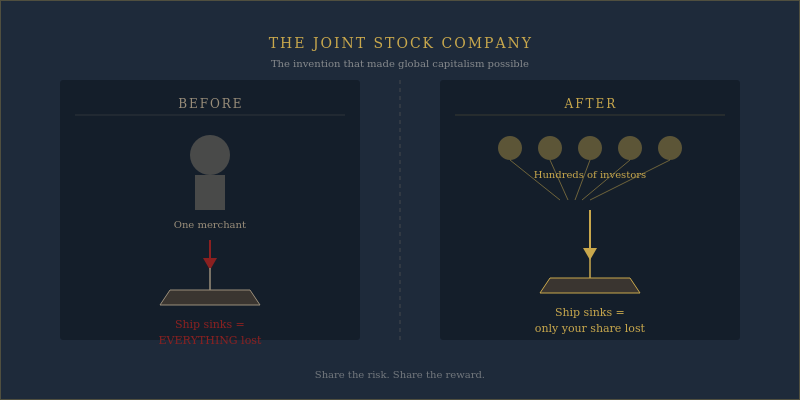
Before the joint stock company existed, financing a major trading voyage required one person — or one family, or one partnership — to bear the entire risk. A single ship, a single voyage, a single storm, and everything was gone. This was not merely financially ruinous; it was a genuine constraint on what was economically possible. Some voyages were simply too expensive, too long, or too risky for any individual to finance.
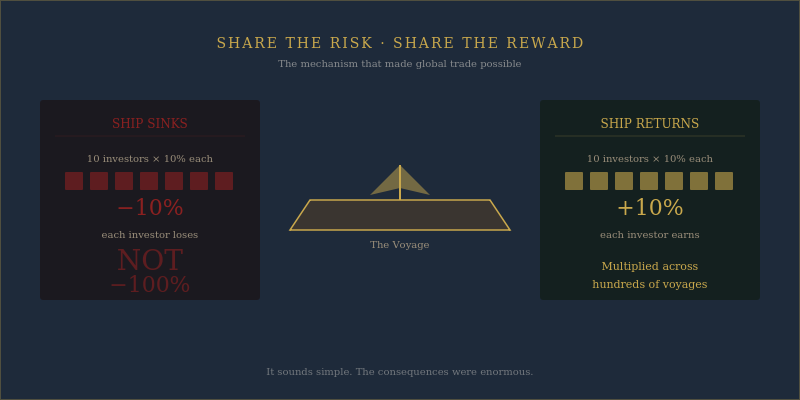
The joint stock company solved this problem by distributing it. Instead of one investor bearing all the risk, many investors could each purchase a share of the enterprise. If the ship sank, each lost only their proportional investment. If it returned with a profitable cargo, each received their proportional share of the profit. The mathematics were straightforward. The consequences were not.
Early Experiments
The idea of shared commercial ventures predates the joint stock company by centuries. Medieval trading partnerships — the commenda in Italian commerce — involved one party providing capital and another providing labour, with profits split according to agreement. The Hanseatic League, the great trading network of northern Europe, created complex arrangements for shared commercial risk.
What distinguished the joint stock company of the sixteenth and seventeenth centuries was the formal issuance of transferable shares and, crucially, the concept of limited liability. In a partnership, each partner was potentially liable for all the debts of the enterprise. In a joint stock company, each investor's liability was limited to their investment. This was a profound innovation: it meant that a wealthy individual could invest in a risky venture without risking bankruptcy if it failed.
The First Joint Stock Companies
The Muscovy Company, chartered in 1553 to trade with Russia, is often cited as the first true English joint stock company. The Dutch East India Company (VOC), established in 1602, was the first to issue shares that could be freely bought and sold on a secondary market — the first stock exchange.
The Dutch East India Company
The Dutch East India Company — the VOC, from its Dutch name Vereenigde Oostindische Compagnie — was established in 1602 as a merger of competing Dutch trading ventures in Asia. Its charter gave it extraordinary powers: the right to make treaties, wage war, establish colonies, and administer justice in the territories it controlled. It was not merely a company. It was, in the territories where it operated, a government.
The VOC's share capital — raised through the public sale of shares to Dutch citizens — was enormous by the standards of the time. Its shares were freely tradeable on the Amsterdam stock exchange, which had been established specifically to accommodate this secondary market. The price of VOC shares, rising and falling with the company's fortunes and with investor sentiment, is the first recorded stock price history in the world.
At its peak in the mid-seventeenth century, the VOC was the wealthiest company that has ever existed, measured in inflation-adjusted terms. It maintained a fleet of more than 150 merchant ships and 40 warships. It employed 50,000 sailors, 10,000 soldiers, and 15,000 civilians. It paid dividends to shareholders for nearly two centuries.
What the Corporate Form Made Possible
The joint stock company with limited liability made possible enterprises that would otherwise have been impossible to finance: long-distance ocean trade, colonial settlement, canal building, railway construction. These were ventures that required more capital than any individual or partnership could provide, carried more risk than anyone could prudently accept without limited liability, and had time horizons longer than any individual would rationally commit to without the ability to sell their stake.
The railway mania of the 1840s illustrates both the productive potential and the speculative dangers of the corporate form. Between 1844 and 1847, the British Parliament approved more than two hundred railway projects, most of which were financed through public share subscriptions. Some produced genuine economic value — the Victorian railway network transformed British commerce and society. Others were fraudulent schemes that transferred money from investors to promoters. The corporate form had enabled both.
A Company With Its Own Army
The most extreme example of what the joint stock company could become is not a comfortable one. The British East India Company — EIC — evolved from a trading enterprise into something closer to a sovereign state. At its peak in the late eighteenth and early nineteenth centuries, it governed more than 200 million people, maintained an army of 260,000 soldiers — larger than the British Army itself — and administered justice, collected taxes, and made foreign policy across most of the Indian subcontinent.
The EIC's power rested ultimately on its shareholders and its charter from the British Crown. It was, legally speaking, a private company. The implications of this — that a private company could conquer and govern a subcontinent — troubled even contemporaries. Edmund Burke spent years in Parliament attempting to hold the Company accountable. The Indian Rebellion of 1857 finally prompted the British government to dissolve the Company and assume direct sovereignty over India. The corporate form had been used to build an empire, and the empire then had to be reclaimed from the corporation.
Key Facts
- First English joint stock company
- Muscovy Company, 1553
- First freely traded shares
- VOC (Dutch East India Company), 1602
- VOC at peak (inflation-adjusted)
- Estimated $7.9 trillion — largest company in history
- EIC army at peak
- ~260,000 soldiers (larger than British Army)
- Population governed by EIC
- 200+ million at peak
The Mechanism That Changed Everything
The joint stock company's contribution to economic history is not primarily the specific companies it produced — the VOC, the EIC, the railway companies — but the general mechanism it created. By separating investment from management, distributing risk across many shareholders, and making investments liquid through secondary markets, it created a system for mobilising capital at scale that had not previously existed.
Every large corporation that exists today — every manufacturer, every technology company, every bank — is built on the foundation that the joint stock company established. The ability to raise capital from many investors, shield those investors from unlimited liability, give management professional autonomy from ownership, and allow investors to exit through secondary markets: these are the features that the seventeenth century invented and that the twenty-first century continues to rely on.
Share risk. Share reward. The idea is simple. The consequences are still unfolding.
Frequently Asked Questions
What is a joint stock company?
A joint stock company is a business entity in which ownership is divided into shares that can be bought and sold. Each shareholder owns a proportion of the company proportional to their shares, and their liability is limited to the value of their investment — not the company's total debts.
When was the first joint stock company?
The Muscovy Company, established in England in 1553, is often cited as the first joint stock company. The Dutch East India Company (1602) was the first to issue freely tradeable shares on a secondary market.
What is limited liability?
Limited liability means that an investor in a company can only lose the value of their investment if the company fails — they cannot be pursued for the company's other debts. This feature, which was not always present in early joint stock companies, is now a standard feature of corporations worldwide.
How did the joint stock company lead to colonialism?
Joint stock companies like the Dutch East India Company and the British East India Company used corporate capital and limited liability to finance trading expeditions and, eventually, colonial administration. The EIC governed most of India for nearly two centuries as a private company.
Enjoyed this?
New stories, hidden mechanisms and forgotten history, straight to your inbox every week.
A Note From The Editor
The East India Company is the detail that I think most dramatically illustrates what the corporate form could become. A private company — answerable to its shareholders in London — governing a subcontinent, maintaining an army twice the size of the British Army, fighting wars, administering justice, collecting taxes. The people of India had no more say in this than Carthage had in Rome's demands. The corporate form that enabled it was the same mechanism that today powers every technology company and every bank.