From Trading Company to Empire
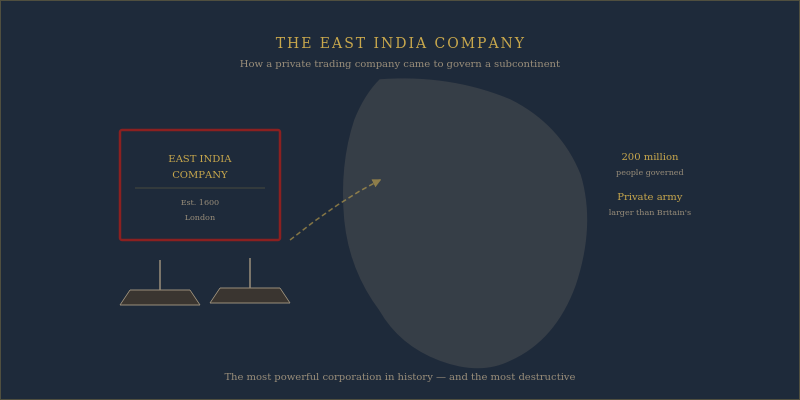
The East India Company was founded in 1600 when Queen Elizabeth I granted a royal charter to a group of London merchants seeking to trade in the Indian Ocean. Its original purpose was straightforward commercial: to buy spices, textiles and other goods in Asia and sell them in Europe at a profit. Within a century it had become something the world had never seen before — a commercial corporation exercising sovereign power over vast territories and hundreds of millions of people.
The transformation from trading company to imperial power happened gradually, through a combination of commercial competition, military opportunism and the progressive weakness of the Mughal Empire. The Company established trading posts — factories — at Surat, Madras, Bombay and Calcutta. To protect these posts it raised its own troops. To defend its commercial interests it fought wars. To administer conquered territories it established courts, collected taxes and built infrastructure.
Key Facts
Founded: 31 December 1600
Dissolved: 1 June 1874
Peak territory: Most of the Indian subcontinent
Peak army: 260,000 soldiers — twice the size of the British army
Population governed: Approximately 200 million people
The Company's Unique Powers
What made the East India Company unique in commercial history was the range of sovereign powers it wielded. Like the Dutch VOC before it, the Company could negotiate treaties with foreign rulers, declare war, coin money, maintain fortifications and administer justice. Unlike the VOC, it eventually governed a subcontinent.
At its peak the Company's army numbered 260,000 soldiers — roughly twice the size of the British army at the time. This private military force was financed by the revenue extracted from Indian territory, creating a self-sustaining engine of imperial expansion. The more territory the Company conquered, the more revenue it collected, the larger army it could maintain, the more territory it could conquer.
Robert Clive and the Battle of Plassey
The decisive moment in the Company's transformation from trader to ruler was the Battle of Plassey in 1757, where Robert Clive led a Company force of approximately 3,000 men against the Nawab of Bengal's army of 50,000. Clive won through a combination of superior firepower and the bribery of the Nawab's key commander, Mir Jafar, who kept a large part of the Bengali army out of the battle.
The victory gave the Company effective control of Bengal — the richest province in India. Clive and other Company officials helped themselves to enormous personal fortunes from the Bengal treasury. The looting of Bengal in the years following Plassey was systematic and devastating.
The Bengal Famine
In 1770 Bengal suffered a catastrophic famine. Between one quarter and one third of the province's population — approximately ten million people — died. The causes were complex: drought, the disruption of traditional agricultural systems, hoarding by merchants. But the Company's role was unambiguous: it continued collecting land revenue throughout the famine, extracting resources from a starving population to maintain its dividend payments to shareholders in London.
The Bengal Famine of 1770 was the first of several devastating famines under Company rule. The pattern was consistent: commercial interests took precedence over the welfare of the governed population. The Company paid its shareholders on time.
The overall scale of economic extraction from India under British rule remains genuinely contested territory among economists. The economist Utsa Patnaik, working from British national accounts data, has estimated the total transfer at approximately $45 trillion between 1765 and 1938 — a figure other economists dispute on methodological grounds, but which reflects a real and unresolved debate about just how much wealth flowed out of India during this period, and how much that extraction shaped the vastly different economic trajectories of Britain and India in the centuries since.
"What is the East India Company but a burdensome monopoly?" — Adam Smith, The Wealth of Nations, 1776
The Indian Rebellion and the End of the Company
The Company's rule ended as a direct consequence of the events of 1857 — remembered very differently depending on where the story is told. British historiography traditionally calls it the "Indian Mutiny"; Indian historiography increasingly refers to it as the "First War of Independence," a naming difference that itself reflects a genuine and unresolved argument over whether the uprising was a narrow military mutiny or the opening chapter of India's independence movement. Whichever framing is used, the trigger was the introduction of new rifle cartridges that soldiers believed were greased with pig and cow fat — offensive to both Muslim and Hindu sepoys — and the uprising rapidly spread far beyond the barracks, drawing in civilian populations across northern and central India with a much broader range of grievances against Company rule. The rebellion was suppressed with considerable brutality on both sides.
The British government concluded that a trading company was not a suitable instrument of imperial governance. The Government of India Act 1858 transferred all Company territories and powers to the British Crown. The Company itself lingered on, stripped of all governing functions, until it was formally dissolved in 1874.
It was dissolved not for the famines, not for the wars, not for the systematic looting. It was dissolved because it had become too expensive to run.
Frequently Asked Questions
How did the East India Company take over India?
The East India Company took over India gradually through a combination of commercial competition, military conquest and exploitation of political divisions within the Mughal Empire. Key moments included the Battle of Plassey in 1757, which gave the Company control of Bengal, and subsequent wars against the Maratha Confederacy and Mysore. The process took over a century and was never a single planned conquest.
Was the East India Company a government or a private company?
The East India Company occupied a unique and legally ambiguous position — it was a private joint-stock company with shareholders and a profit motive, but it wielded powers normally reserved for governments including the right to declare war, administer justice and collect taxes. It was simultaneously a commercial enterprise and a de facto government over hundreds of millions of people.
How big was the East India Company's army?
At its peak in the early 19th century the East India Company maintained an army of approximately 260,000 soldiers — roughly twice the size of the British army at the time. This force consisted primarily of Indian soldiers — sepoys — officered by British commanders. It was the largest private army in history and was financed by revenue extracted from Indian territories.
What caused the end of the East India Company?
The East India Company's governing role ended following the Indian Rebellion of 1857, which demonstrated that a trading company was not an appropriate instrument of imperial governance. The Government of India Act 1858 transferred all Company powers to the British Crown. The Company itself was formally dissolved in 1874, having been stripped of all commercial and governing functions.
How does the East India Company compare to the Dutch East India Company?
Both companies were granted sovereign powers and used them to build commercial empires through force. The VOC dominated the spice trade from Asia but never governed a territory as large or populous as the British EIC's Indian empire. The British EIC outlasted the VOC by nearly a century and governed a far larger population. Both represent the same fundamental model: commercial incentive combined with sovereign power producing imperial expansion.
A Note From The Editor
The East India Company dissolved not for the famines, not for the wars, not for the Bengal famine that killed ten million people while it paid its dividend. It dissolved because it had become too expensive to run. That tells you something important about the moral calculus of imperial commerce: profitability was the only metric that mattered. When the Company stopped being profitable it was wound up. The human cost of its existence was never part of the calculation. The Anarchy by William Dalrymple is the most important book on this subject I've read — it makes the scale of what happened viscerally real in a way that academic history rarely does.
The interpretation remains debated, and the further you read, the more layers emerge.
Could the East India Company have governed differently, or was extraction built into its structure from the beginning?
Sources & Further Reading
- Dalrymple, William. The Anarchy: The East India Company, Corporate Violence, and the Pillage of an Empire. Bloomsbury, 2019.
- Encyclopaedia Britannica. "East India Company." britannica.com
- Ferguson, Niall. Empire: How Britain Made the Modern World. Penguin, 2004.
- Robins, Nick. The Corporation That Changed the World. Pluto Press, 2006.