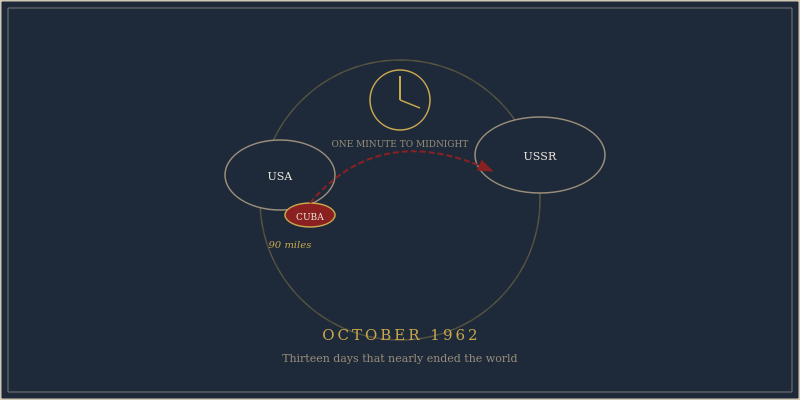
The Thirteen Days That Nearly Ended the World
In October 1962, the United States and Soviet Union came closer to nuclear war than at any point before or since. Not through intention, but through miscommunication, mechanical failure, and the decisions of individuals operating under extreme pressure with incomplete information. The Cuban Missile Crisis lasted thirteen days. On at least one of those days, the world survived because a single Soviet naval officer refused to follow orders.
What makes the crisis genuinely instructive — beyond its drama — is how it exposes the gap between how institutional systems are supposed to work and how they actually function under pressure. Both superpowers had elaborate command-and-control systems designed to prevent accidental war. Both systems came close to failing simultaneously.
Historical Context: How the Crisis Began
To understand October 1962, you need to understand the preceding years. The Cold War had established a brutal logic: the United States ringed the Soviet Union with military alliances and forward-deployed nuclear weapons; the Soviets sought strategic parity they did not yet fully possess.
In 1961, the United States deployed Jupiter ballistic missiles to Turkey and Italy — positioned close enough to the Soviet Union to significantly reduce Moscow's warning time in the event of a first strike. Soviet Premier Nikita Khrushchev found this intolerable, and not merely for strategic reasons. The missiles represented what he saw as American willingness to humiliate the Soviet Union on its own doorstep.
That same year, the failed Bay of Pigs invasion — a CIA-backed attempt to overthrow Fidel Castro using Cuban exiles — convinced Moscow that Washington was intent on eliminating Castro's government. The Kennedy administration had already authorised Operation Mongoose, a covert programme of sabotage and assassination plots against Cuba. Castro, aware of American intentions, welcomed Soviet military support.
In May 1962, Khrushchev proposed placing Soviet nuclear missiles in Cuba. His reasoning combined genuine strategic calculation with political theatre: the missiles would deter an American invasion of Cuba, partially offset American nuclear superiority, and create a bargaining chip he believed Kennedy would eventually have to negotiate over.
The Secret Deployment
Through the summer of 1962, the Soviet Union moved with remarkable speed to deploy nuclear capability to Cuba. Operation Anadyr, as the Soviets called it, involved shipping more than 40,000 military personnel, medium-range ballistic missiles capable of striking most of the eastern United States, and tactical nuclear weapons — a detail that American intelligence did not discover until later.
The operation was designed for concealment. Soviet soldiers wore civilian clothes during transport. Equipment was loaded at night. Communications were kept to a minimum. And for several months, it worked: American intelligence agencies, including the CIA, consistently underestimated the scale and nature of Soviet deployments to Cuba.
On 14 October 1962, a U-2 reconnaissance aircraft flying over western Cuba photographed construction sites that analysts identified the following morning as medium-range ballistic missile launch facilities. The photographs were shown to President Kennedy on 16 October. He was told the missiles could be operational within two weeks.
Kennedy's Decision
Kennedy immediately convened a secret advisory group that came to be known as ExComm — the Executive Committee of the National Security Council. Over the next six days, while publicly maintaining normal appearances, Kennedy and his advisors debated how to respond.
The options ranged from doing nothing — accepting the missiles as a strategic reality — to a full military invasion of Cuba. The Joint Chiefs of Staff, almost unanimously, favoured an immediate air strike followed by invasion. General Curtis LeMay, Air Force Chief of Staff, compared a naval blockade to the appeasement of Hitler at Munich. The pressure on Kennedy to respond militarily was intense.
Kennedy chose a naval blockade, reframed as a "quarantine" for legal reasons. He demanded the Soviet Union remove the missiles and announced this publicly in a television address on 22 October. The world, which had known nothing of the crisis for six days, now knew that the two superpowers were in direct confrontation over nuclear weapons ninety miles from American soil.
The Thirteen Days
The Confrontation at Sea
Soviet ships carrying military cargo were already at sea, heading for Cuba. On 24 October, as the quarantine line came into effect, those ships stopped. A collective breath was held in Washington and Moscow. The ships turned around. Secretary of State Dean Rusk reportedly said: "We're eyeball to eyeball, and I think the other fellow just blinked."
But the confrontation was far from resolved. Soviet missiles were already in Cuba, and construction was continuing. The fundamental demand — that the Soviets remove the missiles — had not been met. Meanwhile, communications between Kennedy and Khrushchev were slow, formal, and prone to misinterpretation. A letter sent from Moscow took hours to arrive, and by the time a response was prepared and transmitted, circumstances had often changed.
The Spy Plane and the Submarine
On 27 October — what came to be called Black Saturday — the crisis reached its most dangerous point. A U-2 reconnaissance aircraft was shot down over Cuba by a Soviet surface-to-air missile. The ExComm had previously agreed that if an American aircraft was shot down, the US would retaliate against the missile batteries responsible. The pressure to respond militarily had suddenly increased dramatically.
Simultaneously, a second U-2 aircraft accidentally strayed into Soviet airspace over the Arctic, prompting Soviet fighters to scramble. American fighters scrambled in response, briefly raising the possibility of an armed confrontation over Soviet territory.
But the most dangerous moment of the entire crisis was happening out of sight, beneath the Atlantic Ocean.
Vasili Arkhipov and the Decision Not to Start World War Three
Four Soviet submarines had been dispatched to Cuban waters before the crisis became public. They were armed with conventional torpedoes — and each also carried a single nuclear torpedo with a yield roughly equivalent to the bomb dropped on Hiroshima. The orders authorising the use of these nuclear weapons in certain circumstances had been issued before the submarines departed.
One of these submarines, B-59, had been submerged for several days and was running low on battery power. The crew had been unable to communicate with Moscow. The submarine was being harassed by American destroyers dropping practice depth charges — small explosive charges designed to force submarines to surface for identification, a standard Cold War procedure that the submarine's crew did not know was not an actual attack.
The submarine's captain, Valentin Savitsky, concluded that war had begun. He ordered the nuclear torpedo armed and prepared for launch. Under Soviet naval procedure, launching the weapon required the agreement of three officers: the captain, the political officer, and the chief of staff of the submarine flotilla.
The political officer agreed. The flotilla chief of staff, Vasili Arkhipov, refused.
Arkhipov argued that they had no confirmation war had started, that the depth charges did not appear to be real attacks, and that launching a nuclear weapon without authorisation from Moscow would be an irreversible act. After a confrontation described by crew members as heated, Savitsky stood down. B-59 surfaced.
Arkhipov's refusal was not celebrated or widely known for decades. The Soviet government did not publicise the incident. American officials did not know how close the submarine had come to launching. It was only after the Cold War ended, as Soviet archives were gradually opened and surviving participants began speaking publicly, that the full significance of that moment became clear.
Thomas Blanton, director of the National Security Archive, later said of Arkhipov: "A guy called Vasili Arkhipov saved the world."
The Resolution — and the Secret Deal
On 26-27 October, Khrushchev sent two letters to Kennedy. The first, apparently written personally by Khrushchev in an emotional state, offered to remove the missiles if the US pledged not to invade Cuba. The second, evidently drafted after hardliners in Moscow intervened, added a new condition: the US must also remove its Jupiter missiles from Turkey.
Robert Kennedy proposed what came to be known as the "Trollope Ploy" — responding publicly only to the first letter, accepting its terms, while ignoring the second. Simultaneously, Robert Kennedy met privately with Soviet Ambassador Anatoly Dobrynin and conveyed that the US would remove the Jupiter missiles from Turkey, but this could not be stated publicly or tied explicitly to the Cuba resolution. It had to appear to be an independent, previously planned decision.
Khrushchev accepted. On 28 October, he announced that the Soviet missiles would be removed from Cuba. The public narrative was of an American diplomatic victory — Kennedy had stood firm, Khrushchev had backed down.
The private reality was a compromise. The United States removed its Jupiter missiles from Turkey and Italy within months. The pledge not to invade Cuba remained in effect. Neither side publicly acknowledged the linkage between the Cuba missiles and the Turkey missiles for decades. Khrushchev's domestic position was severely damaged by what appeared to be a humiliating retreat; he was removed from power two years later, in part because of it.
What the Crisis Actually Revealed
The Limits of Command and Control
The Cuban Missile Crisis is often taught as a story of successful crisis management — two rational leaders stepping back from the brink. This is partially true. But it obscures how much of the outcome depended on factors neither leader controlled.
Neither Kennedy nor Khrushchev knew about B-59. Neither knew how close the submarine came to launching a nuclear weapon. The command-and-control systems of both superpowers — designed precisely to prevent unauthorised nuclear use — nearly failed simultaneously. Arkhipov's refusal was not a system working as intended. It was an individual overriding a system that was, in that moment, pushing toward catastrophe.
The Role of Individuals
The crisis produced several individuals whose decisions shaped outcomes in ways that institutional accounts tend to understate. Arkhipov is the most dramatic example. But Robert Kennedy's back-channel diplomacy with Dobrynin — conducted without formal authorisation and concealed from most of ExComm — was equally significant. The resolution emerged from informal human communication, not from the formal institutional processes that were supposed to manage such crises.
The Information Problem
Both sides operated throughout the crisis on incomplete information. The US did not know the Soviets had tactical nuclear weapons in Cuba, or that the submarines were nuclear-armed. The Soviets did not know that Kennedy had already privately decided that the Jupiter missiles in Turkey were obsolete and would be removed regardless of Cuba. Both sides made decisions based on worst-case assumptions about the other's intentions that turned out to be wrong.
Long-Term Consequences
The Cuban Missile Crisis produced several lasting institutional changes. The most significant was the establishment of the Moscow-Washington hotline — the so-called "red phone" — which came into operation in 1963. The crisis had demonstrated that the existing communication channels were far too slow and formal for managing acute crises; leaders needed a direct, rapid means of communication.
The Partial Nuclear Test Ban Treaty, signed in 1963, prohibited nuclear weapons tests in the atmosphere, in outer space, and underwater. It was the first significant arms control agreement of the nuclear age, and it emerged directly from the political pressure generated by the crisis.
More broadly, the crisis accelerated the shift toward what strategists called "détente" — a managed reduction in Cold War tensions that would define much of the 1970s. Both Kennedy and Khrushchev emerged from the crisis with a more realistic understanding of how close the world had come to catastrophe, and with greater motivation to reduce the risk of accidental nuclear war.
The Cuban Perspective
The Cuban Missile Crisis is typically told as a superpower drama in which Cuba is merely the setting. This is a significant distortion. Cuba had no role in the negotiations that resolved the crisis. Castro was not consulted. The agreement was reached over his head, without his participation, and he was furious about it.
From Havana's perspective, the crisis confirmed that Cuba's security depended entirely on Soviet goodwill — that the Soviet Union was prepared to reach an agreement with the United States that served Soviet interests, regardless of Cuban concerns. Castro later revealed that he had urged Khrushchev, as the crisis reached its peak, to launch a nuclear first strike against the United States if an American invasion appeared imminent. Khrushchev declined.
Common Misconceptions
The missiles in Cuba were not the only nuclear weapons at issue. American Jupiter missiles in Turkey and Italy were a central part of the resolution, but this was concealed from the public for decades. The crisis is often taught as a simple Soviet provocation and American response, when in fact both sides were deploying nuclear weapons close to the other's territory.
Khrushchev did not simply "back down." He received significant concessions — the non-invasion pledge and the Turkey missile removal — that he could present internally as a successful negotiation, even if the public framing was of Soviet retreat. His political position was damaged not because the deal was bad, but because he could not publicly claim credit for what he had achieved.
The crisis was not purely a Kennedy success. Kennedy's handling of the crisis is generally assessed positively by historians, but the outcome also depended on Khrushchev's restraint, Arkhipov's refusal to launch, and a degree of luck that neither side could manufacture. The systems designed to prevent nuclear war came close to failing. That the failure did not occur owed something to good decision-making and something to fortune.
Key Figures
John F. Kennedy — 35th President of the United States. Kennedy resisted intense pressure from his military advisors to respond to the missiles with immediate air strikes and invasion. His decision to pursue a naval quarantine bought time for negotiation, and his willingness to explore back-channel compromises — including the secret Turkey deal — made resolution possible without either side publicly capitulating.
Nikita Khrushchev — Soviet Premier. Khrushchev initiated the crisis by deploying missiles to Cuba, but also demonstrated significant restraint in accepting a resolution that fell short of his original objectives. His decision to remove the missiles, while politically damaging domestically, prevented the crisis from escalating further.
Robert Kennedy — US Attorney General and the President's brother. Robert Kennedy played a crucial back-channel role, meeting privately with Soviet Ambassador Dobrynin to communicate the Turkey missile compromise in terms that allowed both sides to avoid public humiliation.
Vasili Arkhipov — Soviet naval officer. As flotilla chief of staff aboard submarine B-59, Arkhipov refused to authorise the launch of a nuclear torpedo when the submarine's captain believed war had begun. His refusal prevented what could have been the first use of nuclear weapons in combat since Nagasaki.
Anatoly Dobrynin — Soviet Ambassador to the United States. Dobrynin served as the back-channel through which Robert Kennedy communicated the Turkey compromise. His long tenure in Washington and his relationships with American officials made him an ideal conduit for sensitive communications.
Further Reading
For those who want to explore the Cuban Missile Crisis in greater depth, several books stand out. Thirteen Days by Robert Kennedy (1969) is the insider account from someone at the centre of events, though it should be read knowing that it presents Kennedy's perspective in the most favourable light. One Hell of a Gamble by Aleksandr Fursenko and Timothy Naftali (1997) draws on Soviet and Cuban archives to present the crisis from all sides. The Kennedy Tapes edited by Ernest May and Philip Zelikow contains transcripts of ExComm meetings, allowing readers to hear decision-making in real time.
Frequently Asked Questions
How long did the Cuban Missile Crisis last?
The Cuban Missile Crisis lasted thirteen days, from 16 October 1962, when President Kennedy was informed of the Soviet missiles, to 28 October 1962, when Khrushchev announced their removal.
Who was Vasili Arkhipov?
Vasili Arkhipov was a Soviet naval officer serving as flotilla chief of staff aboard submarine B-59 during the Cuban Missile Crisis. On 27 October 1962, he refused to authorise the launch of a nuclear torpedo when the submarine's captain believed war had begun. His refusal is considered one of the most significant individual decisions of the Cold War.
What was the secret deal that ended the Cuban Missile Crisis?
The public resolution involved the Soviet Union removing its missiles from Cuba in exchange for a US pledge not to invade Cuba. The secret component, communicated through back channels by Robert Kennedy, was that the US would remove its Jupiter missiles from Turkey — though this could not be publicly linked to the Cuba agreement.
Did the Cuban Missile Crisis lead to any lasting agreements?
Yes. The crisis led to the establishment of the Moscow-Washington hotline in 1963 and contributed to the Partial Nuclear Test Ban Treaty the same year. It also accelerated moves toward détente between the superpowers.
Why did the Soviet Union put missiles in Cuba?
Khrushchev's motivations were multiple: to deter an American invasion of Cuba, to offset American nuclear superiority by placing Soviet missiles close to US territory, and to create a bargaining chip in negotiations over American missiles in Turkey. The decision followed the failed Bay of Pigs invasion and ongoing US covert operations against Cuba.
The full picture is more complex than any short article can cover.
Would World War One have happened without the Black Hand — or had the conditions for catastrophic conflict already been assembled by other means?