The Heir to an Empire
Archduke Franz Ferdinand was not supposed to be heir to the Austro-Hungarian throne. He became the presumptive heir only after the suicide of Crown Prince Rudolf in 1889 and the death of his own father in 1896. He was a complicated man — conservative, deeply religious, prone to rages, but also genuinely progressive in his political thinking. He favoured a restructured empire that would give greater autonomy to its Slavic peoples, a position that made him simultaneously feared by Serbian nationalists and suspicious to hardliners within his own government.
His marriage to Sophie Chotek, a Czech noblewoman the Habsburg court considered insufficiently aristocratic, had cost him dearly. He was forced to sign away his own children's succession rights, and Sophie endured regular, deliberate humiliations at official court ceremonies for the rest of her life. His love for her, by all accounts, was genuine — and it meant that when Princip's bullet struck her in Sarajevo, Franz Ferdinand's final words were reportedly a plea for her to stay alive for their children's sake. She died beside him within the hour.
On 28 June 1914, Franz Ferdinand and his wife Sophie were visiting Sarajevo, the capital of Bosnia — a province Austria-Hungary had annexed in 1908, to the fury of Serbian nationalists who believed Bosnia should be part of a greater Serbian state. The date was significant: the anniversary of the Battle of Kosovo, a date of profound importance to Serbian national identity. It was, in retrospect, an extraordinarily provocative choice of timing for a royal visit.
Key Facts
Date: 28 June 1914
Location: Sarajevo, Bosnia
Assassin: Gavrilo Princip, 19 years old
Organisation: Young Bosnia, connected to the Black Hand
Result: World War One — 20 million dead
The Plot That Almost Didn't Happen
The Black Hand — a Serbian secret society with connections to Serbian military intelligence — had organised the assassination plot. Seven conspirators were positioned along the Archduke's planned route through Sarajevo, armed with grenades and pistols. The plan seemed straightforward. In practice it was a comedy of errors that came within inches of failing completely.
The first conspirator lost his nerve as the royal motorcade passed and did nothing. The second, Nedeljko Čabrinović, threw a grenade at the Archduke's open-topped car. The grenade bounced off the folded-back convertible hood and exploded under the following vehicle, injuring several people but leaving Franz Ferdinand unharmed. Čabrinović then swallowed his cyanide capsule — which was old and ineffective — and jumped into the nearby River Miljacka to drown himself. The river was four inches deep. He was pulled out, arrested, and beaten by the crowd.
The remaining conspirators, hearing the explosion and seeing the chaos, assumed the assassination had either succeeded or hopelessly failed. They dispersed. The plot appeared to be over.
The Wrong Turn That Changed the World
Franz Ferdinand, shaken but unhurt, continued with his official programme and then insisted on visiting the injured from Čabrinović's grenade attack at the hospital. His motorcade set off through Sarajevo's streets.
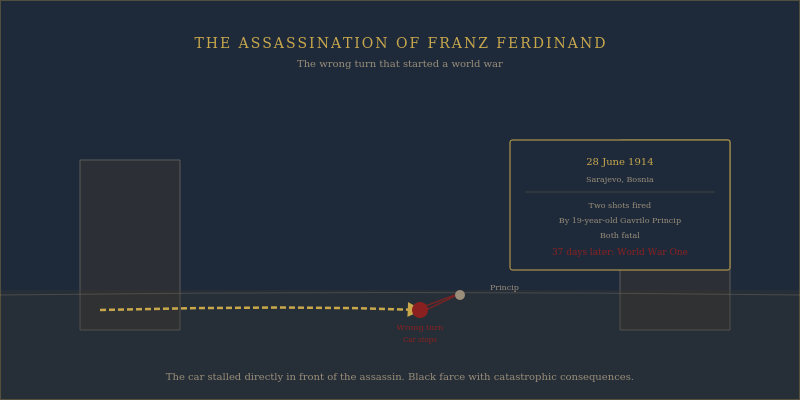
His driver, Franz Urban, did not know the route had been changed. He turned into Franz Josef Street — the original planned route — rather than the new route along the Appel Quay. When the error was pointed out, he stopped the car to reverse. He stopped directly outside Schiller's Delicatessen.
Gavrilo Princip — nineteen years old, a member of Young Bosnia, connected to the Black Hand — had given up on the assassination attempt and gone to buy a sandwich from Schiller's. He walked out of the shop and found the Archduke's car stationary five feet in front of him. He later described being unable to believe what he was seeing.
Princip stepped forward and fired twice. Franz Ferdinand was struck in the jugular vein. Sophie was struck in the abdomen. Both died within the hour.
"I am not a criminal, for I destroyed a bad man. I thought I was doing good." — Gavrilo Princip, at his trial
The Chain Reaction
What followed demonstrated how completely the major European powers had constructed a system designed to turn any significant crisis into a continent-wide catastrophe.
Austria-Hungary, suspecting Serbian government involvement, issued an ultimatum with deliberately unacceptable terms. Serbia accepted most but not all conditions. Austria-Hungary declared war on Serbia on 28 July 1914 — exactly one month after the assassination. Russia, as Serbia's protector and fellow Slavic nation, began mobilising its forces. Germany, bound by treaty to Austria-Hungary, declared war on Russia on 1 August. France, bound by treaty to Russia, was drawn in. Germany invaded Belgium to attack France from the west — bringing Britain into the war under its treaty obligation to protect Belgian neutrality.
Within six weeks of two shots in Sarajevo, all of Europe's major powers were at war.
The Assassination
Franz Ferdinand and Sophie assassinated in Sarajevo by Gavrilo Princip.
The Ultimatum
Austria-Hungary issues ultimatum to Serbia with deliberately unacceptable terms.
War Declared
Austria-Hungary declares war on Serbia. The chain reaction begins.
Germany Enters
Germany declares war on Russia. France mobilises. The war becomes continental.
Britain Enters
Germany invades Belgium. Britain declares war on Germany. World War One has begun.
Armistice
World War One ends. 20 million dead. Four empires destroyed. The modern world begins.
Was the Assassination the Real Cause of World War One?
Historians have debated for a century whether the assassination caused World War One or merely triggered a war that was already inevitable. The alliance system, the arms race, the imperial rivalries and the military planning that had been accumulating for decades — all of these created the conditions in which a single incident could detonate a continental war.
In this reading, if Princip had failed entirely, another incident would eventually have served the same purpose. The powder keg was already built. The assassination was simply the spark.
Others argue that contingency matters — that different decisions at each stage of the July Crisis could have prevented the war, and that the assassination was not inevitable but genuinely accidental in its ultimate form. A different route. A different driver. A sandwich not purchased. Twenty million people might have lived.
Gavrilo Princip
Princip was nineteen at the time of the assassination — too young under Austro-Hungarian law to be sentenced to death. He received the maximum sentence of twenty years imprisonment and was taken to the Theresienstadt fortress in Bohemia. He developed tuberculosis in prison, and his arm was amputated as the disease spread to his bones. He died on 28 April 1918, aged twenty-three, having lost so much weight that his guards described him as barely recognisable. He did not live to see the end of the war his action had started.
Frequently Asked Questions
Who assassinated Franz Ferdinand?
Franz Ferdinand was assassinated by Gavrilo Princip, a nineteen year old Bosnian Serb student and member of Young Bosnia. Princip was connected to the Black Hand secret society, which had organised the assassination plot. He fired two shots at point blank range after the Archduke's car stopped directly in front of him by accident.
Why was Franz Ferdinand assassinated?
Franz Ferdinand was assassinated because Bosnian Serb nationalists opposed Austro-Hungarian rule over Bosnia and wanted unification with Serbia. The Black Hand secret society organised the plot, believing that removing the Archduke would destabilise the empire and advance the cause of South Slav unification.
How did Franz Ferdinand's assassination start World War One?
The assassination triggered a diplomatic crisis through a chain of alliances. Austria-Hungary blamed Serbia and issued an ultimatum. Serbia's partial rejection led Austria-Hungary to declare war. Russia mobilised to support Serbia. Germany declared war on Russia. France entered to support Russia. Germany invaded Belgium, bringing Britain into the war. Within six weeks a regional crisis had become a world war.
What was the Black Hand secret society?
The Black Hand was a Serbian secret society founded in 1911 with the goal of uniting all South Slavic peoples under Serbian leadership. It had connections to the Serbian military and intelligence services. The organisation planned and organised the assassination of Franz Ferdinand, recruiting and training Gavrilo Princip and other conspirators.
How many attempts were made on Franz Ferdinand's life that day?
There were multiple conspirators positioned along the Archduke's route in Sarajevo. One conspirator threw a grenade at the royal car — it bounced off and exploded under the following vehicle. The Archduke survived the initial attack. Gavrilo Princip then encountered the car by chance when the driver took a wrong turn, giving him a second and ultimately successful opportunity.
A Note From The Editor
What haunts me about the Franz Ferdinand story is the role of pure accident in world-historical events. Remove the wrong turn. Remove the sandwich. Remove the indecisive driver. Twenty million people might have lived. Four empires might have stood. The 20th century might have looked entirely different. We like to think history moves according to large forces — economics, ideology, demographics. Sometimes it turns on a driver who doesn't know the route has changed.
This is a topic where the conventional explanation misses much of what actually happened.
If Archduke Franz Ferdinand had survived Sarajevo, would World War One still have happened — and on what timeline?
Sources & Further Reading
- MacMillan, Margaret. The War That Ended Peace. Profile Books, 2013.
- Clark, Christopher. The Sleepwalkers: How Europe Went to War in 1914. Penguin, 2012.
- Encyclopaedia Britannica. "Assassination of Archduke Franz Ferdinand." britannica.com
- National WWI Museum. "The Assassination of Franz Ferdinand." theworldwar.org
- Dedijer, Vladimir. The Road to Sarajevo. MacGibbon and Kee, 1967.