A City With a Reason to Exist
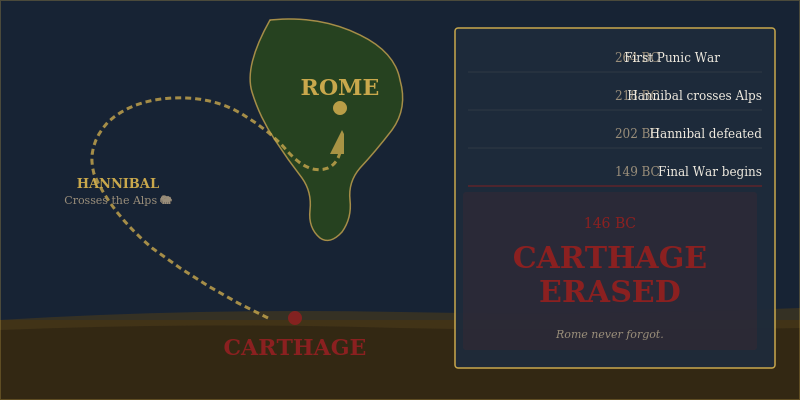
Carthage was founded, according to tradition, by Phoenician settlers from Tyre in the ninth century BC. Its location — on a promontory in what is now Tunisia, with harbours on two sides and a commanding view of the central Mediterranean — was not accidental. Carthage was built to trade. Its wealth came from commerce: from its trading posts along the North African coast, from its colonies in Sicily, Sardinia, and Spain, from its position as the intermediary between the resources of the western Mediterranean and the markets of the eastern.
By the third century BC, Carthage was one of the most prosperous cities in the ancient world. Its population may have reached several hundred thousand. Its navy was the most powerful in the western Mediterranean. Its merchant fleet was ubiquitous. It had, in the Barcid family, a dynasty of talented military commanders who had built a second Carthaginian empire in Spain after the first had been lost to Rome in the First Punic War.
Rome was going to have to deal with it eventually.
One Hundred Years
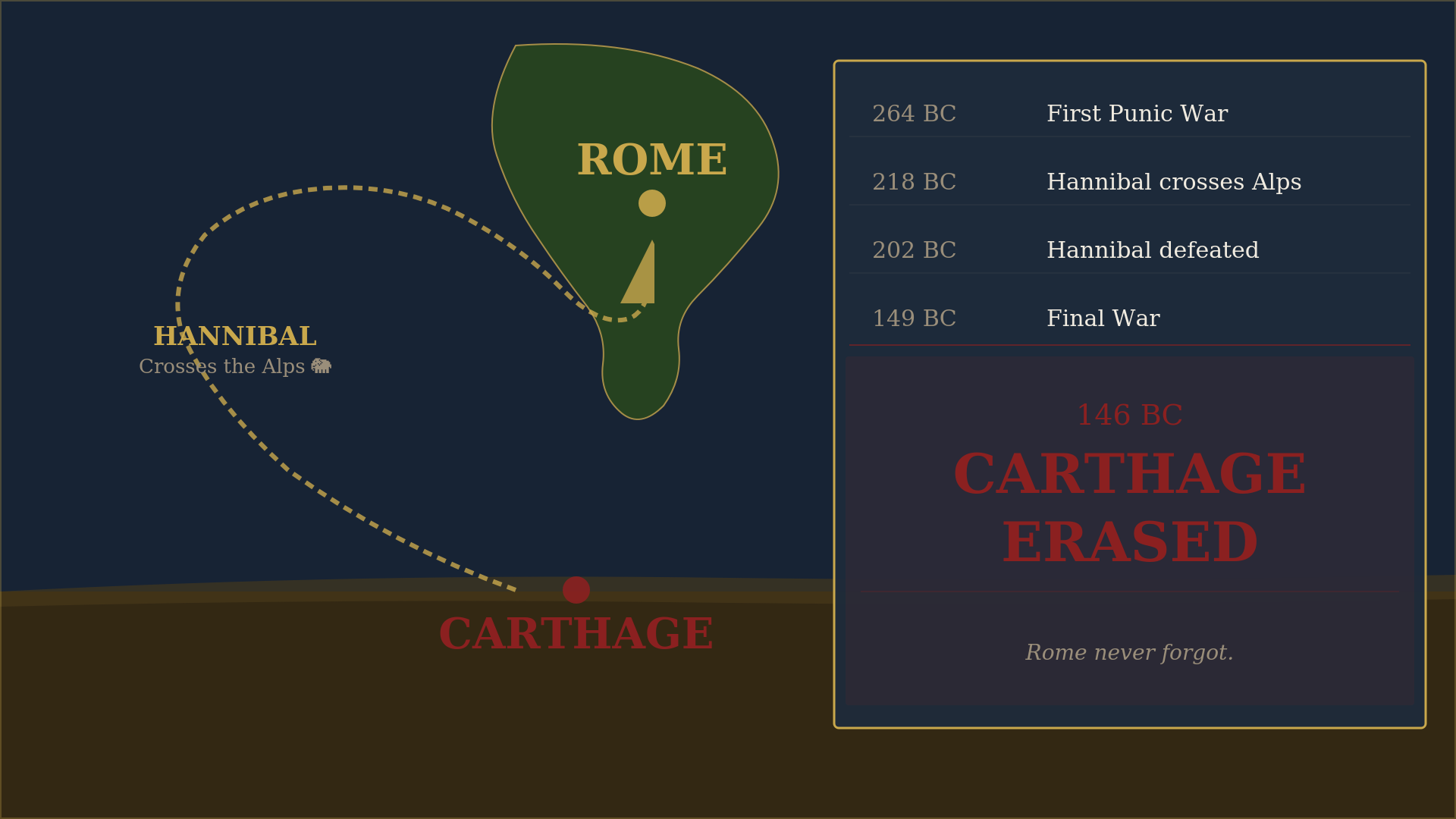
The conflict between Rome and Carthage lasted, in three distinct wars, for over a century. The First Punic War (264–241 BC) began over Sicily and ended with Rome acquiring Sicily, Sardinia, and Corsica, and Carthage paying an enormous indemnity. Rome built its first serious navy in the process, learning amphibious warfare by fighting it.
The Second Punic War (218–201 BC) came close to destroying Rome. Hannibal Barca, son of the general who had lost the First War, led an army from Spain across the Pyrenees, through southern Gaul, and across the Alps — with war elephants — into Italy. He then spent fifteen years in Italy, winning battle after battle. At Cannae in 216 BC, he surrounded and destroyed a Roman army of perhaps seventy thousand men. The battle of Cannae is still studied in military academies as the archetypal example of double envelopment.
But Hannibal never took Rome. Without siege equipment and without the political collapse in Rome's Italian allies that he had expected, he could win battles without winning the war. Rome adapted. It adopted the Fabian strategy — avoiding pitched battle with Hannibal, wearing him down while carrying the war elsewhere. Eventually, Scipio Africanus carried the war to Africa and defeated Hannibal at Zama in 202 BC. Carthage accepted the Roman terms: no fleet, no army, no foreign policy without Roman permission.
Hannibal at Cannae
The battle of Cannae in 216 BC is one of the most studied engagements in military history. Hannibal's double envelopment — allowing his centre to retreat while his flanks encircled the Roman army — destroyed a force of approximately 50,000 to 70,000 men. It remains the textbook example of the tactic of encirclement.
The Third War That Wasn't Really a War
The Third Punic War (149–146 BC) should not have been a war at all. By 149 BC, Carthage had complied with every provision of the peace treaty imposed after the Second. It had no fleet and no real army. It was paying its indemnity. It was, militarily, no threat to Rome or anyone else.
The proximate cause of the Third War was that Carthage had taken up arms against the Numidian king Masinissa — a Roman ally who had spent decades encroaching on Carthaginian territory. When Carthage finally responded to his raids by fighting back, Rome declared that this violated the treaty prohibition on making war without Roman permission. A Roman embassy arrived in Carthage with demands. The Carthaginians, complying with each demand in turn, handed over three hundred aristocratic children as hostages, then all their weapons, war equipment, and naval vessels.
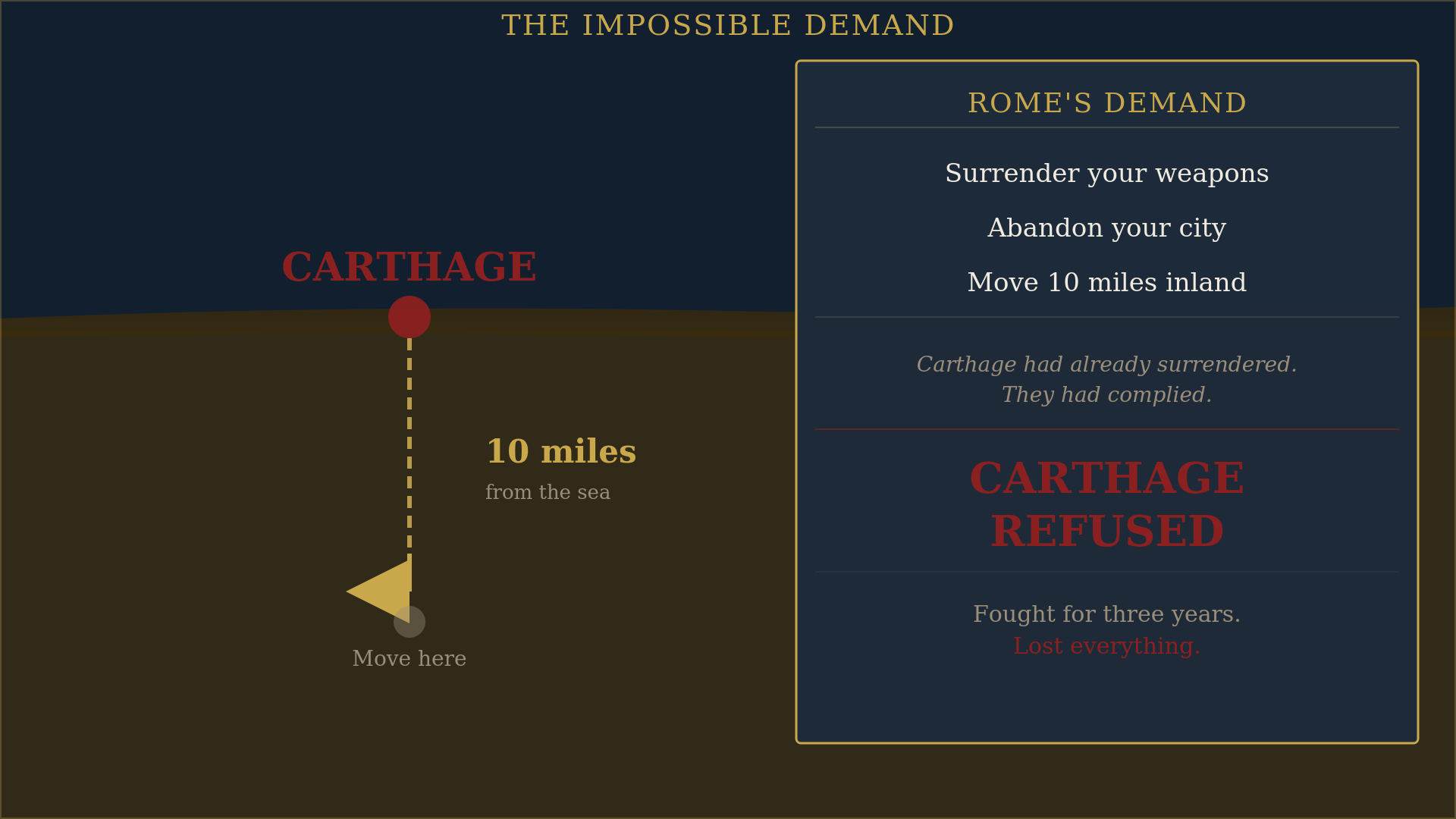
Then came the final demand: Carthage must be destroyed. The Carthaginian people must relocate at least ten miles from the coast and build a new city inland.
The Romans who delivered this message understood exactly what they were saying. A trading city without a harbour was not a trading city. It was a village. The demand was not a concession that Carthage could make and survive. It was an instruction to cease to exist.
The Destruction
Carthage refused to relocate. The city rearmed frantically — women cut off their hair to provide bowstrings, citizens worked through the night manufacturing weapons. The city held out for three years against a Roman siege before Scipio Aemilianus broke through in 146 BC.
The final assault lasted six days of house-to-house fighting through streets that descended to rubble as the Romans advanced. Scipio Aemilianus, watching the burning from a hill outside the city, reportedly wept and quoted Homer: "A day will come when sacred Troy shall perish, and Priam and his people shall be slain." He is said to have feared for Rome itself — that what had happened to Carthage might one day happen to Rome.
The survivors — perhaps fifty thousand people, from a population that had been several hundred thousand — were sold into slavery. The city was razed to its foundations. Roman priests performed rituals invoking the gods' curse on the site. The story that the fields were sown with salt is almost certainly later legend, but it captures the intended finality: this was not simply a city that had been conquered. It was a city that had been unmade.
Key Facts
- Founded
- c. 814 BC (traditional date)
- Population at peak
- Estimates vary: 250,000–700,000
- Destruction
- 146 BC
- Duration of final siege
- 3 years (149–146 BC)
- Survivors enslaved
- Approximately 50,000
- General commanding final assault
- Scipio Aemilianus (adopted grandson of Scipio Africanus)
The Message
Rome did not need to destroy Carthage. By 146 BC, Carthage had been stripped of everything that made it a military threat — its fleet, its army, its empire. Rome had already won everything worth winning. The destruction of Carthage was not a military calculation. It was a political communication, directed not at Carthage — which was about to cease to exist — but at every other city in the Mediterranean world.
The communication was this: surrender is not sufficient. Compliance is not sufficient. There is no version of defeat that guarantees survival. The only question, when Rome is your enemy, is how quickly you lose and how complete the loss is. This is exemplary punishment — the deliberate infliction of a penalty so extreme that it functions not as justice but as deterrence, directed at observers rather than offenders.
The same year, Rome also destroyed Corinth — the wealthiest city in Greece. The timing was not coincidental. Rome was, in 146 BC, broadcasting a message to the Mediterranean world about what subordination to Roman power actually meant. The message was heard.
Frequently Asked Questions
Why did Rome destroy Carthage if it was already defeated?
By 146 BC, Carthage posed no military threat — it had been disarmed after the Second Punic War. Rome destroyed it as a demonstration of the consequences of any defiance of Roman authority, directed not at Carthage but at every other city watching. It was exemplary punishment.
Did Rome really salt Carthage's fields?
Almost certainly not. The story appears in nineteenth-century histories but has no reliable ancient source. The destruction of Carthage was devastating, but the salt legend is most likely a later invention. The real destruction — burning, demolition, enslavement of survivors — was sufficiently catastrophic without embellishment.
Who was Hannibal?
Hannibal Barca (247–183 BC) was a Carthaginian general who crossed the Alps with elephants in 218 BC and spent fifteen years winning battles in Italy. His victory at Cannae (216 BC) remains one of the greatest tactical achievements in military history. He was ultimately defeated at Zama (202 BC) by Scipio Africanus.
Was Carthage really a threat to Rome by 149 BC?
No. Carthage had been stripped of its fleet and army after the Second Punic War and had complied with every provision of the peace treaty. It was paying its indemnity. The Third War was triggered by Rome on a technicality — Carthage fighting in self-defence against a Roman ally — that served as a pretext for a war Rome had decided to fight regardless.
Enjoyed this?
New stories, hidden mechanisms and forgotten history, straight to your inbox every week.
A Note From The Editor
The detail about Scipio Aemilianus weeping while Carthage burned, and quoting Homer's lines about the fall of Troy, is one of the more remarkable moments in ancient historiography. Here is the Roman general who has just destroyed the greatest city in the western Mediterranean, and he's thinking about Rome — about whether the same thing could happen to his own city. It suggests a more complex understanding of what he had just done than the simple narrative of Roman triumphalism usually allows.