A System Built on Belief
The Soviet Union should not have lasted as long as it did. Its command economy was chronically inefficient. Its agricultural system struggled to feed the country. Its consumer goods were shoddy, scarce, and often simply unavailable. Its political system required a level of systematic dishonesty — about economic performance, about historical atrocities, about living conditions in the West — that would eventually become unsustainable.
It lasted because enough people believed in it. Not necessarily believed in communism as an ideal — by the 1970s, ideological commitment of that kind was rare — but believed that the system, for all its faults, was the framework within which Soviet life took place. That its problems were manageable. That the future, however slowly it arrived, would be better. That the state, whatever its failures, was trying.
This kind of institutional belief — call it legitimacy — does not require enthusiasm. It requires only the absence of a better alternative and the absence of proof that the current arrangement is fundamentally broken. The Soviet system maintained both conditions, with considerable effort, for seven decades.
The Economic Reality
Soviet economic statistics, as produced by the Soviet state, showed consistent growth throughout the postwar period. Soviet statistics, as understood by Soviet economists who had access to data that was never published, showed something quite different. By the 1970s, the Soviet growth model had essentially stalled. The extensive growth strategy — adding labour and capital to produce more output — had reached its limits. Total factor productivity was not growing. Technology was falling further behind the West with each passing decade.
These problems were known within the system. A generation of reformist Soviet economists produced analyses and proposals that circulated internally. What they could not do was publish them. The gap between the real economic picture and the published picture — between what Soviet planners knew and what Soviet citizens were told — widened steadily through the Brezhnev years.
The Information Problem
Soviet citizens had no reliable way to compare their standard of living to life in Western countries. Access to foreign media was restricted. Travel was controlled. Official statistics showed a Soviet Union performing well. The comparison that would have revealed the real situation was simply not available — until Gorbachev made it available.
What Gorbachev Intended
Mikhail Gorbachev came to power in 1985 as a reformer who understood that the system had serious problems and believed it could be saved. His reforms — perestroika (restructuring) and glasnost (openness) — were designed to make the system work better, not to end it. Glasnost in particular was conceived as a way to bring accurate information into the system so that problems could be identified and addressed. It was, in other words, a management initiative.
What Gorbachev did not anticipate was that opening the information environment would not merely permit constructive criticism. It would trigger the collapse of the belief structures that sustained the entire edifice.
Soviet newspapers and television, once permitted to discuss previously forbidden topics, did not stop at mild criticism. They published accounts of historical atrocities — the scale of Stalin's terror, the Katyn massacre, the Molotov-Ribbentrop Pact — that contradicted the official version of Soviet history at its foundations. They reported on economic failures, on crime, on corruption, on the gap between official performance figures and lived reality. Television programmes discussing previously unmentionable topics attracted enormous audiences.
The Comparison That Destroyed the System
The most damaging thing glasnost permitted was comparison. Soviet citizens had been told, consistently, that they lived in a system superior to Western capitalism — more equitable, more humane, more rational. Restricted access to information from the outside world had made this claim difficult to verify or refute. As restrictions eased and Western media became more accessible, the comparison that Soviet ideology had depended on preventing became impossible to avoid.
It was devastating. Soviet citizens discovered that their standard of living was significantly lower than that of comparable Western countries — countries that did not require them to stand in queues for basics, countries where consumer goods were available and worked properly, countries where people could travel freely and read what they chose. The ideology had promised that socialism delivered these things better than capitalism. The comparison proved it didn't.
Once the comparison was made, the belief that had sustained the system began to dissolve. Not overnight, and not uniformly. But the process, once begun, was not reversible. The Soviet state could no longer credibly maintain the claim that the system was working as intended — because too many people could now see that it wasn't.
Key Facts
- Soviet dissolution
- 25 December 1991
- Republics becoming independent
- 15 (Russia, Ukraine, Belarus, and 12 others)
- Gorbachev's reforms
- Perestroika (restructuring) and glasnost (openness), introduced 1986-87
- Key event accelerating collapse
- Failed August 1991 coup by Communist hardliners
- Duration of the Soviet Union
- 1922–1991 (69 years)
The Mechanism: Legitimacy Collapse
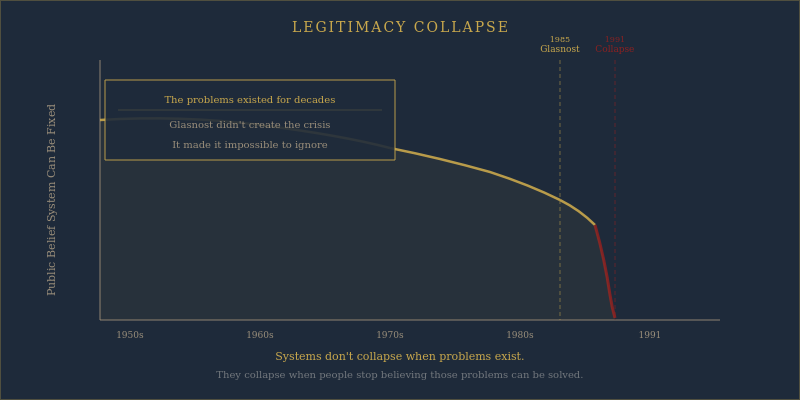
Systems do not collapse when they have problems. Every system has problems. They collapse when the people inside them stop believing that those problems can be addressed within the existing framework — when the gap between what the system claims to be doing and what it is actually doing becomes too wide to sustain.
The Soviet Union's problems — economic stagnation, political dysfunction, historical dishonesty — had existed for decades. What changed in the late 1980s was not the problems but the information environment. Once Soviet citizens could see the gap clearly, the belief that had sustained compliance — the sense that the system was at least trying, that the future would be better, that there was no realistic alternative — began to dissolve. And without that belief, the system had no mechanism to compel continued participation beyond coercion. By 1991, even the will to use coercion had collapsed.
This dynamic — legitimacy collapse following information revelation — is not unique to communist systems. It appears wherever institutions have depended on controlling what their members can know and compare. The Soviet case is simply its most spectacular example.
Frequently Asked Questions
Why did the Soviet Union collapse?
The Soviet Union collapsed because the reforms introduced by Gorbachev inadvertently destroyed the belief systems that sustained the state, by allowing Soviet citizens to compare their situation with life in the West and to learn the true history of the Soviet state. Economic failure alone did not cause the collapse — the system had been economically failing for decades.
Was the Soviet collapse inevitable?
Historians disagree. Some argue that the structural economic problems made some form of collapse inevitable. Others point to specific decisions by Gorbachev — particularly glasnost — as the trigger that turned economic difficulty into political dissolution. A more authoritarian response to the economic problems might have sustained the system longer.
What happened to the Soviet republics?
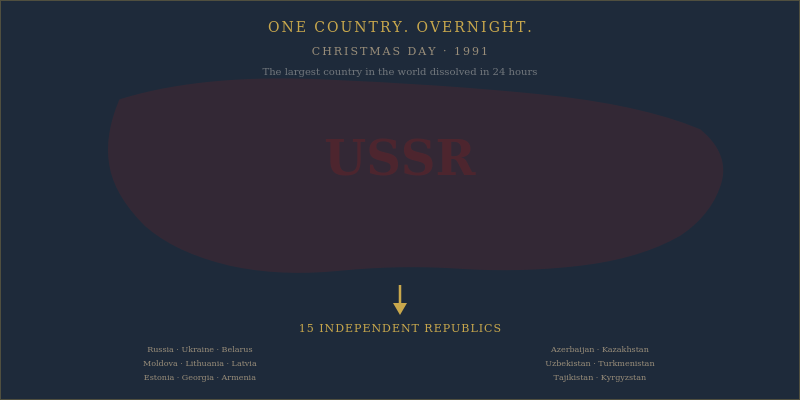
The fifteen Soviet republics became independent states: Russia, Ukraine, Belarus, Moldova, Estonia, Latvia, Lithuania, Georgia, Armenia, Azerbaijan, Kazakhstan, Uzbekistan, Turkmenistan, Tajikistan, and Kyrgyzstan. Twelve of them formed the Commonwealth of Independent States (CIS).
Who predicted the Soviet collapse?
Almost nobody. The CIA did not predict it. Western academic experts on the Soviet Union did not predict it. The speed and completeness of the collapse surprised virtually everyone, including many Soviets.
Enjoyed this?
New stories, hidden mechanisms and forgotten history, straight to your inbox every week.
A Note From The Editor
What strikes me about the Soviet collapse is how long it took for what was already known — the economic stagnation, the technological lag, the historical falsifications — to become politically decisive. The problems were not new. What was new was the information environment that made them impossible to deny. Gorbachev intended to fix the system by making it more honest. He ended up demonstrating that the system had depended on dishonesty to survive.