The Man Who Claimed Not to Know Anything
Socrates was, by his own account, the wisest man in Athens — but only because he alone knew that he knew nothing. This claim, which he derived from a report that the oracle at Delphi had declared no man wiser than Socrates, he took seriously enough to spend his life testing it. He approached people who claimed knowledge — politicians, generals, craftsmen, poets — and asked them to explain it. The explanations invariably fell apart under questioning. The people he questioned were, in his view, worse off than he was: they thought they knew things, and they didn't. He at least knew he didn't know.
This was not endearing to the people he questioned. Generals found it irritating to be unable to define courage in front of their subordinates. Politicians found it uncomfortable to be unable to defend policies they had confidently advocated. Poets found it unsettling to discover they couldn't explain the meaning of their own works. Socrates, by his own account, accumulated enemies the way other men accumulated debts.
The Political Context
The trial of Socrates in 399 BC did not occur in a vacuum. Athens had, in the preceding decade, suffered catastrophically. The Peloponnesian War had ended in 404 BC with Athens' defeat by Sparta after nearly three decades of conflict. The defeat was followed immediately by the brutal oligarchic coup of the Thirty Tyrants, which had lasted eight months and killed approximately 1,500 Athenians before democracy was restored by force.
Several of Socrates' most prominent associates had connections to this traumatic period. Critias, the most savage of the Thirty, had been a follower of Socrates. Alcibiades, the brilliant and treacherous Athenian general who had repeatedly damaged Athenian interests and eventually defected to Sparta, had also been associated with Socrates. The democracy that had been restored in 403 BC had proclaimed a general amnesty — no prosecutions for acts before the restoration. But the associations Socrates had maintained, and his persistent questioning of democratic assumptions, made him politically exposed.
The Jury
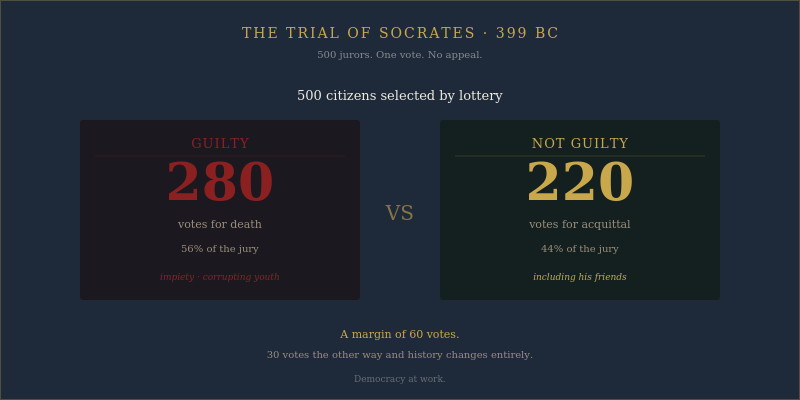
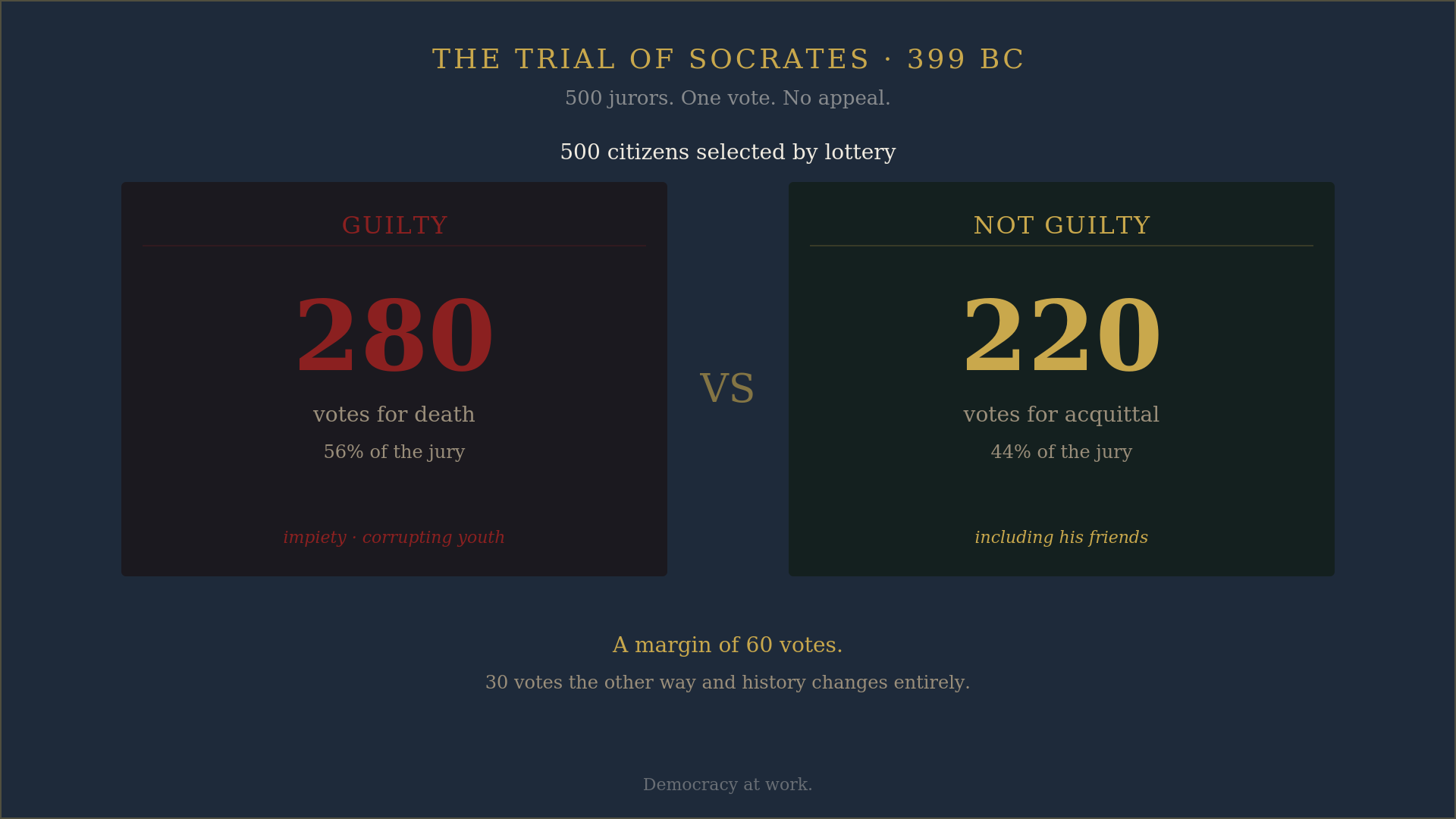
Socrates was tried by a jury of 500 Athenian citizens, selected by lottery — the standard Athenian procedure. He was found guilty by 280 votes to 220: a margin of 30. On the question of penalty, after Socrates proposed a derisory fine, the jury voted for death by a larger margin than had found him guilty.
The Trial
Three Athenians brought the charges: Meletus (a poet), Anytus (a wealthy tanner and influential politician), and Lycon (an orator). The charges were impiety — failing to acknowledge the city's gods and introducing new divine beings — and corrupting the youth of Athens.
Socrates' defence, as recorded by Plato in the Apology, was characteristic. He did not apologise. He did not attempt to ingratiate himself with the jury. He questioned the charges, examined his accusers' assumptions, and made the argument that whatever he had done, it was in service of the city. The god had assigned him his task. He would no more abandon it at the jury's instruction than a soldier would abandon his post at a general's command.
He was found guilty. On the question of penalty, he was given the opportunity to propose an alternative to death. He proposed, with apparent seriousness, that he should receive free meals in the Prytaneum — the honour given to Olympic victors and great benefactors of the state. Under pressure from friends, he eventually proposed a larger fine. He was condemned to death by a larger majority than had found him guilty.
The Refusals
Between the verdict and the execution, Socrates had at least two opportunities to avoid death. The first was at sentencing: had he proposed exile as a penalty, the jury would very likely have accepted it. Exile was uncomfortable but survivable. Socrates refused to propose it, apparently on the grounds that philosophical activity was not possible without an audience — that leaving Athens would be as good as dying for someone whose work required the city's citizens to talk to.
The second opportunity was more direct. His friend Crito arranged for his escape from prison. The jailer could be bribed, a boat was available, friendly territories would receive him. Socrates refused this as well. His reasoning, as Plato records it in the Crito, was essentially contractual: having lived his entire life in Athens and benefited from its laws, escaping when those laws condemned him would be an act of injustice — violating an implicit agreement that he had made by choosing to remain in the city throughout his life.
He drank the hemlock himself, without being compelled to, in conversation with his friends. According to Plato, he remained composed throughout. He died discussing the immortality of the soul.
Key Facts
- Born
- c. 470 BC, Athens
- Died
- 399 BC, Athens
- Trial verdict
- Guilty, 280 to 220
- Charge
- Impiety and corrupting the youth of Athens
- Penalty
- Death by hemlock
- Works written
- None — everything known about Socrates comes from his students, primarily Plato
Why Athens Killed Him
The formal charges were impiety and corrupting youth. The real reasons were more complex and are still debated. The most persuasive account is that Socrates was killed not for his ideas but for his method: for the persistent, public exposure of the gap between claimed authority and actual knowledge among the people who ran the city.
This is a different kind of threat from the one that gets rulers killed in most revolutions. Socrates was not proposing an alternative government. He was not building a political movement. He was simply asking questions that people in authority could not answer — and asking them in public, in front of audiences that included those people's subordinates and clients.
The threat was reputational rather than political. But reputational threats to people who depend on perceived competence can be existential. A general who cannot define courage in front of his troops has a problem. A politician who cannot defend his policies before an audience has a problem. Socrates created these problems, repeatedly, for the people who ran Athens. That they eventually moved against him is, in the context of how power actually works, not surprising.
Frequently Asked Questions
Why was Socrates executed?
Socrates was formally charged with impiety and corrupting the youth of Athens. The underlying reasons are debated, but the most persuasive account holds that his persistent public questioning of Athenian leaders — demonstrating that they lacked the knowledge they claimed — made him politically dangerous in the charged atmosphere following Athens' defeat in the Peloponnesian War.
Why didn't Socrates escape from prison?
Socrates refused escape on philosophical grounds: having lived his entire life in Athens and benefiting from its laws, escaping would violate an implicit agreement he had made by choosing to remain. He argued, in Plato's Crito, that unjust laws still deserved obedience from those who had benefited from the just ones.
Did Socrates write anything?
Socrates wrote nothing. Everything we know about his ideas comes from others, principally his student Plato, whose dialogues are the primary source, and Xenophon. There is a scholarly question about how accurately the Platonic Socrates represents the historical Socrates.
What is the Socratic method?
The Socratic method is a form of philosophical inquiry using questions to expose contradictions and limitations in stated positions. Socrates used it to show that people who claimed knowledge often couldn't defend it under questioning — a technique that was both philosophically productive and personally infuriating to those subjected to it.
Enjoyed this?
New stories, hidden mechanisms and forgotten history, straight to your inbox every week.
A Note From The Editor
The detail that I find most haunting is that the margin was thirty votes. Thirty votes the other way and Socrates lives. Plato never writes the dialogues, or writes different ones. The history of Western philosophy takes a different course. The fragility of historical turning points — the degree to which what we think of as inevitable was in fact contingent — is one of the genuinely useful things history teaches.