The World in 1880
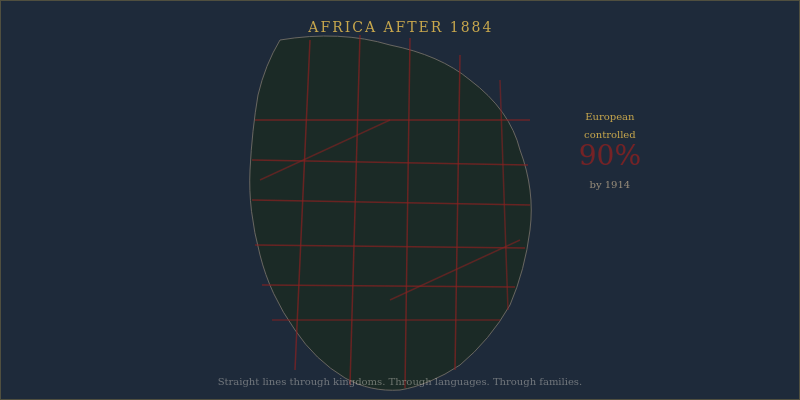
In 1880, European powers controlled roughly ten per cent of Africa. Twenty years later, they controlled ninety. The transformation was so rapid, so systematic, and so complete that it deserves a different word from colonialism — it was closer to a land seizure conducted at continental scale, with the victims excluded from the room where the terms were set.
Understanding what made the scramble possible requires understanding what Africa actually looked like before it. Not the emptiness that European maps implied, but a continent of extraordinary political and cultural diversity. The Sokoto Caliphate in West Africa was, by 1880, one of the largest empires in the world. The Zulu Kingdom had demonstrated, eleven months before Berlin, that African military forces could destroy a British column. Ethiopia maintained its own diplomatic correspondence with European governments. The Ashanti Confederation had been trading gold and other goods with European merchants for two centuries.
None of this prevented what came next.
Why 1884?
Three specific developments turned informal European competition into a formal race. The first was France's occupation of Tunisia in 1881 and Egypt in 1882, which alarmed every other European power with Mediterranean interests. The second was King Leopold II of Belgium, who had spent the late 1870s funding Henry Morton Stanley's expeditions into the Congo basin and extracting treaties from African chiefs — treaties drafted in European legal language that the signatories did not understand, and which Leopold used to claim personal sovereignty over an area the size of Western Europe. The third was Germany's sudden announcement of colonial claims in South-West Africa, Togoland, and Cameroon in 1884, which transformed what had been a British-French competition into something multilateral.
Bismarck's motives for Germany's colonial push remain debated. He had previously been dismissive of colonies as not worth "the bones of a single Pomeranian grenadier." The most convincing explanation is domestic political calculation: German colonial enthusiasts provided useful political support, and stirring up colonial disputes with Britain and France served Bismarck's diplomatic goals. Whatever the motive, the effect was to make a formal framework for managing competing claims urgently necessary.
The Berlin Conference, 1884–85
Fourteen European nations attended the conference convened by Bismarck in November 1884. The United States attended as an observer. The Ottoman Empire — itself an African power through its North African territories — was represented. Not one African nation or leader was invited, consulted, or informed of the proceedings.
What Happened in Berlin
The conference ran from November 1884 to February 1885. Its principal achievement was the General Act of Berlin, which established two key principles. First, "effective occupation": European powers could only claim sovereignty over territory they actually administered, not merely territory they had sailed past or signed a treaty over. Second, free trade in the Congo basin and free navigation on the Congo and Niger rivers, which served the commercial interests of the smaller European powers who feared British and French monopolies.
The "effective occupation" rule had a consequence its drafters may not have fully intended: it transformed the diplomatic competition into a physical one. To make a valid claim required actual presence on the ground. This meant European powers had to establish administrative posts, sign treaties, and deploy personnel across the continent — or lose territory to whoever got there first. The decade after Berlin was characterised by an extraordinary rush of treaty-making with African rulers, most of whom had no idea what they were signing away.
The Lines on the Map
The borders drawn during the scramble were remarkable for their indifference to geography in the human sense — not mountains and rivers, but languages, kinship groups, trade networks, and political communities. The Berlin Conference had said nothing about how borders should be drawn internally; that was left to bilateral negotiation between European powers. Many borders were simply straight lines, drawn at degrees of latitude or longitude because negotiators had no better information and because straight lines were easy to agree on.
A single example: the border between Nigeria and Cameroon, negotiated between Britain and Germany in 1906, cuts across the territory of the Adamawa people, who found themselves divided between two different colonial administrations, with different languages of administration, different tax systems, and different legal codes. They had not been consulted. The Adamawa border was not unusual. It was typical.
Key Facts
- Date of Conference
- November 1884 – February 1885
- Nations attending
- 14 European nations + United States (observer)
- African nations attending
- None
- Territory under European control, 1880
- Approximately 10%
- Territory under European control, 1914
- Approximately 90%
- Nations remaining independent by 1914
- Ethiopia and Liberia only
The Congo: What Effective Occupation Actually Meant
King Leopold II's Congo Free State illustrates what "effective occupation" looked like in practice for the people on the receiving end. Leopold's administration — not a Belgian colonial government but his personal property — extracted rubber from the Congo basin through a system of terror. Villages were given rubber quotas. Failure to meet quotas was punished by the severing of hands. Soldiers were required to produce severed hands as proof that bullets had been used on Africans rather than wasted on animals. Photographs of Congolese children with their hands cut off were eventually published in Europe by campaigners including E.D. Morel and the missionary E.J. Grenfell, triggering what became one of the first international humanitarian campaigns in modern history.
The scandal eventually forced Leopold to transfer the Congo to Belgian state control in 1908. The population of the Congo had declined by an estimated two to ten million people during Leopold's administration — one of the most devastating single episodes of colonial violence in the record.
Why the Borders Persisted
When African nations gained independence in the 1950s and 1960s, their new governments faced an immediate dilemma. Colonial borders were arbitrary — but changing them would require agreeing on replacement borders, which was at least as difficult. The Organisation of African Unity, established in 1963, made a pragmatic decision: to treat colonial borders as inviolable, however arbitrary. The logic was defensible. If colonial borders were opened for revision, there was no clear endpoint.
The consequence is that borders designed to manage European competition — not to reflect African political, cultural, or ethnic realities — have been frozen in place for sixty years. Nigeria, the Democratic Republic of Congo, Sudan, Ethiopia, and many other states continue to grapple with the internal tensions that those borders created. This is not to say that the OAU's decision was wrong — border revision would have created its own catastrophes. It is to say that the decisions made in Berlin in 1884 and 1885, by people who had no stake in the outcome and no knowledge of the territory, are still shaping the lives of over a billion people.
Frequently Asked Questions
What was the Scramble for Africa?
The Scramble for Africa was the rapid partition and colonisation of Africa by European powers between 1881 and 1914. The Berlin Conference of 1884 to 1885 established the rules, but the actual occupation proceeded through bilateral treaties, military expeditions, and administrative expansion over the following decades.
Why were no African nations invited to the Berlin Conference?
The conference was organised by European powers to manage their own competing claims. The prevailing European political and intellectual culture of the 1880s held that African peoples were incapable of self-governance — a self-serving belief that justified excluding them from decisions about their own continent.
Which African countries were never colonised?
Ethiopia remained independent throughout the colonial period, defeating an Italian invasion at Adwa in 1896, though it was briefly occupied by Italy from 1936 to 1941. Liberia, founded by freed American slaves, also maintained independence throughout.
Are African borders still the same as colonial borders?
In most cases, yes. The Organisation of African Unity established in 1963 committed its members to treating colonial borders as inviolable, to prevent the chaos that might result from revision. Most African borders today correspond closely to those drawn during the colonial period.
Enjoyed this?
New stories, hidden mechanisms and forgotten history, straight to your inbox every week.
A Note From The Editor
The detail that stays with me about the Berlin Conference is not the audacity of dividing a continent — European powers were capable of great audacity — but the complete indifference to the people being divided. The conferees were not evil men by their own lights. They were practical men solving a practical problem. That is precisely what makes the episode so instructive about how large-scale harm gets done.