The Rise of the Medici Bank
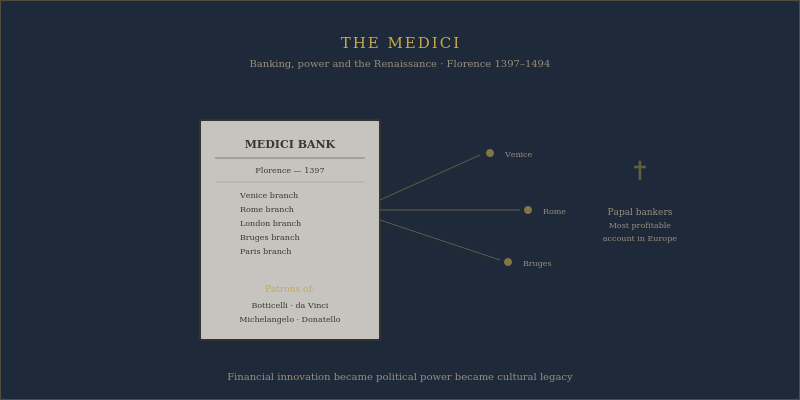
The Medici family's ascent began not with political power but with financial innovation. Giovanni di Bicci de' Medici founded the Medici Bank in 1397, and what distinguished it from rival Florentine banking houses was a structural innovation that would transform European finance: the holding company model.
Rather than operating as a single institution, the Medici Bank functioned as a network of semi-independent partnerships, each operating in a different city — Venice, Rome, Geneva, Bruges, London — but connected through the Florentine headquarters. This structure limited liability: if one branch failed, the losses were contained and the parent institution could survive.
The bank's most profitable relationship was with the papacy. The Church required sophisticated financial services — transferring funds across Europe, converting currencies, managing the revenues from multiple national churches. The Medici provided these services and were rewarded with the lucrative position of papal bankers, giving them access to an enormous and reliable revenue stream.
Cosimo de' Medici and Political Power
The translation of financial power into political power was the work of Cosimo de' Medici, who took control of the bank after his father's death in 1429. Cosimo understood that in Florence's republican system, direct claims to power were dangerous. Instead, he operated through patronage, networks of obligation, and the careful placement of allies in key positions.
When Cosimo was exiled from Florence in 1433 by rival factions, he used his financial network to orchestrate his return the following year. His rivals had made a critical error: so many Florentine institutions depended on Medici credit that the family's exile threatened the city's financial stability. Cosimo returned to Florence in triumph and his enemies were themselves exiled.
He governed Florence for the next thirty years without holding formal office, using the title Pater Patriae — Father of the Fatherland — awarded to him by the city. His power was real but deliberately informal, exercised through relationships rather than through institutions.
Lorenzo the Magnificent and Cultural Patronage
Lorenzo de' Medici, who ruled Florence from 1469 until his death in 1492, gave the family its reputation as patrons of the Renaissance. Under his direction, Florence became the most culturally vibrant city in Europe. Botticelli, Leonardo da Vinci, Michelangelo — all passed through Medici patronage at crucial points in their careers.
Lorenzo was a poet and humanist scholar as well as a politician. He collected ancient manuscripts, sponsored academies for philosophical discussion, and participated in intellectual life as an active contributor rather than a passive supporter. The Platonic Academy that gathered around him brought ancient Greek philosophy into dialogue with Christian thought in ways that influenced European intellectual life for generations.
But Lorenzo also presided over the bank's decline. He was a brilliant politician and cultural figure but a careless banker. The Medici branches in Bruges and London were progressively mismanaged; the bank's capital was increasingly diverted into political expenditure; the innovative partnerships that had distinguished the bank in its early years were allowed to deteriorate. By the time of Lorenzo's death, the Medici Bank was in serious trouble.
The Pazzi Conspiracy
In 1478, the Pazzi family — rival Florentine bankers who had displaced the Medici as papal bankers — conspired with Pope Sixtus IV and the Archbishop of Pisa to assassinate Lorenzo and his brother Giuliano. The attack took place during High Mass in Florence's cathedral on 26 April 1478. Giuliano was stabbed nineteen times and died. Lorenzo was wounded but escaped into the sacristy.
The aftermath revealed the depth of Medici power in Florence. Rather than destabilising Medici rule, the conspiracy strengthened it. Lorenzo's response was swift and brutal: the conspirators who could be found were hunted down and killed. The Archbishop of Pisa was hanged from a window of the Palazzo della Signoria in his ecclesiastical robes. The pope, furious, excommunicated Lorenzo and placed Florence under interdict. Lorenzo's response was to publish a justification of his position that he circulated to the courts of Europe, framing himself as the defender of Florentine liberty against papal tyranny.
The Medici Legacy
The Medici produced two popes — Leo X and Clement VII — and their banking and political model influenced the development of both Renaissance culture and European finance. Catherine de' Medici became Queen of France and effectively ruled the kingdom for decades. Marie de' Medici also became Queen of France in the following century.
The Medici Bank itself collapsed in 1494, when the Medici were expelled from Florence by Savonarola's followers. The financial innovations the Medici pioneered — the holding company structure, the letter of credit, the sophisticated management of papal finances — survived them and shaped the development of European banking.
Why the Medici Matter
The Medici story is not simply one of wealth and patronage. It is a study in how financial power translates into political power, how institutions are built and how they decay, and how cultural patronage can serve political ends while also producing genuine intellectual and artistic achievements. The Medici did not merely accumulate wealth — they transformed it into a comprehensive form of soft power that outlasted their bank, their republic, and ultimately their dynasty.
Frequently Asked Questions
How did the Medici family make their money?
The Medici began as wool traders before pivoting to banking. They exploited loopholes in Church usury laws through currency exchanges, banking fees, and financial contracts designed to generate returns without technically charging interest.
How many Medici popes were there?
Three members of the Medici family became pope: Leo X (1513), Clement VII (1523), and Pius IV (1559).
Did the Medici fund the Renaissance?
Yes. The Medici were among the most significant patrons of Renaissance art and architecture. They commissioned works from Botticelli, Michelangelo, Leonardo da Vinci, and many others.
When did the Medici dynasty end?
The direct Medici line ended in 1737 with the death of Gian Gastone de' Medici. The Medici Bank had collapsed significantly earlier, in 1494.
This is one of those topics where the more you read, the more complicated it gets.
Did the Medici advance Renaissance culture because of genuine patronage values — or because art and scholarship were instruments of political power?