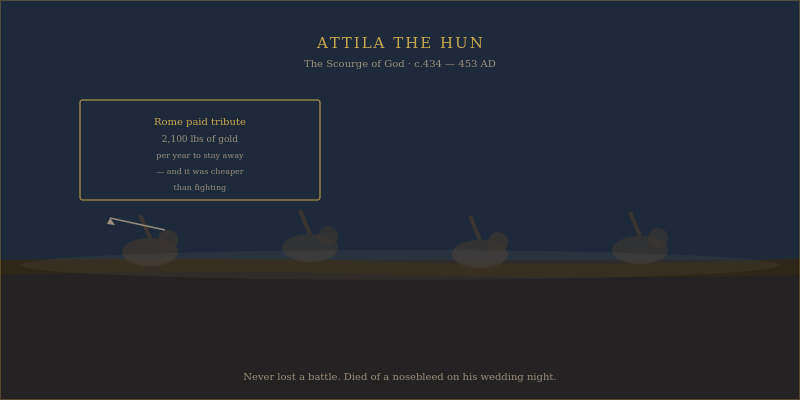
The Rise of Attila
Attila became joint ruler of the Hunnic Empire alongside his brother Bleda in 434 AD, following the death of their uncle Rugila. The Huns were a nomadic people from the Eurasian steppe whose origins remain debated — possibly from Central Asia, possibly from further east. They had swept into Europe in the late 4th century, displacing the Germanic peoples who in turn pushed against the Roman frontier, contributing to the pressures that would ultimately destroy the Western Roman Empire.
Attila consolidated power by having his brother Bleda killed in 445 AD, making himself sole ruler of an empire stretching from the Rhine to the steppes of Central Asia. He would spend the next eight years in almost constant warfare, and would never lose a battle.
Key Facts
Born: c.406 AD
Died: 453 AD, aged approximately 47
Title: King of the Huns
Nickname: Scourge of God — Flagellum Dei
Cause of death: Haemorrhage, possibly a nosebleed
Making Rome Pay
One of the most remarkable aspects of Attila's career was his ability to extract tribute from the Eastern Roman Empire — the most powerful state in the western world. The Eastern Emperor Theodosius II agreed in 435 AD to pay an annual tribute of 700 pounds of gold simply to keep Attila away from Roman territory. After Attila's victories in the Balkans in 441-443 AD, this tribute was raised to 2,100 pounds of gold per year.
The spectacle of Rome — the empire that had dominated the known world for centuries — paying protection money to a nomadic chieftain was without precedent. It represented a fundamental shift in the balance of power that contemporaries found almost incomprehensible.
The Invasions of the West
In 450 AD Attila turned his attention westward. His pretext was a letter from Honoria — sister of the Western Emperor Valentinian III — who had sent Attila her ring asking for his help in escaping an unwanted marriage. Attila interpreted this as a marriage proposal and demanded half the Western Empire as her dowry.
The invasion of Gaul in 451 AD was the most significant military campaign of the 5th century. Attila swept through with an army that ancient sources place at hundreds of thousands — almost certainly an exaggeration, but sufficient to devastate city after city. He was finally stopped at the Battle of the Catalaunian Plains, one of the largest battles of the ancient world, where a combined Roman and Visigoth force under the general Aetius fought him to a standstill.
The following year Attila invaded Italy, sacking and destroying cities across the Po Valley. He withdrew before reaching Rome — ancient sources credit a meeting with Pope Leo I with persuading him to turn back, though disease in his army and a Roman relief force from the east were probably more significant factors.
Death on the Wedding Night
In 453 AD Attila took a new wife — a young woman named Ildico. At the wedding feast he drank heavily, as was customary. He was found dead the following morning. His new wife was discovered beside him, weeping.
The Roman historian Priscus, who had met Attila personally, records that he died from a haemorrhage — specifically that he suffocated on blood from a nosebleed while unconscious from drinking. Other theories have been proposed over the centuries, including assassination, but the haemorrhage explanation is generally accepted by modern historians.
The man who had terrified two continents, forced Rome to pay him tribute, and never lost a battle, died in bed of a nosebleed. His empire disintegrated almost immediately after his death, torn apart by his sons competing for power, the subject Germanic peoples revolting, and within a generation the Huns had ceased to exist as a meaningful political force at all. Their disappearance was so complete that they left almost no archaeological trace and no written records of their own — a civilisation that shook two continents and then vanished from history almost as suddenly as it arrived. Their lasting significance lies less in anything they built than in what they set in motion: the pressure that pushed the Goths, Vandals, and other Germanic peoples into Roman territory in the first place, accelerating the collapse they never stayed to witness.
Frequently Asked Questions
How did Attila the Hun die?
Attila died in 453 AD on the night of his wedding to a woman named Ildico. The most widely accepted account, from the historian Priscus who had met Attila personally, states that he died from a severe haemorrhage — probably a nosebleed — while unconscious from heavy drinking at the wedding feast. He was found dead the following morning.
Did Attila the Hun ever conquer Rome?
No — Attila never conquered Rome itself. He invaded Italy in 452 AD and sacked several northern Italian cities but withdrew before reaching Rome. Ancient sources credit a meeting with Pope Leo I with persuading him to turn back, though disease in his army and military pressure from the east were probably more significant factors in his withdrawal.
How large was Attila's empire?
At its peak Attila's empire stretched from the Rhine and Danube rivers in the west to the steppes beyond the Caspian Sea in the east — roughly from modern Germany to Kazakhstan. It encompassed much of what is now Hungary, Romania, Ukraine and Russia. It was held together almost entirely by Attila's personal authority and began to disintegrate immediately after his death.
Why was Attila called the Scourge of God?
The title Flagellum Dei — Scourge of God — was applied to Attila by Christian writers who interpreted his devastating invasions as divine punishment for the sins of the Roman people. The term reflects the psychological impact of his campaigns on the Christian Roman world rather than anything Attila himself claimed. He likely relished the terror the title conveyed regardless of its theological implications.
What happened to the Hunnic Empire after Attila died?
The Hunnic Empire disintegrated rapidly after Attila's death in 453 AD. His sons — Ellac, Dengizich and Ernak — fought each other for supremacy. The subject Germanic peoples seized the opportunity to revolt, defeating the Huns at the Battle of Nedao in 454 AD. Within a generation the Hunnic Empire had ceased to exist as a political entity.
A Note From The Editor
Attila's death by nosebleed is one of history's great deflating endings — the most feared man on earth, undone not by a rival or a battle but by the mundane fragility of the human body. What strikes me is how completely his empire depended on him personally. The moment he was gone it collapsed. That's a pattern you see repeatedly in history — empires built on individual charisma and terror rather than institutions have no succession mechanism. They are as strong as their founder and no stronger. Rome lasted a thousand years. Attila's empire lasted one generation.
Key Facts
- Reign
- 434–453 CE (as sole ruler from 445 CE)
- Empire extent
- From the Rhine and Danube to the Caspian Sea
- Known as
- "The Scourge of God" — flagellum Dei
- Death
- 453 CE, on the night of his wedding to Ildico
This is one of those topics where the more you read, the more complicated it gets.
Did Attila's death fundamentally change the course of European history, or had the Hun threat already peaked before 453 AD?
Sources & Further Reading
- Encyclopaedia Britannica. "Attila." britannica.com
- Man, John. Attila: The Barbarian King Who Challenged Rome. Bantam, 2005.
- Kelly, Christopher. Attila the Hun: Barbarian Terror and the Fall of the Roman Empire. Bodley Head, 2008.
- Priscus. Fragment 24. Primary source account of Attila's death.