The Cold War Nuclear Architecture
To understand what Stanislav Petrov did on 26 September 1983, it is necessary to understand the system within which he operated. The Soviet early warning infrastructure was designed to detect and report an incoming nuclear strike with sufficient speed that Soviet leadership could authorise a retaliatory strike before their own missiles and bombers were destroyed on the ground. The entire logic of nuclear deterrence depended on this capability — an adversary would be deterred from striking first only if they knew that their strike could not prevent a devastating response.
The system operated under extreme time pressure. The flight time of an American intercontinental ballistic missile from launch to Soviet territory was approximately thirty minutes. Submarine-launched missiles could arrive in as little as ten or fifteen minutes. Soviet leaders and military commanders had minutes — not hours — to assess whether an incoming signal represented a genuine attack and to decide whether to respond.
Petrov was a lieutenant colonel in the Soviet Air Defence Forces, serving as the duty officer at Serpukhov-15, the command bunker responsible for processing data from the Soviet Union's satellite early warning system. The satellites were designed to detect the infrared signatures of rocket launches — the heat generated by a missile engine — and relay the data to ground stations for processing and analysis.
26 September 1983
The geopolitical context of September 1983 was extraordinarily tense. Three weeks earlier, on 1 September, Soviet fighters had shot down Korean Air Lines Flight 007, a civilian airliner that had strayed into Soviet airspace, killing all 269 people aboard. The international reaction had been fierce. Relations between the United States and Soviet Union were at their most hostile since the Cuban Missile Crisis. The Reagan administration had announced the Strategic Defense Initiative — "Star Wars" — earlier in the year, alarming Soviet military planners who feared it could neutralise their deterrent capability.
Within this context, Soviet military and political leaders had become increasingly concerned about the possibility of an American first strike. A classified Soviet intelligence assessment of 1981 had concluded that the United States was preparing for nuclear war, and the Soviet intelligence community had mounted Operation RYAN — an intensive programme of intelligence collection designed to provide early warning of American attack preparations.
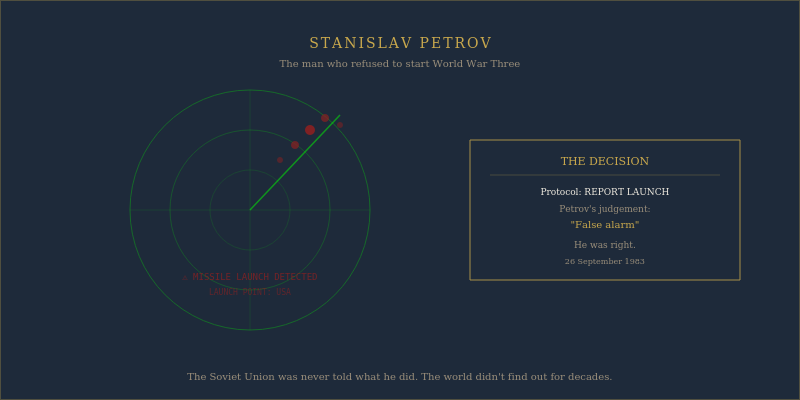
Shortly after midnight on 26 September, Petrov's monitoring station received an alarm. The satellite system reported that a single American intercontinental ballistic missile had been launched from the continental United States.
The Decision
Soviet protocol in response to such a warning was clear: report the launch to the chain of command, which would then assess the data and make a decision about whether to authorise a retaliatory strike. Petrov's role was not to make that decision — it was to report what the system was telling him.
But Petrov hesitated. Something about the warning did not seem right. A first strike with a single missile made no military sense. American nuclear doctrine called for a massive, overwhelming first strike — hundreds or thousands of missiles launched simultaneously to destroy Soviet retaliatory capability before it could be used. A single missile launch was not consistent with any rational nuclear war strategy Petrov knew of.
As he was processing this, the system generated further alarms. The satellite was now reporting not one but five missile launches. The alarm level was at its highest.
Petrov had approximately five minutes to make his assessment. He reported the launches to his superiors as a "system malfunction" — a false alarm — rather than as confirmed missile launches.
Why Petrov Was Right — and Why It Was Not Obvious
Petrov's assessment turned out to be correct. The Soviet satellite system had malfunctioned. The "missiles" it had detected were a rare alignment of sunlight reflected off clouds above Montana that produced infrared signatures the satellite's algorithms interpreted as rocket launches. The software had a known flaw in its verification procedures; the alarm was genuine, but the threat was not.
But Petrov did not know this at the time. He was making a judgment call under extreme pressure, based on incomplete information, with no way to definitively verify his assessment before having to act. The factors that led him to conclude the alarm was false — the single-missile logic, his intuition about how American doctrine would operate, his awareness of the satellite system's technical limitations — were all reasonable but none of them was conclusive.
Petrov later said he was "fifty-fifty" on his assessment. He made the judgment call he made because he believed a false alarm was more likely than a genuine launch, and because the consequences of reporting a false launch as genuine were, in his view, worse than the consequences of failing to report a genuine launch.
The Aftermath
Petrov was neither rewarded nor publicly praised for his decision. The Soviet military launched an investigation into the incident, and Petrov was formally reprimanded — not for his decision to treat the alarm as a malfunction, but for failing to properly fill out his paperwork during the incident. He was subsequently reassigned to a less demanding posting and retired from the military in 1984.
The incident was classified. It remained unknown to the wider world until after the Cold War ended. Petrov himself kept quiet about it for years. He gave his first public interview about the incident in 1998, to a Russian journalist writing a book about Soviet military history.
International recognition came slowly. In 2006, Petrov was invited to New York by the Association of World Citizens and received an award at the United Nations. He died in May 2017 at the age of 77.
The Broader Lesson
The Petrov incident is significant not primarily because of what Petrov did, but because of what it reveals about the system within which he operated. The Soviet early warning infrastructure — designed to ensure that the Soviet Union could respond to any first strike — created conditions in which a technical malfunction could have triggered a nuclear war. The system's logic demanded rapid response; its technology was imperfect; and the human beings operating it were under pressures that made careful deliberation difficult.
The incident is not unique. American nuclear systems also generated false alarms during the Cold War — notably in November 1979, when a training tape was accidentally inserted into the real-time warning system, and in June 1980, when a faulty computer chip caused repeated alerts of Soviet submarine launches. In each case, the system was stopped before it reached the point of irreversible action by human beings who concluded that something was wrong.
The lesson is that nuclear systems are not purely technical. They are human systems embedded in institutional, political, and psychological contexts. Their safety depends not only on the reliability of their technology but on the judgment and courage of the individuals operating them.
The full picture is more complex than any short article can cover.
How many other moments like Petrov's exist in Cold War history that we still don't know about?
Frequently Asked Questions
Who was Stanislav Petrov?
Stanislav Petrov was a Soviet Air Defence Forces officer serving as duty officer at the Serpukhov-15 command bunker on the night of 26 September 1983, when the Soviet early warning system falsely reported an American missile attack.
What actually caused the false alarm?
A rare alignment of sunlight reflecting off high-altitude clouds above Montana produced infrared signatures that the Soviet satellite system's algorithms misidentified as missile launches — a known flaw in the system's verification procedures.
Was Petrov ever recognised for his decision?
Not by the Soviet government at the time — he was reprimanded for a paperwork error during the incident. International recognition came decades later, including a 2006 award from the Association of World Citizens at the United Nations.
Why didn't Petrov simply follow protocol?
He judged that a genuine American first strike would involve hundreds of missiles, not five, and reasoned the probability of a system malfunction was higher than a real attack — a judgement he later described as "fifty-fifty."